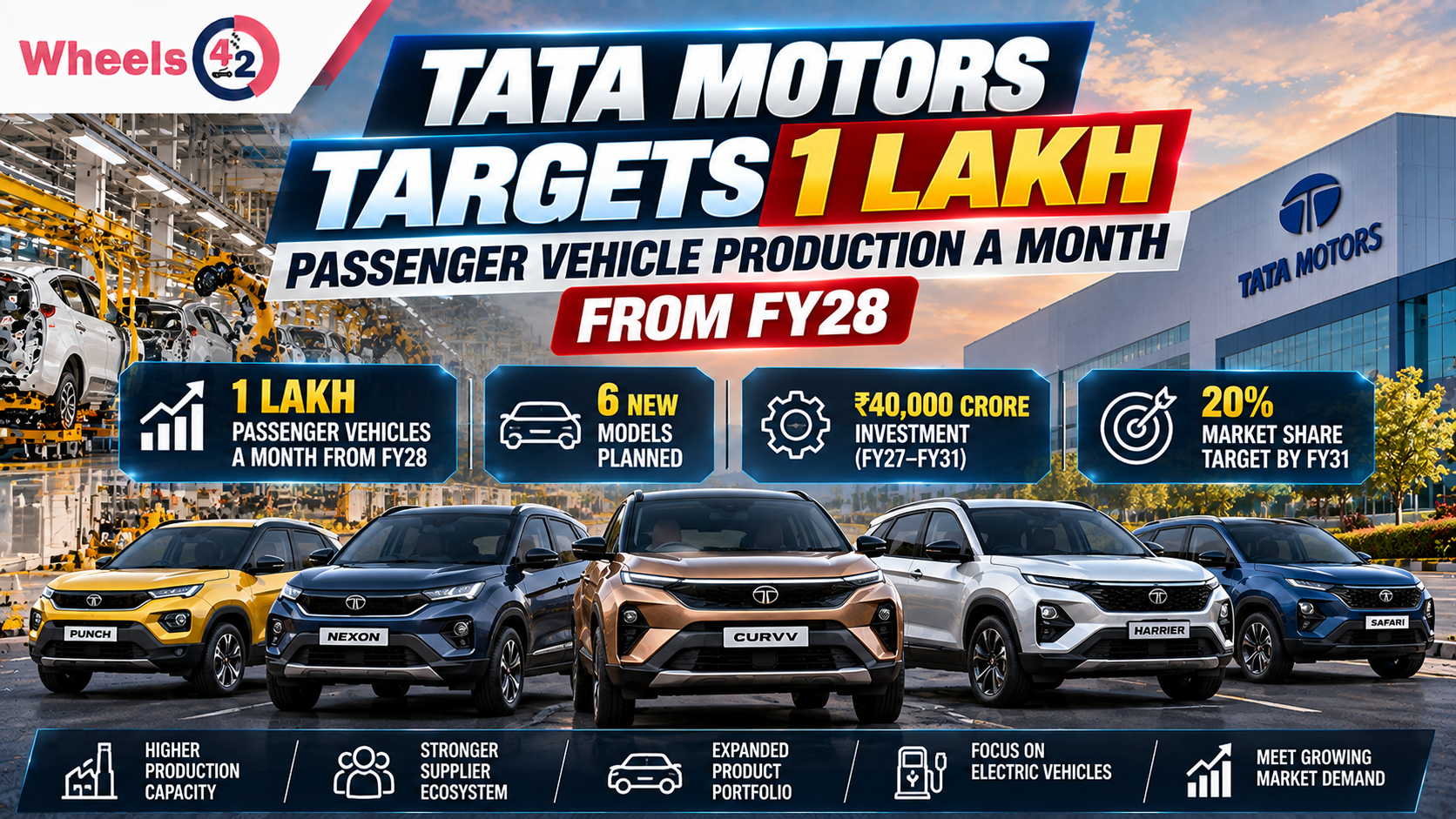
Tata Motors is preparing for a major expansion of its passenger vehicle operations, with the company reportedly working towards a monthly production capacity of up to 1 lakh passenger vehicles from FY28. The planned increase comes as Tata Motors looks to address rising demand, strengthen its product portfolio and gain a larger share of India's passenger vehicle market.
The company has reportedly asked its supplier network to increase component production capacity ahead of the planned ramp-up. Tata Motors is currently scheduling production at around 75,000 passenger vehicles per month, although supply-side limitations have made it difficult to consistently reach that level.
Tata Motors Targets 1 Lakh Units Per Month
The proposed production target represents a significant increase over Tata Motors' current sales volumes.
During the first six months of FY27, the company averaged around 65,000 passenger vehicle sales per month. The planned 1 lakh-unit monthly production level would therefore represent an increase of more than 50% over that sales run rate.
Industry estimates also indicate that demand for Tata passenger vehicles is currently higher than the company's available output. This has made supplier capacity an important factor in the automaker's expansion plans.
The production increase is expected to give Tata Motors greater flexibility to meet demand and prepare for the arrival of several new products.
Supplier Capacity to Play a Key Role
Tata Motors' production expansion is not limited to its own manufacturing facilities. The company is also working with its supplier ecosystem to ensure that component availability keeps pace with higher vehicle production.
The automaker has reportedly been scheduling around 75,000 units per month recently, but supplier capacity constraints have prevented it from fully achieving the planned production level.
Increasing supplier capacity ahead of FY28 could therefore help Tata Motors reduce production bottlenecks as new models are introduced.
Six New Models Planned
Tata Motors is also preparing an extensive product offensive as part of its long-term growth strategy.
The company is expected to introduce six new nameplates, potentially taking its passenger vehicle portfolio to around 15 models by the end of the decade.
One of the important upcoming products is the next-generation Tata Nexon, which is expected to arrive in 2027. The company is also preparing products under its Avinya electric vehicle programme, with launches expected as Tata expands its premium EV portfolio.
The wider product strategy is expected to cover multiple segments rather than relying only on existing high-volume models.
₹40,000 Crore Investment Planned
Tata Motors Passenger Vehicles is planning to invest approximately ₹37,500 crore to ₹40,000 crore between FY27 and FY31.
The investment is expected to support several areas, including:
- New vehicle development
- Electric vehicle expansion
- Manufacturing capacity
- Product portfolio expansion
- Technology development
- Supply-chain strengthening
The company is targeting a 20% share of India's passenger vehicle market by FY31, along with annual sales of more than 12 lakh vehicles.
Tata Motors Passenger Vehicle Sales Rise in September
The planned capacity expansion comes at a time when Tata Motors is already seeing strong demand for its passenger vehicles.
In September 2026, Tata Motors Passenger Vehicles recorded sales of 70,210 units, marking a 15% year-on-year increase.
The company also reported its strongest-ever quarterly performance in the second quarter of FY27, with passenger vehicle sales reaching 2,01,723 units, representing around 40% growth compared with the same period a year earlier.
Electric cars and CNG-powered models have also become important contributors to Tata Motors' overall passenger vehicle strategy.
EVs Will Remain an Important Growth Area
Tata Motors has established a strong presence in India's electric passenger vehicle segment, and future production expansion is expected to support further growth in this area.
The upcoming Avinya-based models are expected to strengthen the company's premium EV offering, while existing electric models continue to contribute to overall volumes.
With the Indian passenger vehicle market expected to expand significantly over the next few years, Tata Motors is positioning increased production capacity and a wider EV portfolio as key parts of its growth strategy.
Why the 1 Lakh Monthly Target Matters
Moving towards 1 lakh passenger vehicles a month would represent a major change in Tata Motors' production scale.
The higher capacity could help the company:
- Meet stronger customer demand
- Reduce supply-related constraints
- Support upcoming model launches
- Increase EV production
- Improve availability across dealerships
- Strengthen its market position
- Move closer to its FY31 market-share target
However, achieving the target will depend on the successful expansion of both Tata Motors' manufacturing operations and its supplier network.
What This Means for Tata Motors
Tata Motors is entering an important phase of expansion, combining higher production capacity with new vehicle launches and increased investment.
The company currently has a broad portfolio covering hatchbacks cars, SUV cars or EVs and CNG-powered vehicles. Adding six more nameplates could allow Tata Motors to address more customer segments while reducing its dependence on a limited number of high-volume products.
If the planned production ramp-up progresses as expected, the 1 lakh-unit monthly target from FY28 could give Tata Motors significantly more capacity to respond to India's growing passenger vehicle market.

 Khyati Sharma 2026-10-07