Suzuki car is preparing a major shift in its approach to vehicle safety, with plans to bring core Advanced Driver Assistance Systems (ADAS) to future cars across its Indian range, including more affordable models. The company says it is developing a lower-cost, India-focused ADAS package rather than simply transferring expensive systems from premium vehicles to mass-market cars.
The plan was outlined as part of Suzuki Motor Corporation's technology strategy for the next decade. Suzuki has not yet announced which Maruti Suzuki models will receive the new system first or when the rollout will begin.
Suzuki Wants ADAS to Reach Affordable Cars
ADAS has traditionally been associated with more expensive cars because the technology can require cameras, radar sensors, powerful processors and additional electronic control systems.
Suzuki's latest strategy takes a different approach. The company wants to develop what it describes as "just-right ADAS", designed around Indian traffic conditions while keeping hardware and system costs under control.
The objective is to make core accident-prevention functions available across a much wider range of vehicles rather than limiting them to premium models.
This approach could eventually bring driver-assistance technology to some of the more affordable vehicles sold through Maruti Suzuki in India.
Which ADAS Features Are Planned?
Suzuki has specifically indicated that two safety functions are intended to become standard across future vehicles:
- Automatic Emergency Braking (AEB)
- Lane Departure Prevention
Other driver-assistance and convenience functions could remain optional depending on the vehicle and customer requirements.
This distinction is important. Suzuki is not saying that every future car will have the same complete Level 2 ADAS package. Instead, the company is looking at making core safety functions standard, while allowing additional features to vary between models.
Why India Is Important to Suzuki's ADAS Strategy
India is central to this plan because of the sheer number of vehicles sold by Maruti Suzuki and the country's varied traffic environment.
Suzuki is developing its ADAS technology specifically with Indian roads in mind, where motorcycles, pedestrians, cars, commercial vehicles and other road users frequently share the same space.
Suzuki Research & Development India has already been working on driver-assistance technology using real-world Indian road data and has highlighted technologies such as forward-collision warning, lane-departure warning and emergency braking as important building blocks for future systems.
The company's latest strategy therefore goes beyond simply adding ADAS as a premium feature. It involves developing technology that can operate in India's complex driving environment while remaining affordable enough for mass-market vehicles.
How Will Suzuki Reduce ADAS Costs?
One of the biggest challenges is making ADAS affordable without significantly increasing vehicle prices.
Suzuki says it is working on a simplified hardware approach involving high-resolution cameras, AI processing chips and greater integration between electronic systems. One notable aspect of the proposed system is that Suzuki is looking at removing the front radar from its configuration.
The company is targeting significant cost reductions while maintaining comparable or improved safety performance, although those are development objectives rather than independently verified production-system results at this stage.
Suzuki's Cost-Reduction Approach
|
Technology Area
|
Suzuki's Approach
|
|
Cameras
|
High-resolution camera technology
|
|
Processing
|
AI-based chips
|
|
Radar
|
Proposed system can avoid front radar
|
|
Driver monitoring
|
Integration with ADAS
|
|
Electronic architecture
|
Greater system integration
|
|
Target
|
Lower-cost ADAS for wider vehicle range
|
What Is "Just-Right ADAS"?
The idea behind Suzuki's "just-right ADAS" is to avoid adding technology simply for the sake of increasing a vehicle's feature list.
Instead, Suzuki wants to identify safety functions that can provide meaningful assistance in real-world conditions and then engineer them around the requirements of each market.
For India, that means developing a system that can work with the country's road environment while keeping hardware and software costs under control.
Suzuki's strategy also involves combining electronic functions wherever possible. The company is developing a next-generation central-zone electronic control unit as part of its broader SDV Right approach. Suzuki estimates that this controller could be around 30% cheaper and 15% lighter than its conventional arrangement. These figures apply to the controller itself, not the complete vehicle or ADAS package.
ADAS Is Already Expanding in India's Mass Market
Suzuki's announcement comes at a time when ADAS is becoming increasingly common in India's mainstream passenger-car market.
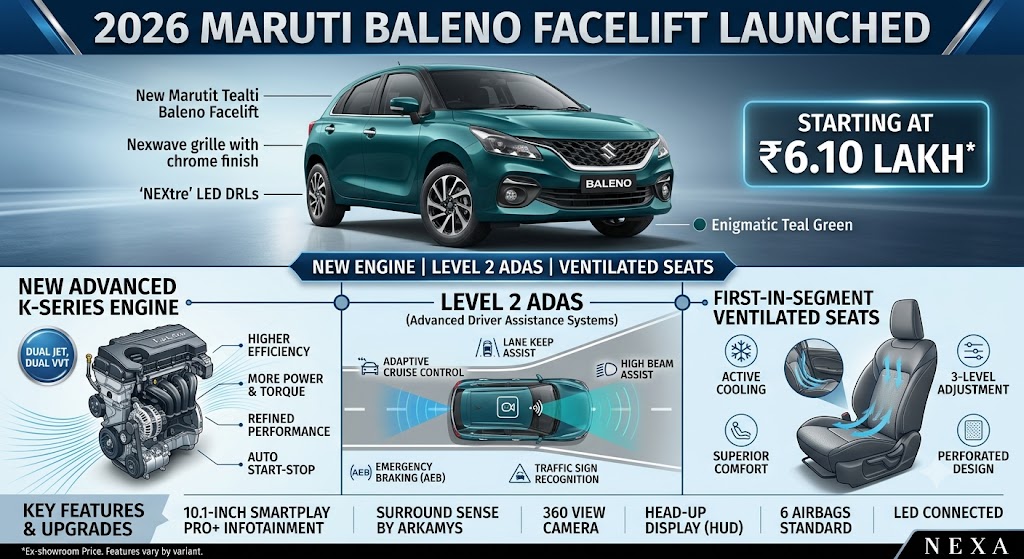
Several manufacturers have already introduced driver-assistance technology on vehicles positioned well below the luxury segment. Maruti Suzuki itself currently offers ADAS on models including the e VITARA, while the new Baleno introduced in September 2026 features Level 2 ADAS using a radar-and-camera combination.
The new Baleno's Level 2 system includes functions such as automatic emergency braking, lane-keep assistance, adaptive cruise control and other driver-assistance features.
Suzuki's latest plan could take this technology further down the price ladder in the future.
Will Alto, Celerio and Other Affordable Cars Get ADAS?
There is no confirmed model-by-model rollout yet.
Suzuki has stated that affordable vehicles are part of its intended coverage, but it has not announced that specific models such as the Alto K10, Celerio, WagonR or S-Presso will receive ADAS on a particular date.
Therefore, it would be premature to assume that every current Maruti Suzuki model will immediately receive the technology.
The strategy is focused on future vehicles and future development programmes, with the timing and exact model applications still to be announced.
What Could This Mean for Maruti Suzuki Buyers?
If Suzuki successfully reduces the cost of ADAS hardware, the technology could become available on vehicles where it has traditionally been difficult to justify because of price sensitivity.
That could change how buyers compare safety equipment between mainstream hatchbacks, sedans and SUVs.
However, ADAS should be viewed as an assistance system rather than a replacement for attentive driving. Functions such as automatic emergency braking and lane-departure prevention are designed to assist the driver and can have operating limitations depending on road conditions, visibility, markings and other factors.
Suzuki's Bigger Technology Strategy
The ADAS announcement is part of a much broader Suzuki technology plan.
The company wants to reduce the time required to develop new vehicles by around 50% by 2030, compared with its fiscal 2020 baseline. Suzuki is also targeting improved development and manufacturing efficiency and has identified India as a major production and export base.
Suzuki has also outlined a multi-pathway approach involving hybrids, EVs, CNG, CBG and efficient internal-combustion engines, rather than relying on one powertrain technology for every market.
This means the company's future Indian cars are likely to see changes not only in safety technology but also in vehicle architecture, powertrains and electronic systems.
What Happens Next?
The immediate question is which Maruti Suzuki model will become the first production vehicle to use Suzuki's new lower-cost ADAS architecture.
Suzuki has not announced a launch date or identified the first model. As development continues, more details are expected about the system's sensor configuration, functions, performance and pricing strategy.
The key takeaway is that Suzuki is planning to move core ADAS technology beyond premium vehicles and into affordable cars, with India playing an important role in that strategy.

 Khyati Sharma 2026-09-29