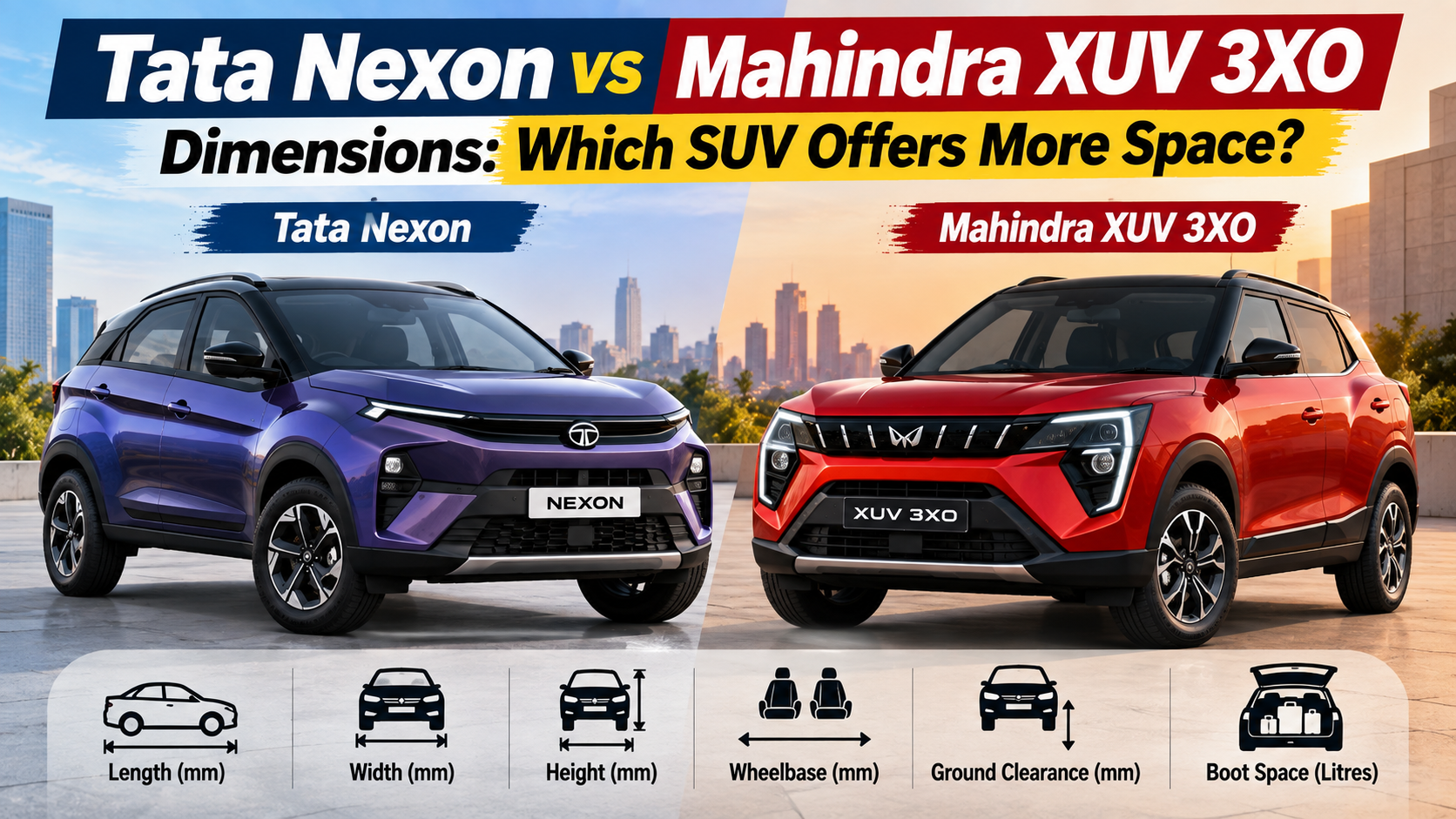
The Tata Nexon and Mahindra XUV 3XO are two popular compact SUVs in India, and their dimensions play an important role in everyday usability. Both models stay below the four-metre length mark, making them suitable for Indian city conditions, but their overall width, height, wheelbase and luggage capacity are not identical.
The Tata Nexon measures 3,995mm long, 1,804mm wide and 1,620mm tall, with a 2,498mm wheelbase. The Mahindra XUV 3XO measures 3,990mm long, 1,821mm wide and 1,647mm tall, with a longer 2,600mm wheelbase.
So, while the two SUVs are almost identical in length, the XUV 3XO has a wider body, taller profile and longer wheelbase.
Tata Nexon vs XUV 3XO: Dimension Comparison
|
Dimension
|
Tata Nexon
|
Mahindra XUV 3XO
|
|
Length
|
3,995mm
|
3,990mm
|
|
Width
|
1,804mm
|
1,821mm
|
|
Height
|
1,620mm
|
1,647mm
|
|
Wheelbase
|
2,498mm
|
2,600mm
|
|
Ground Clearance
|
208mm
|
Around 201mm
|
|
Boot Space
|
382 litres*
|
364 litres
|
|
Seating Capacity
|
5
|
5
|
Which SUV Is Longer?
The Tata Nexon is marginally longer.
- Nexon: 3,995mm
- XUV 3XO: 3,990mm
The difference is only 5mm, so it is unlikely to make a meaningful difference when parking or driving through tight urban spaces.
Both SUVs remain within India's four-metre compact-SUV category.
Which SUV Is Wider?
The Mahindra XUV 3XO is wider.
Its 1,821mm width compares with the Nexon's 1,804mm, giving the Mahindra a 17mm advantage.
A wider body can potentially contribute to greater shoulder room inside the cabin, although exterior width alone does not determine actual passenger comfort.
Mahindra itself highlights the XUV 3XO's 1,821mm width and 2,600mm wheelbase as part of its spacious cabin package.
For city driving, however, the wider body also means drivers should pay a little more attention in narrow lanes and tight parking spaces.
Which SUV Is Taller?
The XUV 3XO has a taller overall profile.
- Tata Nexon: 1,620mm
- Mahindra XUV 3XO: 1,647mm
That gives the Mahindra a 27mm height advantage.
The XUV 3XO's official specification lists 1,647mm with roof rails.
A taller body can contribute to a more upright seating position and easier ingress and egress, although actual cabin comfort depends on seat design and interior packaging.
XUV 3XO Has a Longer Wheelbase
The wheelbase difference is much more significant.
The Nexon has a 2,498mm wheelbase, while the XUV 3XO has a 2,600mm wheelbase.
That means the XUV 3XO has a 102mm longer wheelbase.
Wheelbase is the distance between the front and rear axles. A longer wheelbase can provide designers with more opportunity to create additional cabin space, particularly for rear passengers.
Mahindra's specifications list 1,050mm of first-row legroom and 878mm of second-row legroom for the XUV 3XO.
What About Ground Clearance?
Ground clearance is important for Indian roads, especially when a vehicle regularly encounters speed breakers, potholes and uneven surfaces.
The current Tata Nexon brochure lists 208mm of ground clearance.
The XUV 3XO is listed at around 201mm, depending on the specification/source.
On paper, therefore, the Nexon has a slightly higher ground-clearance figure.
However, ground clearance can change with vehicle load, tyre pressure and measurement methodology, so buyers should not judge real-world rough-road ability solely from the numerical difference.
Which Has More Boot Space?
The Nexon has a larger listed boot capacity in its petrol and diesel configurations.
Tata Nexon
382 litres in the current petrol/diesel specification.
Mahindra XUV 3XO
364 litres according to Mahindra's current specifications.
That gives the Nexon an 18-litre advantage based on these figures.
However, Tata's CNG version has a different luggage capacity, listed at 321 litres, because of its CNG packaging.
For families carrying luggage regularly, the exact powertrain and variant should therefore be considered.
Which One Is Easier to Drive in the City?
The dimensions are close enough that both SUVs remain practical for urban use.
The Nexon is slightly longer but narrower, while the XUV 3XO is slightly shorter but wider and taller.
The difference in exterior dimensions is unlikely to be the deciding factor for most buyers. Turning radius, visibility, seating position, camera systems and the driver's familiarity with the vehicle can have a bigger effect in real-world parking and traffic situations.
Which Offers More Cabin-Space Potential?
The XUV 3XO's longer 2,600mm wheelbase and wider 1,821mm body give it a useful dimensional advantage for interior packaging. Mahindra specifically positions the model around spaciousness and lists its long wheelbase and wide body among its key space-related specifications.
The Nexon, meanwhile, combines its compact exterior dimensions with a 2,498mm wheelbase and a larger listed petrol/diesel boot.
This means the two SUVs approach practicality differently rather than one being dramatically larger overall.
Tata Nexon vs XUV 3XO: Which Dimension Matters Most?
It depends on how the SUV will be used.
For rear-seat space:
The XUV 3XO's 2,600mm wheelbase is an important advantage on paper.
For exterior width:
The XUV 3XO is wider by 17mm.
For ground clearance:
The Nexon has the higher published figure at 208mm.
For boot space:
The Nexon's petrol/diesel specification has the larger listed capacity at 382 litres.
For overall length:
There is almost no difference, with just 5mm separating the two.
Tata Nexon vs Mahindra XUV 3XO: Dimensions at a Glance
|
Area
|
Tata Nexon
|
Mahindra XUV 3XO
|
|
City-friendly length
|
3,995mm
|
3,990mm
|
|
Body width
|
1,804mm
|
1,821mm
|
|
Overall height
|
1,620mm
|
1,647mm
|
|
Wheelbase
|
2,498mm
|
2,600mm
|
|
Ground clearance
|
208mm
|
~201mm
|
|
Boot
|
382L petrol/diesel
|
364L
|
|
Seating
|
5
|
5
|
The Tata Nexon and Mahindra XUV 3XO are closely matched in overall exterior size, but their proportions are different.
The Nexon is 5mm longer and has higher published ground clearance and a larger listed petrol/diesel boot, while the XUV 3XO is 17mm wider, 27mm taller and has a 102mm longer wheelbase.
For buyers primarily concerned about rear-seat space and a wider cabin, the XUV 3XO's dimensions are worth examining. Buyers who place greater emphasis on boot capacity and ground clearance will find the Nexon's numbers relevant.
Ultimately, dimensions are only one part of the comparison. A physical inspection and test drive can reveal differences in seating comfort, visibility, parking ease and usable cabin space that numbers alone cannot show.

 Khyati Sharma 2026-09-29