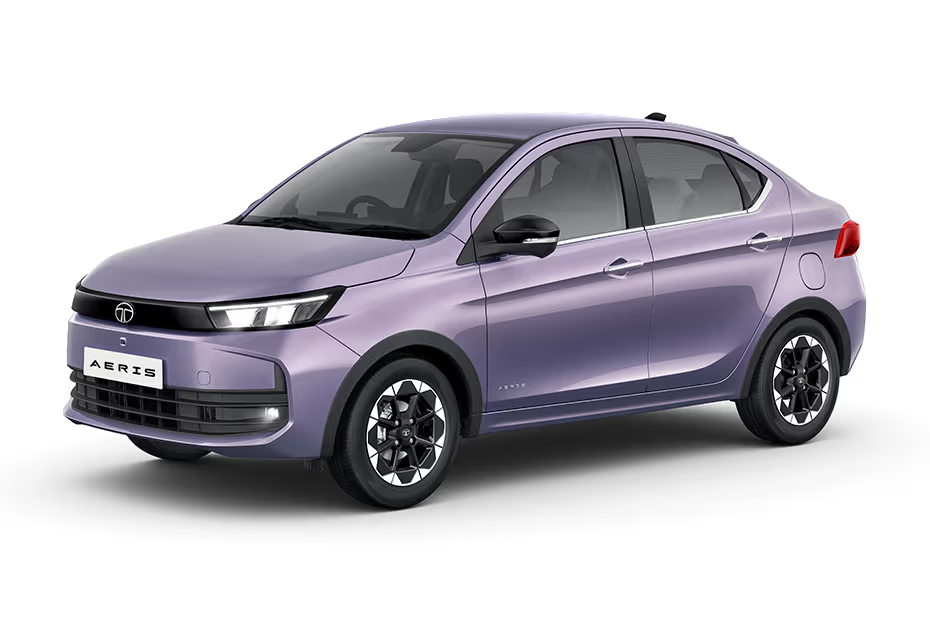
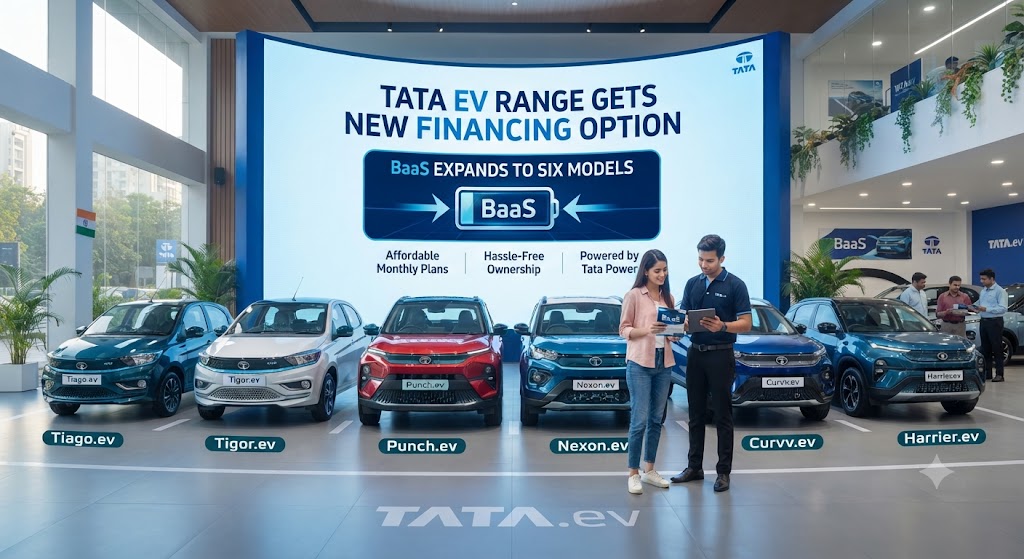
Tata.ev has expanded its Battery-as-a-Service (BaaS) financing programme to every electric car in its current portfolio in India. The scheme, which was initially offered with the Tiago.ev and Punch.ev, is now available with the Nexon.ev, Curvv.ev, Sierra.ev and Harrier.ev as well.
The key idea behind the programme is to separate the cost of the vehicle from the battery. This allows buyers to pay for the car and battery through separate financing arrangements, reducing the initial vehicle price displayed to customers.
Six Tata EVs Now Available With BaaS
With the latest expansion, Tata's complete electric passenger vehicle range is covered by the BaaS option.
The starting vehicle prices under the programme are:
These figures represent the vehicle component of the purchase under the BaaS structure. The battery is financed separately and therefore needs to be included when calculating the customer's overall ownership cost.
Lower Upfront Price Does Not Mean a Direct Discount
One of the most important points for buyers is that BaaS does not simply reduce the total price of an EV.
Instead, Tata separates the battery cost from the vehicle's upfront acquisition price.
For example, the difference between the conventional price and the BaaS vehicle price ranges from approximately ₹2.30 lakh on the Tiago.ev to ₹7.30 lakh on the Harrier.ev.
The lower displayed price therefore represents a different financing structure rather than an equivalent discount on the complete vehicle.
How Tata's Battery-as-a-Service Model Works
Customers choosing BaaS essentially have two financing components: one for the vehicle and another for the battery.
The battery financing EMI can vary depending on several factors, including:
- Battery capacity
- Down payment
- Loan tenure
- Financing provider
- Individual loan terms
Tata has partnered with multiple financiers, giving customers access to different financing arrangements.
Buyers who do not want the BaaS structure can continue with the conventional purchase option, where the battery remains part of the vehicle purchase.
Same EV, Different Payment Structure
Choosing BaaS does not change the vehicle itself.
Customers continue to receive the same vehicle technology, features and ownership support. The major difference is the way the vehicle and battery costs are financed.
This could be particularly relevant for customers who want to reduce the initial amount required to purchase a larger EV.
Bigger SUVs Now Have a Lower Entry Price
The expansion becomes particularly significant for Tata's larger electric SUVs.
The Nexon.ev, Curvv.ev, Sierra.ev and Harrier.ev now have BaaS starting prices that are lower than their conventional battery-included purchase prices.
For example, the Harrier.ev's BaaS vehicle price starts at ₹14.49 lakh, while the Sierra.ev starts at ₹11.99 lakh under the programme.
This gives customers another way to structure the financing of a more expensive electric SUV.
BaaS Running Costs Need to Be Calculated Separately
Buyers should not confuse battery financing charges with the complete running cost of an EV.
Electricity used to charge the vehicle is an additional expense. Battery EMI also does not include maintenance, repairs or other ownership costs.
Tata's published calculations use different daily driving assumptions, including 60 km per day for most models and 44 km per day for the Tiago.ev.
Actual costs can therefore differ significantly depending on how much a customer drives and the financing terms available to them.
EV Financing Becomes an Increasingly Important Factor
The expansion comes at a time when manufacturers are experimenting with new ways to make EV ownership more accessible.
The higher upfront cost of electric vehicles has traditionally been one of the barriers for some buyers. Battery financing allows manufacturers to advertise a lower initial vehicle price while spreading the battery cost separately.
Other manufacturers have also explored similar approaches for selected electric models, making financing an increasingly important part of competition in India's EV market.
What Buyers Should Check Before Choosing BaaS
A lower starting price can make an EV look more affordable, but buyers should calculate the total amount payable before making a decision.
Customers should compare:
- Vehicle loan EMI
- Battery loan EMI
- Down payment
- Electricity/charging expenses
- Maintenance costs
- Loan tenure
- Applicable taxes and charges
- Total amount payable over the financing period
Tata's stated BaaS prices also exclude road tax, insurance, TCS and other applicable statutory charges.
The current offer is intended for personal users.
Tata's Full EV Portfolio Now Gets BaaS
By extending BaaS from two models to the entire six-model electric portfolio, Tata.ev is giving customers more flexibility in how they finance an EV.
The programme does not change the specifications or technology of the vehicles. Instead, it changes the way the cost of the battery is handled during purchase.
For buyers considering a Tata EV, the most important figure is therefore not just the advertised BaaS vehicle price, but the combined cost of the vehicle and separately financed battery over the complete ownership period.

 Khyati Sharma 2026-09-29