_A_Checklist_Before_You_Take_Delivery.jpeg)





2026-10-18
The best discount comes from comparing written on-road quotes, not from haggling over the sticker price. Get the same model, variant, and colour quoted by at least three dealers. Then ask each one to name every benefit they’re offering. The real savings usually show up once the numbers sit side by side.
Not every discount is the same. Some come from the dealer’s own margin. Others come from the carmaker, also called the OEM (original equipment manufacturer). You may also see corporate tie-ups, loyalty bonuses for existing customers, exchange bonuses, and benefits tied to a loan or insurance policy.
Ask the dealer to name each one. A discount you can’t name is one you can’t check. If they say “special benefit” without a breakdown, ask what it actually is.
The label matters more than most buyers expect. Dealer discounts and carmaker schemes are funded differently, and carmaker schemes often change from month to month. An offer that’s real today might be gone next week.
A headline discount is a sales line. What you actually pay is the on-road price, which is the total to drive the car away. Ask for the full breakdown on one page: ex-showroom price, discount, road tax, insurance, registration, accessories, and any extra charge.
The ex-showroom price is the base you bargain from. In many states, road tax is calculated on that figure, so a cut there can lower your road tax too. Most buyers never think to ask about that.
Pick one model, one variant, and one colour. Then send the same request to three dealers by email, asking for an itemised quote in writing. Include the delivery timeline and whether insurance is bundled.
Why bother with email? Phone quotes have a way of changing once the paperwork shows up. A written quote is the only thing you can hold the dealer to.
Once you have the numbers, you can push back on the first offer without guessing. Show the other quotes and ask the dealer to beat the real total, not the headline. Dealers expect buyers to compare, so a polite request usually gets a sharper number.
Timing can add real value to your deal. Month-end and quarter-end sales targets, the festive season, and the weeks after a new model launch often bring better offers. Older stock sitting on the lot can also be easier to negotiate.
But here’s the catch: a festive offer isn’t always better than a good offer on a quiet weekday. Compare the written numbers, not the calendar. And don’t rush because a deadline sounds urgent. Some deadlines are just sales tactics.
Dealers sometimes advertise a big discount on a lower trim. Check the trim before you celebrate. A cheaper variant may lack airbags, a reverse camera, or stability control, and those features matter more than a few thousand rupees.
Also, a heavier car isn’t automatically a safer one. Weight can help in some crashes, but the design and the safety kit matter just as much. So compare the features and crash test ratings before you pay for size.
Free accessories, fuel vouchers, and extended warranties sound generous. But ask what each one costs on its own. An accessory pack billed at list price isn’t a gift, and a fuel voucher is only worth what you’ll actually use.
Before you count a fuel voucher as savings, think about how you drive. Some drivers swear by it when they fill up early in the morning. That’s worth checking before you plan around it.
A cash discount is usually more flexible. You can skip accessories you don’t want and buy the ones you do need from a seller you trust.
If you’re exchanging a car, don’t let the dealer fold the trade-in into the discount. An exchange bonus can look generous until you compare it with what the dealer would pay for your old car alone.
Check online valuation tools for a starting point. Then ask a used car dealer or two for a firm written price. If the new car dealer’s trade-in number is lower, the exchange bonus is partly an illusion.
Dealer loans sometimes come with cashback or a lower rate. That can help, but the cashback can be smaller than the extra interest you pay over the years. Get a bank pre-approval and compare the total interest, not just the monthly EMI.
Here’s the math that changes minds. On an ₹8 lakh loan over five years, one percentage point of interest can add about ₹22,000 to what you pay. That’s often more than a small cashback is worth.
Insurance works the same way. A dealer-bundled policy is convenient, but you can buy from any IRDAI-licensed insurer. Compare two or three quotes before you accept the bundle.
Your best tool is a polite exit. Thank the dealer, say you need a day to compare, and leave with a copy of the quote. Many dealers call back with a better number. Not always, but often enough to be worth a day.
And if they don’t call? You still have the written numbers, which is all you needed in the first place.
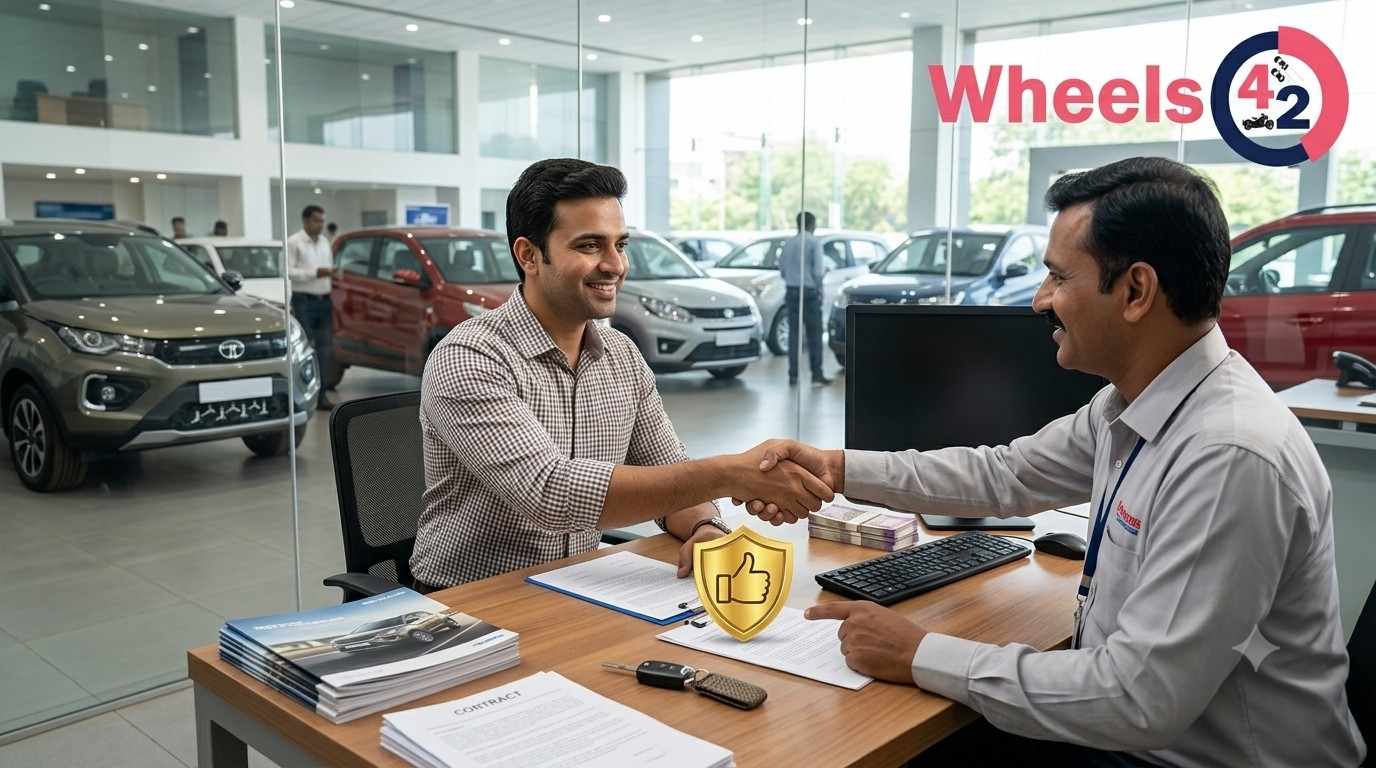
Before you pay the token, ask for the final deal sheet. It should list every discount by name, the scheme’s validity dates, the accessories, the insurance, and the delivery date. If a benefit isn’t on paper, it isn’t in the deal, no matter what the salesperson says.
Rahul, a school teacher in Jaipur, wanted a compact SUV in the mid petrol variant. The ex-showroom price was ₹10,00,000, and he planned to exchange an older hatchback. The figures below are rounded so the math is easy to follow.
Dealer A’s first offer sounded great: a “₹80,000 benefit.” When Rahul asked for the breakdown, it had three parts. There was a ₹40,000 dealer discount on the car. A ₹25,000 accessory pack was called a free gift, but it was still added to the bill at list price. The last ₹15,000 was a cashback that applied only if he took the dealer’s loan. His real discount was ₹40,000, and the on-road total came to ₹11,25,000.
Dealer B gave him a written quote with a ₹60,000 discount, no accessory pack, and the same insurance and registration charges. The on-road total came to ₹10,80,000. Dealer C offered a ₹50,000 festive discount and a ₹20,000 exchange bonus, but only if he traded in the hatchback with them. Their trade-in figure for the hatchback was ₹2,70,000.
So Rahul took the hatchback to two independent used car dealers. One offered ₹3,15,000 in writing, which was ₹45,000 more than Dealer C’s trade-in figure. He sold the car there. Then he got a loan pre-approval from his bank, at a rate one point lower than the dealer’s finance offer. He borrowed about ₹7.65 lakh, the difference between the on-road price and the trade-in money.
He went back to Dealer B with the other numbers, and they confirmed the ₹60,000 discount in writing. Dealer B’s total was the lowest without the accessory pack, so he chose them.
Between the cheaper car, the better trade-in, and the lower loan interest, Rahul came out about ₹1.1 lakh ahead. He didn’t win by haggling harder. He won by putting the numbers side by side. The first offer had the biggest headline and the smallest real discount.
There’s no fixed number. Discounts depend on the model, the season, the dealer’s stock, and how popular the car is. Models with long waiting lists rarely get big cuts, so compare written quotes to find your real number.
Often, yes. Monthly and quarterly sales targets can push dealers to close deals near month-end. A written quote still beats a vague promise that the offer will get better later.
It’s often one of the best windows, since carmakers and dealers run schemes around major festivals. Offers can change quickly, so check the terms in writing before you rely on them.
Usually only on small items, like accessories or a service package. Once the deal is signed, big price changes are hard to get. Do your negotiating before you pay.
A dealer discount comes from the dealer’s own margin. A manufacturer scheme is funded by the carmaker and often changes monthly. Ask which one you’re getting, because it affects how long the offer lasts.
Only if the cashback is bigger than the extra interest you’d pay. Compare the total cost of the dealer loan with a bank pre-approval before you decide.
It depends on the trade-in value. Compare the dealer’s number with independent offers for your old car. If an independent offer is higher, selling separately may be the better deal.
Usually a cash discount is more flexible. You can skip accessories you don’t want, and buy the ones you need from another seller. Check what each accessory costs on its own before you accept a pack.
No. They apply only to buyers who qualify under a corporate tie-up, such as employees of partner companies. Ask the dealer to show the tie-up in writing before you count it.
Ask for the scheme’s name, the terms, and the validity dates in writing. If the dealer won’t put it on paper, treat it as a sales line, not a real discount.
In many states, road tax is calculated on the ex-showroom price, so a discount on that line can lower it too. Check your state’s rule, or ask the dealer to show the calculation.
It can, especially when a new model is about to launch. Check spare parts availability, warranty terms, and resale value first. A small saving isn’t worth much if parts are hard to find later.
Getting a good discount is less about being tough and more about being organized. Get written quotes, ask which benefit is which, time your visit, and value your old car on its own. Offers change every month, so confirm the current scheme with the dealer and the carmaker before you sign anything.