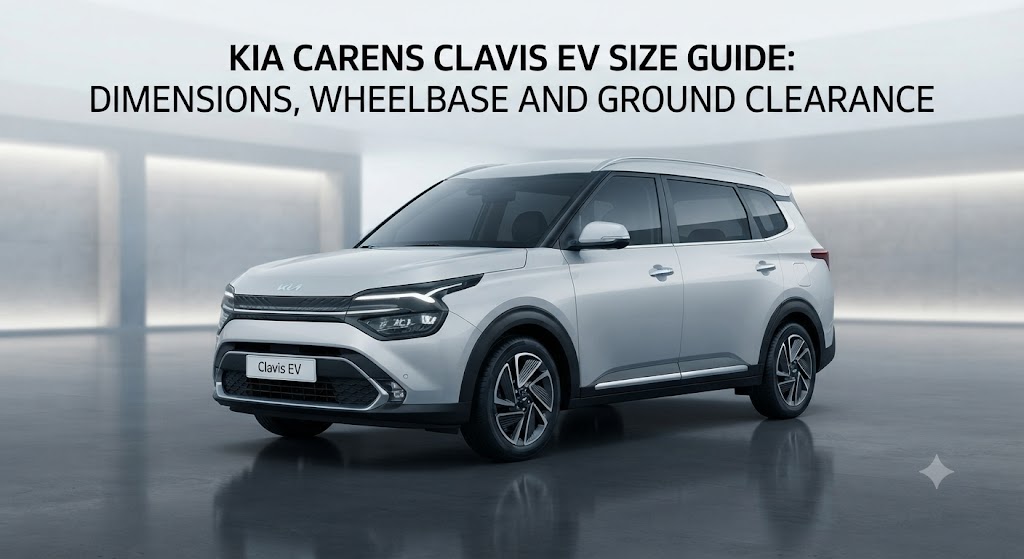
The Kia Carens Clavis EV brings electric power to a body style that has traditionally been valued for one thing above all else: family practicality. With three rows of seats, a long wheelbase and a relatively tall body, the Clavis EV is designed to offer space for a large family while retaining the benefits of an electric powertrain.
But how big is the Carens Clavis EV actually?
The electric MPV measures 4,550mm in length, 1,800mm in width and 2,780mm in wheelbase. Kia's official documentation lists the height at 1,725mm without the roof rack and 1,730mm with the roof rack. The model is also reported to have around 200mm of unladen ground clearance, giving it useful clearance for Indian roads.
These numbers tell only part of the story. The more interesting question is how these dimensions affect the car's road presence, cabin space, parking experience and everyday usability.
Kia Carens Clavis EV Dimensions at a Glance
|
Dimension
|
Kia Carens Clavis EV
|
|
Length
|
4,550mm
|
|
Width
|
1,800mm
|
|
Height
|
1,725mm without roof rack / 1,730mm with roof rack
|
|
Wheelbase
|
2,780mm
|
|
Ground clearance
|
Around 200mm unladen
|
|
Seating capacity
|
Up to 7
|
|
Doors
|
5
|
|
Frunk
|
25 litres
|
|
Drive layout
|
Front-wheel drive
|
4,550mm Length Gives the Clavis EV a Large Road Footprint
At 4,550mm long, the Carens Clavis EV is not a small electric vehicle.
Its length is important because this is fundamentally a family-oriented three-row vehicle. A longer body gives the designers more room to package multiple seating rows without making the cabin feel excessively cramped.
The length also contributes to the vehicle's road presence. The Clavis EV has a relatively long and upright profile compared with many five-seat electric SUVs.
For buyers moving from a hatchback or compact SUV, the difference in overall size will be noticeable, particularly when parking in tight urban spaces.
At the same time, 4.55 metres is still a manageable size for a vehicle designed for Indian cities.
1,800mm Width: Wide Enough for a Family-Focused Cabin
The Clavis EV measures 1,800mm in width.
Width has a direct influence on the amount of shoulder room available inside the vehicle. This becomes particularly important in a three-row vehicle because the second row needs to accommodate passengers comfortably while leaving sufficient space for access to the third row.
The 1,800mm figure also gives the Clavis EV a substantial stance without making it exceptionally wide for Indian roads.
For city users, width is worth considering because a wider vehicle can require more attention in narrow lanes, older parking structures and tight multi-storey car parks.
The advantage is that the additional width can contribute to a more comfortable cabin.
How Tall Is the Kia Carens Clavis EV?
The height figure needs a little explanation because Kia's official documents provide more than one number.
The Kia owner's manual lists the vehicle at:
- 1,725mm without roof rack
- 1,730mm with roof rack
Kia's product specification page and brochure commonly display 1,730mm as the overall height figure.
This relatively tall profile is useful for a family vehicle because it supports an upright seating position and helps create more vertical space inside the cabin.
The height also contributes to the Clavis EV's MPV-like practicality rather than giving it the low-slung proportions of a conventional coupe-style electric SUV.
2,780mm Wheelbase Is One of Its Most Important Dimensions
If there is one number that deserves particular attention in a three-row vehicle, it is the wheelbase.
The Kia Carens Clavis EV has a 2,780mm wheelbase.
Wheelbase is the distance between the front and rear axles.
A longer wheelbase generally provides more space between the axles for engineers to package the passenger compartment. It can also contribute to high-speed stability and a more settled ride, although suspension tuning, tyre specifications and weight distribution are equally important.
In the Clavis EV, the long wheelbase is particularly relevant because Kia is trying to accommodate three rows of seats.
Does the 2,780mm Wheelbase Help Cabin Space?
Yes, the wheelbase is an important contributor to the Clavis EV's family-focused layout.
The vehicle has three seating rows and can accommodate up to seven occupants. Kia's standard Clavis architecture also focuses heavily on second-row flexibility, with sliding, reclining and tumble functionality depending on specification.
This means the available interior space can be managed according to the number of passengers.
For example, when the third row is occupied, the second row can be positioned to balance passenger comfort and access. When fewer people are travelling, the available space can be rearranged for luggage or additional legroom.
That flexibility is one reason why wheelbase matters more here than simply looking at the vehicle's exterior length.
Kia Carens Clavis EV Ground Clearance: Around 200mm
Ground clearance is especially important for Indian buyers.
The Clavis EV has been reported with approximately 200mm of unladen ground clearance. Autocar India's road test specifically measured the vehicle at 200mm unladen and noted that the battery pack and body did not make contact with the ground over broken sections during its evaluation.
This is useful because the battery pack of an EV sits underneath the vehicle.
A healthy amount of clearance provides additional room when negotiating:
- Speed breakers
- Potholes
- Broken roads
- Steep ramps
- Uneven village roads
- Rough parking entrances
However, ground clearance is not a guarantee that the vehicle will clear every obstacle. Vehicle load, approach angle, departure angle and the shape of the obstacle can all affect underbody clearance.
Does the Battery Affect Ground Clearance?
One interesting aspect of the Clavis EV is how Kia has packaged the battery.
The battery is positioned underneath the vehicle, but the Clavis EV still maintains around 200mm of unladen ground clearance. Autocar India's review found that the underbody and battery pack remained clear of the road over the broken-road sections tested.
This is important for an electric family vehicle because the battery is one of the most expensive components underneath the car.
The combination of a protected underbody and useful ground clearance is therefore important for Indian driving conditions.
Is the Clavis EV Too Large for City Driving?
Not necessarily.
At 4,550mm long and 1,800mm wide, the Clavis EV is certainly larger than a typical hatchback.
However, its dimensions are still within the range that many Indian SUV and MPV buyers are accustomed to.
The bigger consideration is not whether it can be driven in a city, but whether the driver is comfortable with its size.
Features such as:
- Front and rear parking sensors
- 360-degree camera on equipped variants
- Parking assistance
- Rear-view camera
- Good visibility
can make manoeuvring easier, depending on the variant.
For someone upgrading from a small hatchback, there will be an adjustment period. For an existing MPV or midsize SUV owner, the dimensions should feel more familiar.
What About the Third Row?
The three-row layout is arguably the most important reason for the Clavis EV's dimensions.
A 7-seater electric vehicle has to balance several competing requirements:
Passenger space + battery packaging + boot capacity + exterior size
A larger battery could theoretically provide more range, but using too much underfloor space can compromise the third row or luggage area.
Kia has instead positioned the Clavis EV as a family EV where seating practicality remains an important part of the package.
That makes the vehicle different from many electric SUVs that prioritise two-row seating and larger battery packs.
Kia Carens Clavis EV Boot and Storage
The Clavis EV also provides additional storage in the form of a 25-litre frunk. Kia's official specifications confirm this front storage compartment.
Third-party specifications list approximately 216 litres of luggage capacity with all three rows in use, with considerably more room available when the third row is folded.
This is an important consideration for a seven-seat vehicle.
With all seats occupied, luggage space is naturally more limited than in a conventional five-seat SUV. Folding the third row can significantly increase the available cargo area.
Therefore, buyers should think about how often they actually use all three rows before deciding whether the Clavis EV's storage arrangement meets their requirements.
How the Clavis EV Dimensions Affect Everyday Driving
The dimensions influence different parts of the driving experience in different ways.
In traffic:- The 1,800mm width gives the vehicle a substantial footprint, so drivers need to be aware of the vehicle's sides in narrow roads.
On highways:- The 2,780mm wheelbase can contribute to a stable and planted feel, although actual ride and handling depend on the suspension and tyres.
In parking lots:- The 4,550mm length means the Clavis EV occupies more space than a small SUV, making cameras and sensors useful.
On rough roads:- The approximately 200mm unladen ground clearance gives additional protection against common road obstacles.
With a full family:- The three-row layout allows the vehicle to carry up to seven occupants, making its relatively large dimensions useful rather than excessive.
Kia Carens Clavis EV vs Regular Carens: Are the Dimensions Different?
The basic dimensions remain very close because the Clavis EV is based around the same broad family-oriented architecture.
The standard Carens Clavis measures 4,550mm in length and 1,800mm in width, with a 2,780mm wheelbase.
The electric version retains the same length, width and wheelbase.
The major difference is in the powertrain packaging and the EV-specific underbody components.
This means the Clavis EV retains the practical proportions that buyers associate with the Carens family while adding an electric drivetrain.
Kia Carens Clavis EV Size Compared With a Typical SUV
The Clavis EV's dimensions reveal its intended role.
It is:
- Longer than many compact SUVs
- Wider than many small urban cars
- Taller than most coupe-style SUVs
- Long-wheelbase compared with many compact EVs
- Configured around three rows rather than two
This makes it more of an electric family mover than a traditional compact electric SUV.
Its dimensions are therefore not simply about making the vehicle look large. They serve a specific purpose: creating a practical cabin for families.
Why Wheelbase Matters More Than Length for Families
Two vehicles can have similar overall lengths but offer very different interior space.
This happens because the distance between the axles and the amount of bodywork extending beyond the wheels can vary.
The Clavis EV's 2,780mm wheelbase gives Kia a useful foundation for creating passenger space across three rows.
For buyers, this means wheelbase can sometimes tell you more about potential cabin packaging than length alone.
However, wheelbase should not be treated as a direct measurement of legroom. Seat design, floor height, dashboard packaging and the position of each row also matter.
Is 200mm Ground Clearance Enough for Indian Roads?
For normal urban and highway use, around 200mm of unladen clearance provides a useful margin.
It should be adequate for many:
- City speed breakers
- Potholes
- Uneven roads
- Rural roads
- Basement ramps
But the vehicle should still be driven carefully over particularly sharp or tall obstacles.
When the vehicle is heavily loaded with passengers and luggage, suspension compression can reduce the available clearance.
This is especially relevant to a seven-seater because a fully occupied vehicle can carry considerably more weight than a lightly loaded one.
Kia Carens Clavis EV Dimensions: Key Numbers Explained
|
Measurement
|
What It Means
|
Clavis EV
|
|
Length
|
Front-to-rear body size
|
4,550mm
|
|
Width
|
Overall body width
|
1,800mm
|
|
Height
|
Overall vehicle height
|
1,725mm without roof rack / 1,730mm with roof rack
|
|
Wheelbase
|
Distance between axles
|
2,780mm
|
|
Ground clearance
|
Lowest underbody clearance
|
Around 200mm unladen
|
|
Seating
|
Maximum occupants
|
Up to 7
|
|
Frunk
|
Front storage
|
25 litres
|
Who Will Appreciate the Clavis EV's Size?
The dimensions make the most sense for buyers who prioritise family practicality.
It could suit:
- Large families
- Buyers who regularly carry six or seven people
- People upgrading from an MPV
- Buyers who need flexible second- and third-row seating
- EV users who frequently travel with passengers
- Families looking for a practical electric alternative to a conventional SUV
On the other hand, someone who spends most of their time driving alone through narrow city streets may find a smaller EV easier to manoeuvre and park.

 Khyati Sharma 2026-09-30