Suzuki car Wants ADAS to Reach More Cars
ADAS has traditionally been associated with higher-priced vehicles because the technology can require multiple cameras, radar sensors, electronic control units and sophisticated software.
Suzuki's latest strategy is aimed at changing that equation.
The company says it is developing a “just-right ADAS” approach suited to Indian traffic conditions and intends to make key safety functions available across its future vehicle range, including affordable models.
Suzuki's chief technology officer Katsuhiro Kato said the company wants to avoid a situation where advanced accident-prevention technology is available only on a small number of expensive cars.
What Features Could Be Included?
Suzuki has indicated that the focus will be on core safety functions, rather than loading every vehicle with the most expensive driver-assistance features.
The company has specifically mentioned technologies such as:
|
ADAS Feature
|
What It Does
|
|
Automatic Emergency Braking
|
Can automatically apply the brakes when a collision is detected
|
|
Lane Departure Prevention
|
Helps prevent unintended movement out of a lane
|
|
Forward Collision Warning
|
Alerts the driver to a potential frontal collision
|
|
Driver Monitoring
|
Can monitor driver attention and behaviour
|
|
Occupant Monitoring
|
Helps integrate cabin monitoring with safety systems
|
Suzuki has indicated that customers could potentially choose additional comfort-oriented functions separately, while essential accident-prevention features could become standard.
How Suzuki Plans to Reduce ADAS Costs
The interesting part of Suzuki's plan is the way it wants to simplify the hardware.
According to the company's technology strategy, Suzuki is looking at a combination of high-resolution cameras, AI chips and integrated electronic systems.
One major change under consideration is eliminating the conventional front radar from its proposed lower-cost ADAS configuration.
The objective is not simply to remove features but to redesign the system around what Suzuki considers necessary for real-world driving conditions.
The company is targeting major cost reductions while aiming to maintain equal or better safety performance, although Suzuki has not yet published production-system performance results.
Why India Is Important for Suzuki's ADAS Strategy
India could be an important market for this technology because of Suzuki's huge presence in the country's mass-market car segment.
Suzuki's broader 2026 strategy places significant importance on India, with the company targeting around 4 million vehicles of annual production capacity in India by fiscal 2030.
The company is also pursuing shorter development cycles, greater use of modularisation and more efficient manufacturing.
This could make it easier to spread common technologies across several models instead of developing completely separate systems for every vehicle.
Could Future Maruti Suzuki Cars Get ADAS?
Suzuki has not yet announced which specific Maruti Suzuki models will receive this proposed lower-cost ADAS system first.
It also has not announced a confirmed rollout date for the system.
Therefore, it would be premature to say that a particular upcoming Maruti Suzuki model will definitely get this technology.
However, if Suzuki succeeds in reducing the cost sufficiently, the technology could eventually become relevant to the company's high-volume affordable models.
ADAS Is Already Moving Down the Price Ladder
Suzuki's strategy comes at a time when ADAS is becoming increasingly available in more affordable cars in India.
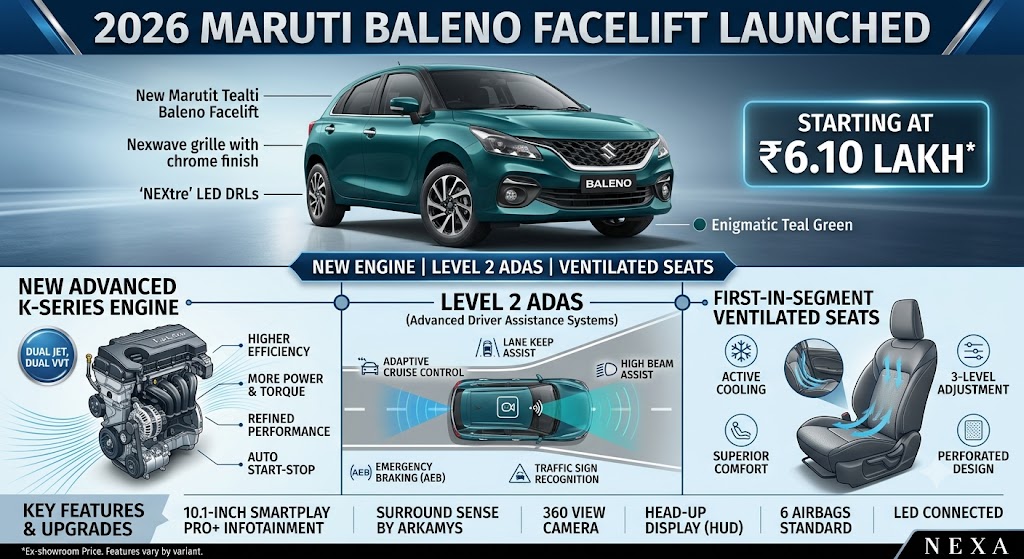
As of September 2026, several mass-market models already offer ADAS, with the technology appearing in cars such as the Maruti Suzuki Baleno, Honda Amaze and Mahindra XUV 3XO, depending on variant.
The Honda Amaze, for example, currently offers ADAS on its higher-spec variant, while the updated Maruti Suzuki Baleno has also introduced Level 2 ADAS on its top-spec version.
This means Suzuki's proposed technology could be part of a broader industry movement toward making advanced safety systems accessible beyond premium vehicles.
What Could This Mean for Affordable Car Buyers?
If Suzuki's cost-reduction programme succeeds, future affordable cars could potentially receive important safety technologies without requiring the expensive hardware traditionally associated with ADAS.
For buyers, the biggest potential benefit would be wider access to active safety technology.
Instead of ADAS being restricted to premium variants, essential functions could eventually become available on a much larger number of vehicles.
However, actual pricing and equipment will depend on how Suzuki implements the technology in production cars.
Suzuki's “Just-Right ADAS” Approach Explained
Suzuki appears to be taking a different approach from simply adding as many driver-assistance features as possible.
The concept can be summarised as:
Affordable hardware + locally suitable software + essential safety functions = wider ADAS adoption
The company wants to identify the functions that provide meaningful safety benefits and build a system around those requirements.
This fits into Suzuki's wider “SDV Right” strategy, which aims to combine electronic functions and reduce unnecessary complexity.
What Happens Next?
Suzuki's next step will be developing and validating the proposed lower-cost ADAS architecture.
The company has not yet revealed the first production models, final specifications, or launch timeline for the system.
If the technology reaches production as planned, it could eventually allow Suzuki and Maruti Suzuki to extend selected ADAS safety functions to a much wider range of vehicles.
For now, the key development is Suzuki's intention to make core accident-prevention technology more affordable rather than restricting it to expensive cars.

 Khyati Sharma 2026-09-30