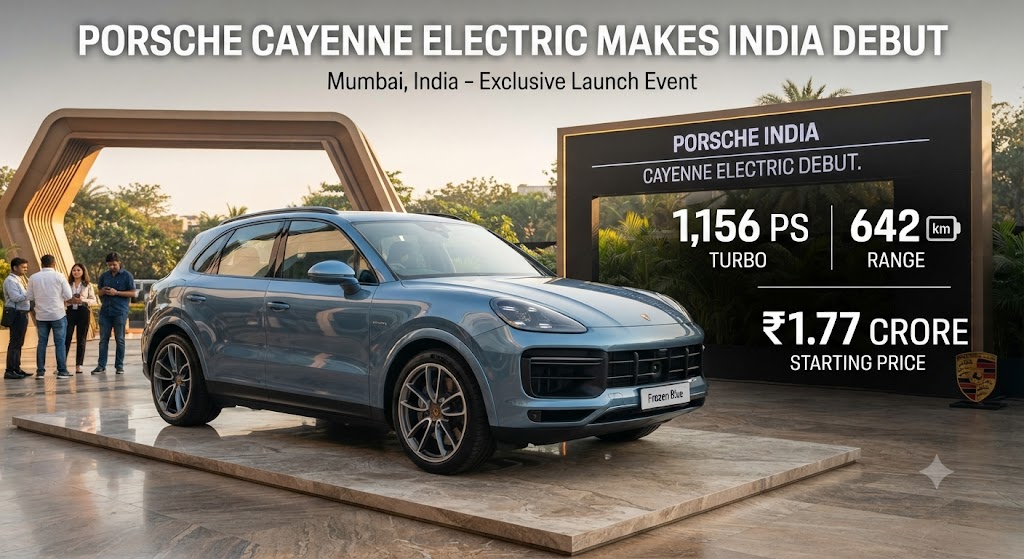
Porsche has officially brought the all-electric Cayenne to India,marking the arrival of one of the brand's most powerful and technologically advanced SUVs in the country. The new Cayenne Electric combines the familiar Cayenne silhouette with an all-electric powertrain,800-volt architecture and performance figures that push it deep into sports-car territory.
The India range starts with the Cayenne Electric at ₹1.77 crore,while the range-topping Cayenne Turbo Electric is priced from ₹2.28 crore,ex-showroom. Porsche India's official configurator currently lists the two models at ₹1,77,27,000 and ₹2,27,51,000 respectively.
Both versions use a 113kWh battery and dual electric motors with all-wheel drive. The standard Cayenne Electric can deliver up to 442 PS with Launch Control,while the Turbo Electric produces an extraordinary 1,156 PS under Launch Control.
A New Electric Chapter for the Cayenne
The Cayenne name has been associated with Porsche's performance SUV formula for more than two decades.
The electric version doesn't abandon that identity.
Instead,it retains the familiar Cayenne proportions while replacing the combustion powertrain with Porsche's latest electric technology. The company describes the new model as a combination of performance,comfort,long-distance ability and everyday practicality.
The result is an SUV that looks recognisably like a Cayenne but has the instant response associated with a high-performance EV.
Two Versions Arrive in India
|
Specification
|
Cayenne Electric
|
Cayenne Turbo Electric
|
|
Battery
|
113 kWh
|
113 kWh
|
|
Drive
|
Dual-motor AWD
|
Dual-motor AWD
|
|
Max Launch Control power
|
442 PS
|
1,156 PS
|
|
Torque
|
835 Nm
|
Up to 1,500 Nm
|
|
0-100 km/h
|
4.8 sec
|
2.5 sec
|
|
Top speed
|
230 km/h
|
260 km/h
|
|
Claimed range
|
Up to 642 km
|
Up to 623 km
|
|
Starting price
|
₹1.77 crore
|
₹2.28 crore
|
113kWh Battery With More Than 600km of Claimed Range
At the heart of the Cayenne Electric is a 113kWh high-voltage battery.
Porsche has developed the battery as an integrated structural component of the vehicle. The battery uses six modules and 192 cells,with cooling from both sides to help manage temperatures.
The standard Cayenne Electric has a claimed WLTP range of up to 642km,while the Turbo Electric is rated for up to 623km.
That gives the electric Cayenne a range figure designed to make it suitable for more than short urban journeys.
Of course,actual range in India will depend on driving conditions,traffic,temperature,speed and other factors.
800V Architecture Enables Extremely Fast Charging
One of the biggest technological highlights is Porsche's 800-volt electrical architecture.
The Cayenne Electric can accept up to 390kW of DC charging power,with Porsche stating that under specific conditions the system can handle up to 400kW.
The battery can be charged from 10 to 80 percent in less than 16 minutes under ideal conditions with a sufficiently powerful charging system.
Porsche says approximately 325km of additional range can be added to the standard Cayenne Electric in around 10 minutes under the specified conditions.
This is particularly significant for a luxury SUV that is likely to be used for long-distance travel.
Regenerative Braking Reaches 600kW
Porsche has also focused heavily on energy recovery.
The Cayenne Electric can recuperate energy at up to 600kW,a figure Porsche compares with Formula E-level recuperation technology.
The company says around 97 percent of braking operations in everyday driving can be handled purely by the electric motors,with the conventional hydraulic brakes stepping in when greater braking force is required.
The driver can also adjust the level of overrun recuperation through different settings.
Turbo Electric Can Hit 100km/h in Just 2.5 Seconds
The numbers become particularly dramatic with the Turbo Electric.
With Launch Control,the SUV can accelerate from 0 to 100km/h in 2.5 seconds.
Its maximum speed is electronically limited to 260km/h.
The Turbo Electric can produce up to 1,156 PS and 1,500 Nm with Launch Control. Porsche says up to 630kW,or 857 PS,is available in normal driving,while its Push-to-Pass function can provide an additional 130kW for up to 10 seconds.
Those figures put the Cayenne Turbo Electric firmly into high-performance territory despite its SUV body.
Adaptive Air Suspension Comes as Standard
Performance isn't the only priority.
Both Indian versions come with adaptive air suspension with Porsche Active Suspension Management,helping the Cayenne balance handling with ride comfort.
Rear-axle steering is available as an option and can turn the rear wheels by up to five degrees.
The system is designed to improve manoeuvrability at lower speeds while enhancing stability and agility at higher speeds.
The Turbo Electric additionally gets Porsche Torque Vectoring Plus as part of its performance-oriented hardware,and Porsche Active Ride is available as an option.
The Design Still Looks Like a Cayenne
Porsche hasn't attempted to make the electric version look radically different.
Instead,the Cayenne Electric retains the basic silhouette associated with the nameplate.
However,the front-end design has been revised for electric power.
The conventional grille treatment has been replaced by a cleaner front fascia,while active aerodynamic elements and side air openings help manage cooling and airflow.
The SUV can be specified with 20-,21- and 22-inch wheels,depending on configuration.
At the rear,a full-width LED light bar stretches across the tailgate,with illuminated Porsche lettering adding to the visual identity.
Larger Than the Combustion Cayenne
The electric Cayenne measures:
- Length: 4,985mm
- Width: 1,980mm
- Height: 1,674mm
- Wheelbase: 3,023mm
It is around 55mm longer than the combustion-engined Cayenne.
Despite its performance focus,the SUV retains a strong practicality element.
Porsche quotes a 90-litre front luggage compartment and a 781-litre rear boot.
With the powered rear seats folded,the luggage capacity increases to 1,588 litres.
A High-Tech Cabin
The cabin represents another major departure from older Cayenne models.
The electric Cayenne gets a digital driver's display and a 14.5-inch curved central infotainment touchscreen.
An optional 14.9-inch passenger display is also available,along with an augmented-reality head-up display.
Other available equipment includes:
- Four-zone climate control
- Ventilated front seats
- Panoramic sunroof
- Wireless smartphone charging
- Electrically adjustable front seats
- Porsche Digital Key
- Bose premium audio
- Optional Harman Kardon audio
- Porsche App Centre
- AI-powered voice assistant
A 14-speaker Bose sound system is standard,while a 20-speaker Harman Kardon system is available as an option.
Wireless Charging for the SUV Itself
One of the more unusual features associated with the Cayenne Electric is wireless vehicle charging.
Porsche offers an optional wireless charging system capable of transferring energy at up to 11kW.
The system uses a vehicle-side component and a ground charging pad,with the vehicle positioned over the pad. Porsche says the system operates at around 90 percent efficiency under its specified conditions.
This technology is being rolled out in markets in stages,so exact availability can depend on the market and configuration.
A Luxury SUV That Is Also Designed for Long Journeys
The Cayenne Electric's appeal isn't solely about acceleration.
The combination of:
- More than 600km of claimed range
- 113kWh battery
- 800V architecture
- Fast DC charging
- Adaptive air suspension
- Large luggage capacity
- Five-seat layout
- Four-zone climate control
- Premium audio
gives it the ingredients expected from a luxury long-distance SUV.
Porsche has also engineered the electric Cayenne with everyday usability in mind,rather than treating it purely as a performance vehicle.
Porsche Cayenne Electric Price in India
The Porsche Cayenne Electric starts at ₹1.77 crore,while the Cayenne Turbo Electric starts at approximately ₹2.28 crore,ex-showroom.
Porsche India's official configurator lists the exact starting prices as:
Cayenne Electric: ₹1,77,27,000
Cayenne Turbo Electric: ₹2,27,51,000
These are starting prices before optional equipment and applicable on-road costs.
Because Porsche offers extensive personalisation,adding options can substantially increase the final purchase price.

 Khyati Sharma 2026-09-30



.avif)