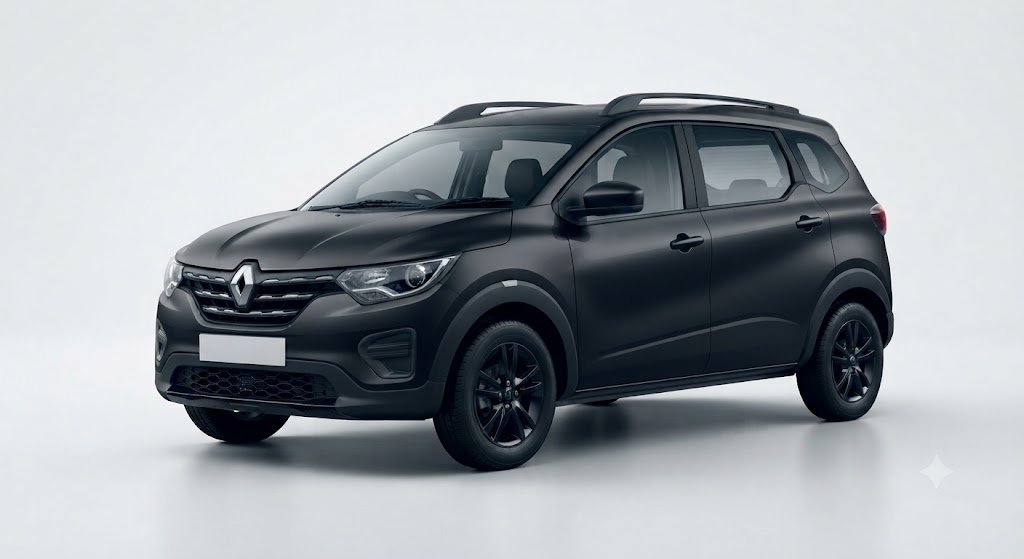
The Renault Triber has always stood out for offering impressive cabin flexibility and seven-seat practicality in a compact package. However, its naturally aspirated petrol engine was one area where the MPV left some buyers wanting more performance, particularly when carrying several passengers.
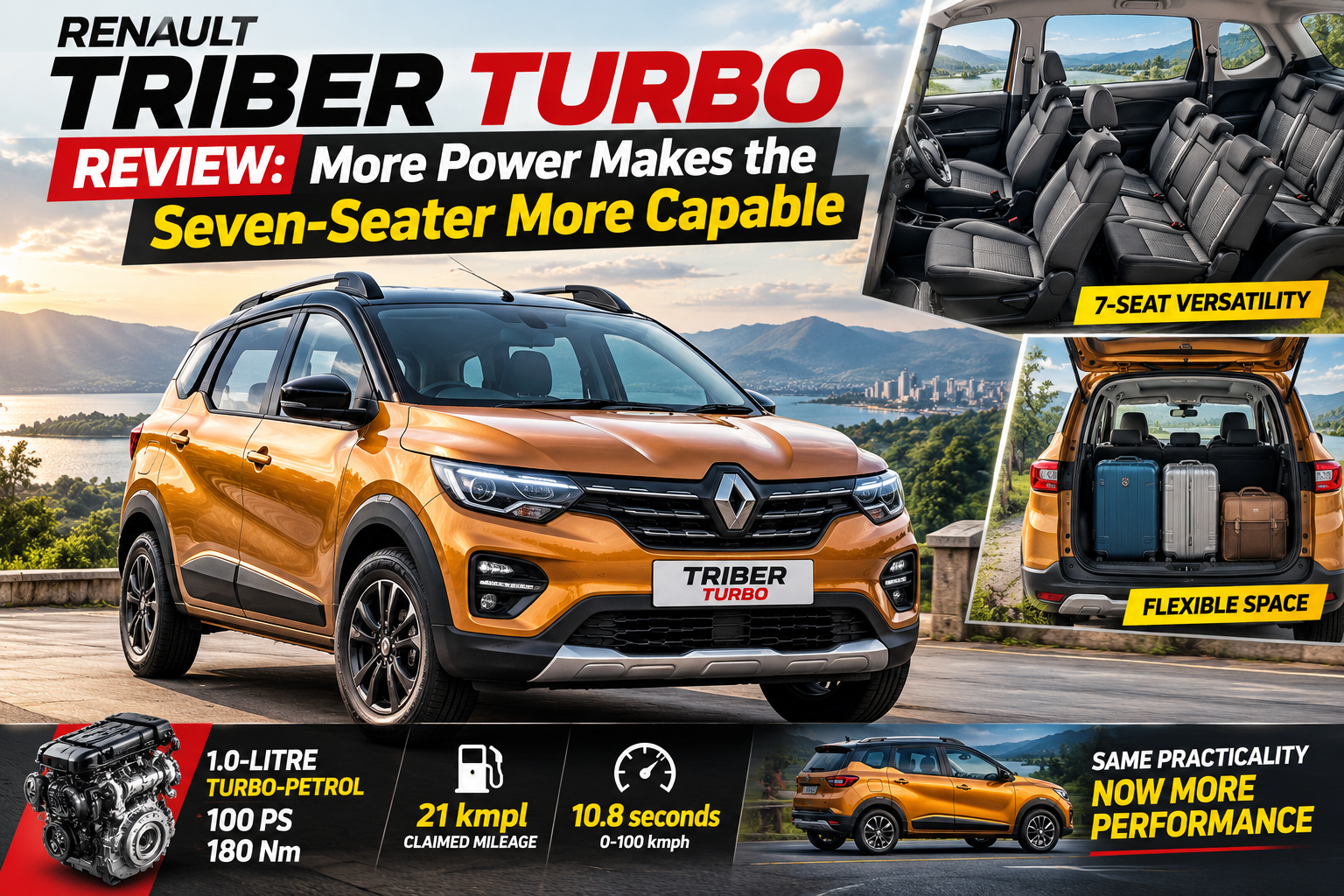
Renault has now addressed that limitation with the new Triber Turbo, which gets a 1.0-litre three-cylinder turbo-petrol engine, revised mechanical components and improved driving dynamics. The result is a Triber that retains its practical character while offering considerably stronger performance.
More Powerful Turbo-Petrol Engine
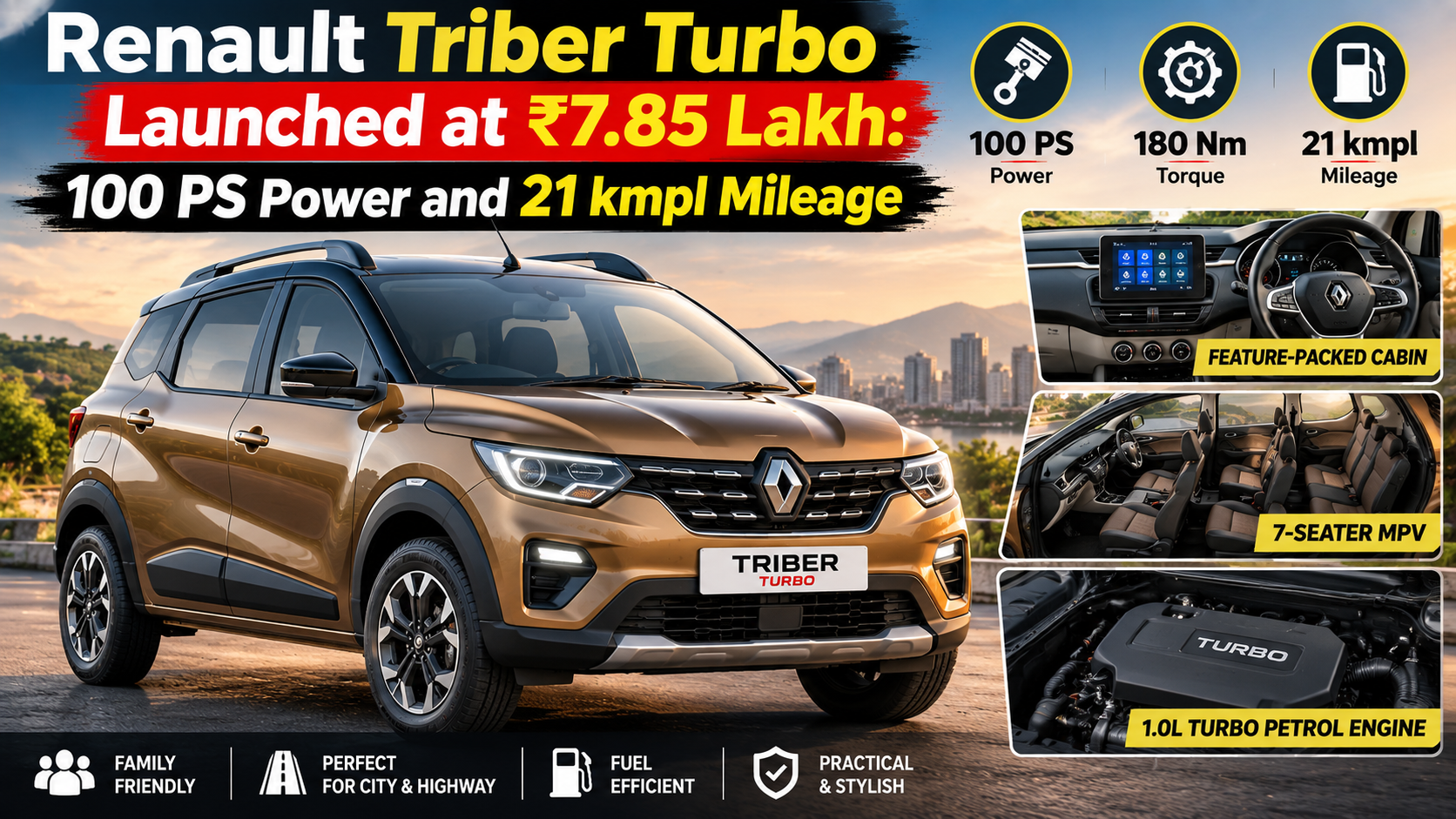
The biggest change comes under the bonnet. The new Triber Turbo uses a 1.0-litre three-cylinder turbocharged petrol engine producing around 100 PS and 180 Nm of torque. It is paired with a five-speed manual transmission.
The higher torque output is particularly important for a seven-seater. Compared with the naturally aspirated version, the additional pulling power makes the Triber more comfortable during acceleration, overtaking and climbing inclines.
Renault claims a 0-100 kmph acceleration time of 10.8 seconds, while the certified fuel-efficiency figure stands at 21 kmpl.
How Does the Triber Turbo Drive?
On the road, the additional torque changes the character of the Triber considerably. The naturally aspirated engine could feel strained when the vehicle was heavily loaded, but the turbocharged version has a stronger mid-range and requires fewer downshifts during everyday driving.
The turbo engine delivers its strongest response once it gets into its effective rev range. This makes the car feel more confident on highways, especially when overtaking or maintaining speed with passengers and luggage onboard.
There is still some turbo lag at lower engine speeds, particularly when starting from an incline or demanding immediate acceleration. However, once the turbo comes into its operating range, the engine delivers a more energetic and usable performance.
Revised Suspension and Driving Dynamics
Renault has not simply added a turbocharger and left the rest of the car unchanged. The Triber Turbo has been substantially re-engineered, with changes to its underlying architecture, suspension setup and braking calibration.
The car gets revised suspension geometry along with front and rear anti-roll bars and updated damping technology. Renault has also recalibrated systems such as ABS, electronic stability control and traction control for the turbocharged version.
These changes are designed to help the chassis handle the additional performance while maintaining the comfortable ride quality expected from a family-oriented MPV.
Seven-Seat Practicality Remains
One of the biggest strengths of the Triber has always been its flexible interior, and the Turbo version retains this feature.
The MPV continues to offer multiple seating configurations, allowing owners to adjust the cabin according to passenger and luggage requirements. The second row can be slid and reclined, while the third-row seats can be removed or configured to increase luggage capacity.
With the third row folded and the vehicle configured as a five-seater, Renault quotes up to 625 litres of boot space.
This means the stronger engine does not come at the expense of the Triber's core practicality.
Features and Safety
The Triber Turbo continues with a substantial equipment list for a compact MPV. Depending on the variant, buyers can get an 8-inch touchscreen infotainment system, wireless Android Auto and Apple CarPlay, a digital instrument cluster, wireless charging, automatic climate control, cruise control, automatic headlamps and rain-sensing wipers.
Safety equipment includes six airbags, ABS with EBD, electronic stability control, traction control, hill-start assist, ISOFIX child-seat mounts and tyre-pressure monitoring.
The turbo version also receives revised electronic safety-system calibration to suit its stronger performance.
Price and Variants
The Renault Triber Turbo is available in Evolution, Techno and Emotion variants. Prices start at approximately ₹7.84 lakh and go up to ₹8.99 lakh (ex-showroom).
The turbocharged versions command a premium over comparable naturally aspirated variants, but the additional performance and mechanical upgrades give buyers a substantially different driving experience.
Renault Triber Turbo: Key Specifications
|
Specification
|
Renault Triber Turbo
|
|
Engine
|
1.0-litre, 3-cylinder turbo-petrol
|
|
Maximum Power
|
100 PS
|
|
Maximum Torque
|
180 Nm
|
|
Transmission
|
5-speed manual
|
|
Claimed 0-100 kmph
|
10.8 seconds
|
|
Claimed Fuel Efficiency
|
21 kmpl
|
|
Seating Capacity
|
Up to 7 passengers
|
|
Maximum Boot Space
|
Up to 625 litres
|
|
Airbags
|
6
|
|
Ground Clearance
|
182 mm
|
|
Turbo Variants
|
Evolution, Techno, Emotion
|
What Has Improved?
The biggest improvement is clearly performance. The additional torque makes the Triber more suitable for families who regularly travel with several passengers or luggage.
The revised suspension and chassis tuning are also important because they help the vehicle make better use of the extra power. The Triber remains compact and easy to manoeuvre, while its highway ability has improved significantly.
However, buyers should still remember that this is a practical family MPV rather than a performance-focused car. Engine noise and some three-cylinder vibrations can become noticeable at higher revs, while the manual gearbox does not have the slickest feel.
The Renault Triber Turbo addresses one of the most obvious limitations of the original model without sacrificing the qualities that made the MPV popular.
Its 100 PS engine and 180 Nm torque provide a major improvement in everyday drivability, while the revised suspension and chassis changes give the car greater confidence at higher speeds.
Most importantly, Renault has managed to retain the Triber's key strengths: compact dimensions, flexible seating, generous practicality and seven-seat capability.
For buyers looking for a compact family vehicle but who previously felt the standard Triber lacked sufficient performance, the Turbo version brings a much stronger proposition. It is still focused on practicality rather than outright sportiness, but the additional performance makes the overall package considerably more capable.
 Khyati Sharma 2026-09-30