Royal Enfield Himalayan 750 Test Mules Spotted at UK Scrapyard, Raising Questions Over Prototype Disposal
The upcoming Royal Enfield Himalayan 750 continues to undergo extensive testing ahead of its expected introduction, with development motorcycles recently spotted at a scrapyard in the UK. The sight of several seemingly complete motorcycles at a vehicle disposal facility initially sparked speculation among enthusiasts, although the latest information suggests these could simply be retired development prototypes.
The Himalayan 750 is expected to become Royal Enfield's flagship adventure motorcycle and has already been spotted testing in both India and Europe on several occasions.
Multiple Royal Enfield Test Bikes Reportedly Sent for Disposal
Images recently surfaced showing multiple Himalayan 750 test motorcycles at what appears to be a vehicle recycling facility in the UK. According to a post shared in the Royal Enfield Himalayan 411 Facebook group, the motorcycles had reportedly arrived from Bruntingthorpe.
The post claimed that the scrapyard received as many as eight van loads of Royal Enfield motorcycles on the same morning. The motorcycles were described as pre-production or development units, with some reportedly showing virtually no mileage.
However, it has not been independently confirmed that all the motorcycles mentioned in the post were Himalayan 750 prototypes.
Bruntingthorpe is particularly relevant because Royal Enfield operates its UK Technology Centre at Bruntingthorpe Proving Ground in Leicestershire. The facility supports the company's global product development and testing activities alongside its operations in India.
Why Were the Prototypes Not Sold?
The sight of apparently usable motorcycles being prepared for disposal naturally led to questions about why they could not be sold, donated or dismantled for spare parts.
According to the person who visited the facility, the scrapyard operator reportedly said that the motorcycles or their individual components could not be removed or sold. Doing so could potentially breach the terms of the disposal contract.
This type of handling is not unusual for prototype vehicles. Development motorcycles can contain non-production components, prototype parts or specifications that have not been approved for road use. They may also have undergone extensive testing that places considerable stress on their mechanical and structural components, regardless of the mileage displayed on the odometer.
As a result, manufacturers commonly destroy or recycle development vehicles once their testing programmes are complete.
Himalayan 750 Development Continues
The presence of the Himalayan 750 prototypes at a disposal facility does not necessarily indicate any problem with the motorcycle's development. Instead, it could suggest that these particular test units have completed their intended role in the development programme.
Royal Enfield has been testing the Himalayan 750 extensively in different environments. The motorcycle is expected to sit above the Himalayan 450 in the company's adventure motorcycle range and could become its flagship adventure-tourer.
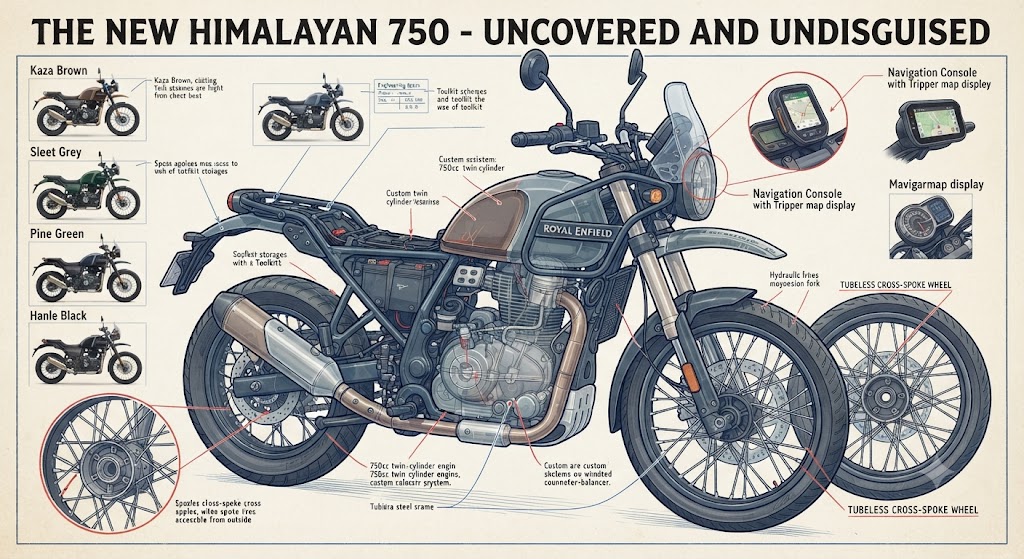
Previous spy shots have revealed several key elements of the upcoming motorcycle, including a larger parallel-twin engine, substantial fuel tank, tall windscreen and upright adventure-focused riding position.
The test motorcycles have also been spotted with USD front forks, monoshock rear suspension and twin front disc brakes. Royal Enfield appears to be evaluating different wheel and tyre combinations as development progresses.
New 750cc Twin-Cylinder Engine Expected
At the heart of the Himalayan 750 is expected to be a new around-750cc parallel-twin engine. The larger powertrain is likely to represent an evolution of Royal Enfield's existing 650cc twin-cylinder architecture.
The new engine could also serve as the basis for several other future Royal Enfield motorcycles, giving the manufacturer a larger-capacity twin-cylinder platform for its upcoming product portfolio.
Prototype Destruction Is Common Industry Practice
The reported disposal of the Himalayan 750 test motorcycles may look unusual to enthusiasts, but manufacturers regularly retire and destroy development vehicles after testing is completed.
Prototype motorcycles and cars can differ considerably from their final production versions. They may use experimental components, temporary bodywork or parts that were never intended for customer vehicles. This makes them unsuitable for conventional resale.
The same Facebook post also claimed that the same scrapyard handles development motorcycles from other manufacturers, including Triumph. That particular claim has not been independently verified.
For Royal Enfield enthusiasts, seeing several Himalayan 750 prototypes together at a scrapyard is certainly an unusual sight. However, their presence there could simply mark the end of their testing life rather than any setback for the upcoming Himalayan 750.

 Khyati Sharma 2026-08-18