Tata Aeris
5.29 Lakh*

 Khyati Sharma 2026-09-26

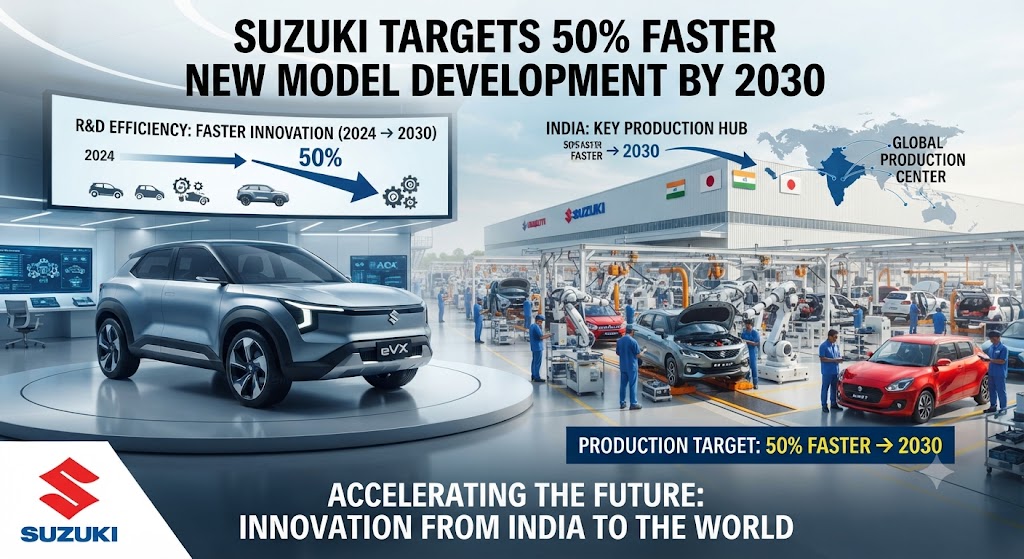
Suzuki Motor Corporation has announced a major change in the way it develops and manufactures vehicles, with the company targeting a 50% reduction in new vehicle development lead time by 2030. The move is part of Suzuki’s new “Technology Strategy 2026 for 10 Years Ahead” and is aimed at helping the automaker respond faster to changing customer requirements, regulations and market conditions.
Along with cutting development time by half, Suzuki plans to improve development efficiency by 30% and manufacturing efficiency by 50% by 2030. The targets are part of a wider effort to transform engineering and production processes rather than simply reducing costs.
Suzuki plans to change the traditional sequence in which different teams work on a vehicle. Instead of planning, design, production engineering, quality and procurement being handled largely one after another, these functions will increasingly work together from the early stages of a vehicle programme.
The company will also increase the use of digital engineering, simulation and modularisation. Shared components and engineering modules can help reduce duplicated development work while allowing different models to be adapted for individual markets.
This approach is particularly important as Suzuki expands its range of powertrain technologies. The company plans to continue developing petrol engines, CNG, hybrids, electric vehicles, flex-fuel and other carbon-neutral fuel technologies rather than relying on a single powertrain solution.
India is expected to play a major role in Suzuki’s global strategy. The company wants to strengthen India as a manufacturing and export hub, with annual production capacity targeted at approximately 4 million vehicles from fiscal 2030 onward.
For Maruti Suzuki, the faster development process could eventually mean shorter gaps between major model launches and updates. However, Suzuki’s 2030 target is a global development target, and the company has not disclosed the exact current development period against which the 50% reduction will be measured.
|
Area |
2030 Target |
|
New vehicle development lead time |
50% reduction |
|
Development efficiency |
30% improvement |
|
Manufacturing efficiency |
50% improvement |
|
India annual production capacity |
Approx. 4 million units |
|
Technology approach |
Multi-powertrain |
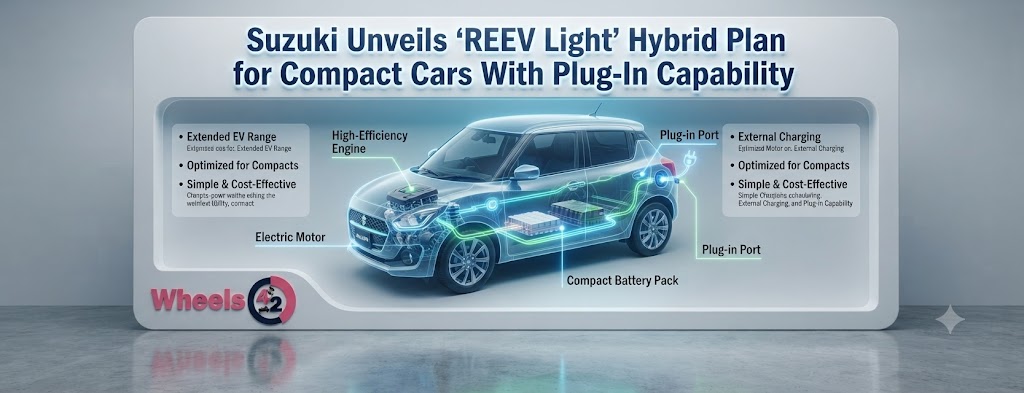
Suzuki says its future products will use technologies according to the requirements of individual markets. Among the technologies under development are series-hybrid systems, the Super Ene-Charge hybrid system, new direct-injection turbo engines, the lightweight S Light architecture and SDV Lite.
The company is also pursuing a “lean-battery” approach for EVs, with an emphasis on developing common battery systems while adapting battery cells to regional requirements.
For India, the strategy could be significant as Maruti Suzuki expands its product portfolio and strengthens the country’s role in Suzuki’s global manufacturing network. The combination of faster development, modular engineering and greater production capacity is designed to allow new Suzuki products to reach different markets more quickly.















Land Rover
₹83.90 - 98.75 Lakh