 Khyati Sharma 2026-10-01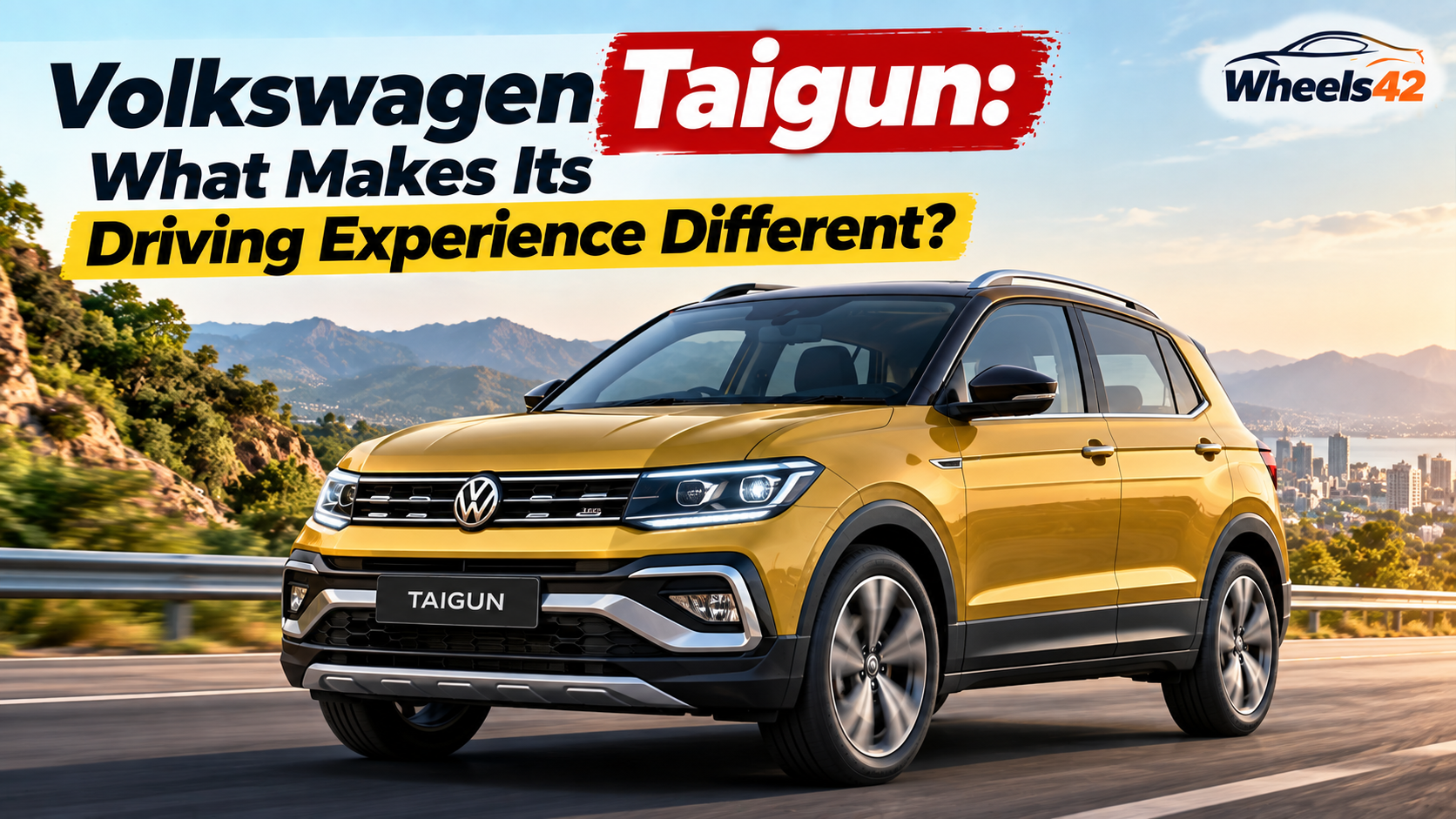
The Volkswagen Taigun is a midsize SUV that puts a strong focus on the experience behind the wheel. While modern SUVs often compete mainly on features, design and cabin technology, the Taigun also places considerable attention on performance, steering response and driving feel.
Its turbo-petrol engines, automatic transmission options and Volkswagen's chassis setup give it a character that is aimed at drivers who enjoy driving themselves rather than simply getting from one place to another.
So, what makes the Volkswagen Taigun's driving experience different?
The Taigun is currently offered with two TSI turbo-petrol engines.
The 1.0-litre TSI produces 115 PS and 178 Nm, while the larger 1.5-litre TSI develops 150 PS and 250 Nm.
The 1.0-litre engine is available with a 6-speed manual and an 8-speed automatic transmission. The 1.5-litre TSI is paired with a 7-speed DSG automatic.
The turbocharged engines provide their torque at relatively low engine speeds, helping the Taigun feel responsive during normal city driving and highway acceleration.
For buyers who spend most of their time in cities, the 1.0-litre TSI offers a useful combination of performance and practicality.
With 178 Nm of torque, the engine does not need to be pushed hard for normal acceleration. This can be helpful while moving through traffic, joining faster roads or overtaking slower vehicles.
The availability of an 8-speed automatic transmission also makes the 1.0 TSI easier to use in stop-and-go traffic. Volkswagen says the transmission is designed to provide smooth shifts and linear power delivery.
The more powerful option is the 1.5-litre TSI EVO.
It produces 150 PS and 250 Nm, making it the performance-oriented engine in the Taigun range. It is paired with a 7-speed DSG automatic transmission.
The engine also gets Active Cylinder Technology (ACT). Under suitable light-load conditions, the system can deactivate two cylinders to help improve efficiency while maintaining normal driving performance.
For someone who regularly drives on highways or enjoys stronger acceleration, this engine gives the Taigun a different personality from the smaller 1.0 TSI.
The Taigun uses electromechanical power-assisted steering and has a turning radius of 5.05 metres.
This setup is useful in everyday driving because the SUV remains manageable when making U-turns, entering parking spaces or negotiating tighter city roads.
At higher speeds, the driving experience is also designed around providing the driver with a more controlled feel. This is one of the areas where the Taigun's driving-focused character becomes more noticeable.
The Taigun uses McPherson suspension with a stabiliser bar at the front and a twist-beam axle at the rear.
The setup is intended to balance everyday comfort with controlled handling.
That means the Taigun is not simply designed to feel soft and relaxed. Instead, its suspension works with the steering and chassis to give the driver a more composed experience, particularly when the road becomes more interesting.
One interesting aspect of the Taigun range is that buyers can choose between different transmission types.
The 1.0 TSI comes with either a 6-speed manual or 8-speed automatic, while the 1.5 TSI uses a 7-speed DSG.
The manual can appeal to drivers who prefer more direct involvement, while the automatic versions are better suited to people who want convenience in daily traffic.
The DSG-equipped 1.5 TSI takes the performance-oriented approach further.
A focus on driving does not mean the Taigun ignores practicality.
The SUV measures 4,221 mm in length and 1,760 mm in width. It offers 385 litres of boot space, which can be expanded to as much as 1,405 litres when the rear seats are folded.
This makes it suitable for everyday family requirements, shopping trips and weekend travel.
The combination of a raised SUV seating position and compact-enough dimensions also makes it easier to use in urban conditions.
The latest Taigun also adds several features aimed at making driving easier and more enjoyable.
Depending on the variant, the SUV gets features such as a 10.1-inch infotainment system, 10.25-inch digital cockpit, voice assistant, front parking sensors and panoramic sunroof.
The technology is not the only reason to consider the Taigun, but it complements its driving-focused character by making everyday journeys more convenient.
Volkswagen says the new Taigun comes with a 5-star Global NCAP safety rating, six airbags as standard and more than 40 safety features.
The equipment includes systems such as Electronic Stability Control, Hill Hold Control, Multi-Collision Braking and front and rear parking sensors.
These features are particularly useful for buyers who want a combination of driving enjoyment and everyday family usability.
|
Specification |
1.0 TSI |
1.5 TSI |
|
Engine |
1.0-litre TSI |
1.5-litre TSI EVO |
|
Displacement |
999 cc |
1,498 cc |
|
Power |
115 PS |
150 PS |
|
Torque |
178 Nm |
250 Nm |
|
Transmission |
6MT / 8AT |
7-speed DSG |
|
Steering |
Electromechanical |
Electromechanical |
|
Turning Radius |
5.05 m |
5.05 m |
|
Boot Space |
385 litres |
385 litres |
The Volkswagen Taigun's driving experience is different because it puts the driver at the centre of the SUV's character.
The 1.0 TSI offers a practical balance of turbo-petrol performance and everyday usability, while the 1.5 TSI adds more power and the quick-shifting 7-speed DSG.
Its steering, suspension, turbocharged engines and range of transmission options give buyers the opportunity to choose how involved they want to be behind the wheel.
At the same time, the Taigun remains a practical five-seat SUV with useful boot space, modern technology and a strong safety package.
For buyers who want an SUV that combines daily practicality with a more driving-focused character, the Taigun continues to offer a distinct approach.