
 Khyati Sharma 2026-11-23
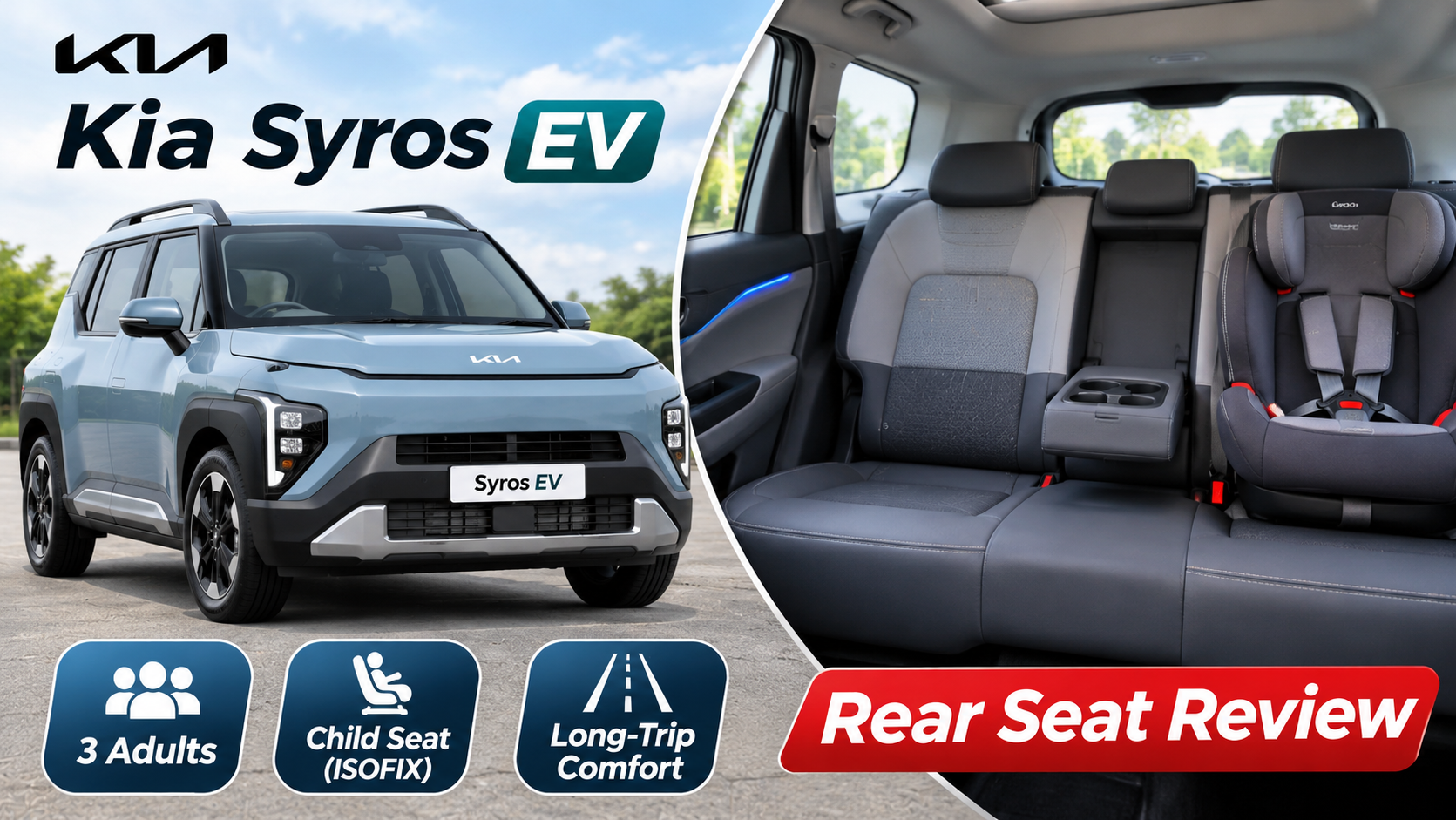
An electric car may offer impressive range, modern technology and low running costs, but family buyers often have another important question: how comfortable is the rear seat? For people who regularly travel with children, parents or friends, the second row can be just as important as the driving experience.
The Kia Syros EV aims to attract buyers who want a compact electric SUV with a practical cabin. Kia highlights its second-row space, sliding and reclining rear seats, rear-seat ventilation on selected variants, and a flexible luggage area. These features make it worth considering for families, but do they make it comfortable enough for three adults, a child seat and long journeys?
Rather than treating advertised features as proof of real-world comfort, this assessment looks at what the specifications suggest and what buyers should check during a test drive.
The Kia Syros EV brings an electric powertrain to Kia's compact SUV cars offering. Its cabin is designed around technology and everyday convenience, with a wide panoramic display, automatic climate control, rear AC vents and several passenger-focused features.
The SUV measures 3,995 mm in length, 1,805 mm in width and has a 2,550 mm wheelbase. These dimensions provide a useful starting point when considering cabin practicality. However, exterior measurements alone cannot tell us how comfortable the rear bench will be.
Kia cars also offers a rear-seat arrangement with sliding and reclining functionality on specified variants. This is particularly useful because families do not always need the same balance of passenger space and luggage capacity. On a daily school run, passengers may prefer more legroom, while a weekend trip may require additional boot space.
The Syros EV's family appeal therefore depends on how effectively its cabin features work together.
Three-adult seating is one of the most important tests for a family SUV. A vehicle may have enough space for two rear passengers but become uncomfortable when a third person occupies the middle position.
The Kia Syros EV has a bench-type rear seat. Its 1,805 mm overall width is a positive starting point, but that measurement includes the body and does not represent the actual seating width available to passengers.
For two adults, the rear cabin should be easier to use. Passengers can occupy the outer seating positions, where the seat shape and available support are generally more important than the middle-seat arrangement.
The situation changes when three adults travel together. The middle passenger may have less shoulder room and may need to sit closer to the other occupants. The comfort of this position also depends on the shape and cushioning of the centre section.
Buyers should check three things before deciding:
Whether all three passengers can sit without their shoulders pressing against each other.
Whether the middle passenger has enough foot space.
Whether the centre seating position offers sufficient cushioning and head support.
A short showroom visit may not reveal every limitation. Ask three adults of different heights to sit in the rear together. This will provide a much better idea of whether the vehicle can handle regular five-person journeys.
Our assessment: The Syros EV appears better suited to two adults travelling in the rear. Three adults may be manageable for shorter journeys, but families should physically check shoulder room and middle-seat comfort before treating it as a regular five-person touring vehicle.

For families with young children, child-seat compatibility can be more important than the number of adults the rear bench can accommodate.
Kia lists ISOFIX rear anchors as part of the Syros EV's safety equipment. ISOFIX mounting points help compatible child seats attach securely to the vehicle without relying only on the seat belt for installation.
This is useful for parents who regularly move between home, school and other destinations with a young child.
However, the presence of ISOFIX does not automatically mean every child seat will fit easily. Child seats come in different sizes and designs. Rear-facing seats, in particular, can occupy considerable space and may affect the position of the front passenger seat.
Before purchasing, parents should bring their actual child seat to the dealership and check the following:
Whether the ISOFIX connectors are easy to reach.
Whether the child seat locks securely into place.
Whether the front passenger seat can maintain a comfortable position.
Whether the child seat interferes with the neighbouring rear passenger.
Whether the seat belt and top-tether arrangements match the child-seat manufacturer's instructions.
The Syros EV also lists child locks and rear occupant alert among its safety features. These are useful additions for families, although parents should always check the exact equipment on their chosen variant.
Which EV Charger Is Right for Your Car? AC, DC and CCS2 Explained
One of the Syros EV's most practical cabin features is its sliding and reclining rear-seat arrangement on specified variants.
A fixed rear bench gives passengers one seating position. A sliding seat offers more flexibility. Passengers can move the second row to create additional legroom, while moving it forward can free up more space for luggage.
The reclining function can also make a difference during longer journeys. A more relaxed backrest angle may help passengers find a comfortable seating position, particularly when travelling for several hours.
This flexibility is useful for families with different needs. Parents may want to keep the rear seats farther back when children are travelling. When the family carries more luggage, the seats can be adjusted to create a better balance between passenger and cargo space.
Kia also lists a 60:40 split rear-seat arrangement on selected variants. This allows one section of the rear seat to be folded while the other remains available for a passenger.
Buyers should remember that the exact seat functions and equipment can vary by variant. Check the version being considered rather than assuming every Syros EV gets the same rear-seat configuration.
Rear-seat comfort is not only about legroom. Cabin temperature can have a major effect on the experience, particularly during hot Indian summers.
The Kia Syros EV lists rear AC vents, allowing air-conditioning to reach passengers in the second row. This is an important convenience feature for families who regularly travel with children or older passengers.
Selected higher variants also offer rear-seat ventilation. Kia describes ventilation for the second row, with the exact specification depending on the trim. This feature can improve comfort by helping circulate air through the seat surface.
It is important to distinguish between rear AC vents and ventilated seats. AC vents distribute cooled air through the cabin, while ventilated seats provide airflow through the seat itself. They serve different purposes and are not interchangeable.
During a test drive, passengers should check whether the rear vents deliver sufficient airflow and whether their position makes them easy to use. Also check whether the rear-seat ventilation controls are convenient and whether the feature is included in the selected variant.
For families living in warmer parts of India, these details can make everyday journeys more comfortable.
How Does an Electric Car Work? EV Basics Explained, and Why Buyers Should Know Them
A family car needs to perform well beyond short city journeys. Weekend drives, holidays and visits to relatives can put greater demands on rear-seat comfort.
The Syros EV has several features that could make longer journeys more pleasant. The sliding and reclining rear seats offer flexibility, while rear AC vents help maintain cabin comfort. The centre armrest with cup holders on specified variants can also make the second row more convenient for passengers.
However, long-trip comfort depends on more than the feature list.
Seat cushioning, thigh support, backrest angle and shoulder room all matter when passengers remain seated for several hours. Families should also consider how easily passengers can enter and exit the rear cabin, especially when a child seat is installed.
Another important factor is luggage space. Kia lists boot capacity figures of up to 465 litres, depending on the configuration and seat position. The rear-seat sliding arrangement can help owners balance passenger room and luggage requirements.
For an actual family holiday, it is worth checking whether the boot can accommodate suitcases, a stroller and smaller travel bags without forcing passengers into uncomfortable seating positions.
Electric-car trip planning is another consideration. The Syros EV's official specifications highlight a claimed range of up to 526 km under the ARAI MIDC cycle, depending on the version. Real-world range will vary with speed, weather, traffic, air-conditioning use, passenger load and driving style.
Families travelling long distances should plan charging stops and check charging availability along their route instead of relying entirely on the certified range figure.
|
Feature |
Kia Syros EV Details |
Family Benefit |
|
Overall width |
1,805 mm |
Useful starting point for rear passenger space |
|
Wheelbase |
2,550 mm |
Helps define the cabin's packaging |
|
Rear seating |
Bench-type rear seats |
Accommodates up to three rear passengers |
|
Seat adjustment |
Sliding and reclining on specified variants |
Allows adjustment of legroom and seating position |
|
Seat split |
60:40 on specified variants |
Offers flexibility for passengers and luggage |
|
Child-seat support |
Rear ISOFIX anchors |
Helps install compatible child seats |
|
Rear AC vents |
Available |
Helps cool the second row |
|
Rear-seat ventilation |
Available on selected variants |
Adds comfort in hot weather |
|
Centre armrest |
Available on specified variants |
Adds convenience for rear passengers |
|
Boot capacity |
Up to 465 litres, depending on configuration |
Useful for family luggage |
A comfortable rear seat is only one part of family practicality. Luggage capacity can become equally important when travelling with children.
The Kia Syros EV offers a boot capacity of up to 465 litres in specified configurations. The available space can vary with the rear-seat position and version.
For daily use, this should be useful for shopping bags, school equipment and smaller luggage. A family holiday may require more careful packing, particularly if parents carry a stroller, extra clothes and other child-related items.
The sliding rear seat is helpful here. Moving it forward can create additional luggage room, although this reduces the space available to rear passengers.
The 60:40 split arrangement also provides flexibility when carrying longer objects. One section can be folded while another passenger continues to use the rear seat.
Families should test the boot with their own luggage rather than relying only on the advertised capacity. A showroom demonstration with a stroller and two or three travel bags can reveal whether the layout suits their routine.

The Syros EV's rear-seat equipment makes it worth considering for different family situations, but not every feature will matter equally to every buyer.
For a small family with one child, the ISOFIX anchors, rear AC vents and adjustable rear seats are particularly useful. Parents can install a compatible child seat and adjust the seating arrangement according to their luggage requirements.
For a family with older children, rear-seat space, charging convenience and long-distance comfort may become more important. The panoramic display and connected technology add to the cabin experience, but passengers will still care most about seating comfort.
For a family that regularly travels with three adults in the second row, the middle-seat position deserves special attention. It should not be assumed that a compact SUV will provide comfortable three-adult seating simply because it has a five-seat layout.
The most sensible approach is to test the vehicle with the people who will actually use it.
Before booking the Kia Syros EV, families should spend enough time evaluating the rear cabin. A quick look at the showroom vehicle may not reveal whether it suits everyday requirements.
Here is a practical checklist:
1. Test with three adults
Ask three adults to sit in the second row. Check shoulder room, knee space, foot placement and the comfort of the middle position.
2. Install your child seat
Bring the actual child seat and check ISOFIX access, installation, front-seat clearance and the comfort of the neighbouring passenger.
3. Adjust the rear seats
Try the sliding and reclining functions. Check how much extra legroom is available and how much boot space is lost when the seats move backwards.
4. Check rear air-conditioning
Sit in the second row with the AC running. Check airflow, vent positioning and whether rear passengers can remain comfortable.
5. Try a longer sitting position
Spend several minutes in the rear seat rather than simply sitting down and getting out. Check thigh support, backrest angle and headroom.
6. Load family luggage
Try placing a stroller, suitcase and everyday bags in the boot. This will help establish whether the available cargo space is sufficient.
An EV With a Flat Traction Battery Can Be Jump-Started Like a Petrol Car: Myth or Fact?
The Kia Syros EV has several features that support its family-car ambitions. Rear-seat sliding and reclining functionality, ISOFIX anchors, rear AC vents and a flexible luggage area are all useful additions.
Its strongest appeal may be for small families who need a comfortable daily electric SUV with occasional long-distance use. Parents with young children should appreciate the child-seat mounting provisions, while rear passengers can benefit from the available comfort equipment on higher variants.
However, families who regularly travel with three adults in the rear should not make a decision based only on the vehicle's exterior width or five-seat configuration. The actual comfort of the middle seat needs to be checked.
The same applies to child-seat compatibility. ISOFIX is a useful feature, but the fit of a particular child seat depends on its design and the available cabin space.
The Kia Syros EV looks promising as a family-oriented electric SUV because it combines adjustable rear seating, child-seat mounting points and passenger-focused convenience features. Its rear AC vents and available seat ventilation also strengthen its appeal for Indian conditions.
For two adults or a parent travelling with children, the second row appears to offer a practical set of features. Three adults may be comfortable for shorter journeys, but a proper seating test is necessary before relying on it for regular long-distance travel.
Ultimately, the Syros EV's rear seat could be one of its important family advantages. The deciding factor will be how well its space and seating arrangement work for the people who will use it every day.