
 Khyati Sharma 2026-11-20
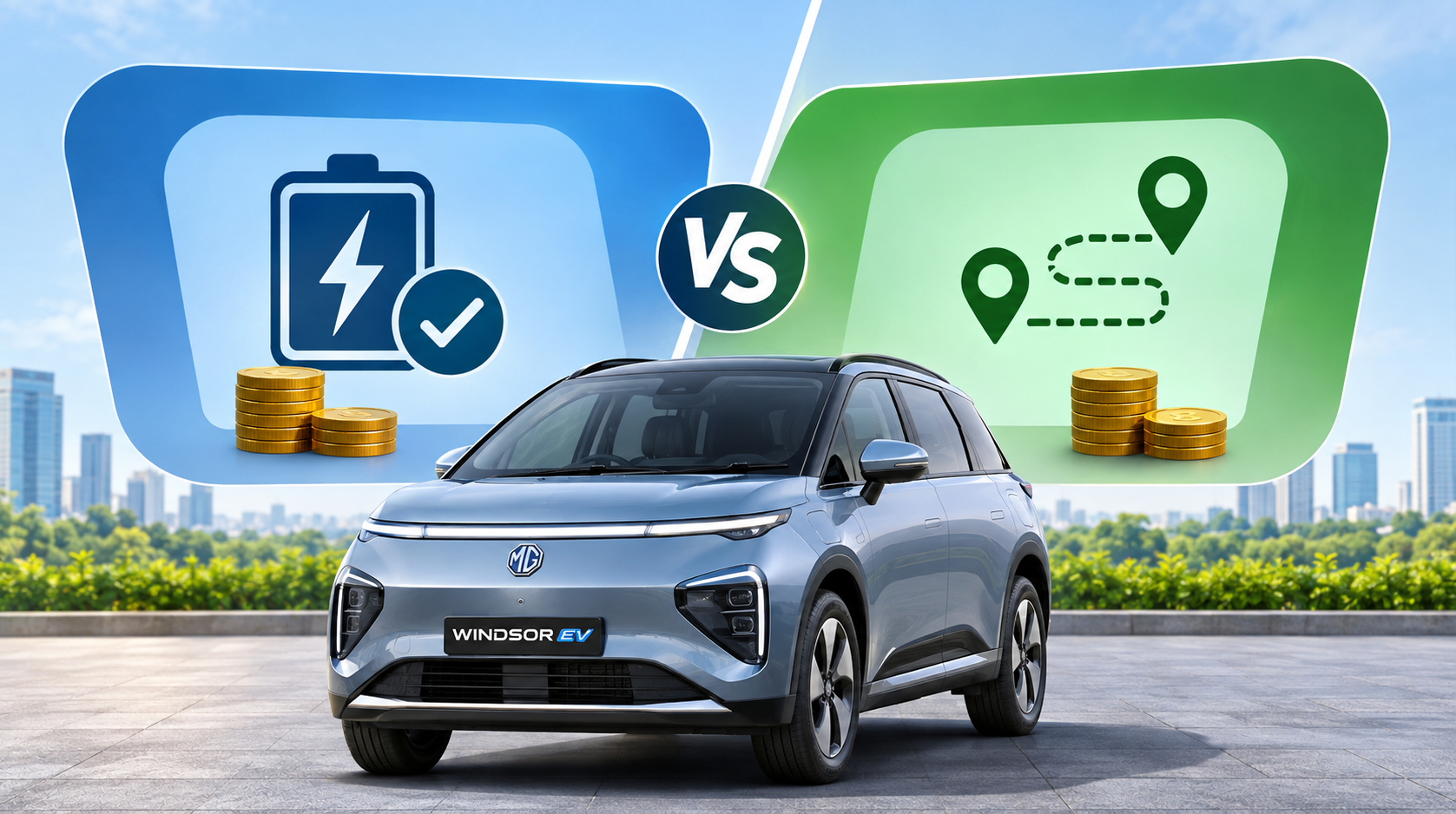
The MG Windsor EV has introduced a different approach to electric car ownership in India through its Battery-as-a-Service (BaaS) programme. Instead of purchasing the car along with its battery, buyers can pay a lower upfront amount for the vehicle and separately pay for battery usage on a per-kilometre basis. This arrangement makes the initial purchase more affordable, but it also raises an important question: Is paying for every kilometre better than purchasing the battery outright?
For customers planning to buy the MG Windsor EV, choosing between these two ownership methods can significantly affect long-term expenses. Drivers covering shorter monthly distances may benefit from the lower initial investment, while people who drive extensively need to calculate how much they will eventually spend on battery rental.
The decision becomes particularly important for customers who plan to keep their electric car for five to eight years. Although BaaS reduces the initial purchase price, recurring battery payments can gradually add up. On the other hand, purchasing the battery requires a higher initial investment but removes the separate per-kilometre battery rental.
A Short Drive Fully Recharges a Completely Flat Car Battery – Myth or Fact?
MG Motor introduced its Battery-as-a-Service ownership programme with the Windsor EV to make electric mobility more accessible. Under this arrangement, the customer purchases the vehicle without paying the full battery cost upfront. Instead, battery usage is charged separately according to the kilometres driven.
The biggest advantage of this arrangement is the reduced initial purchase price. Customers can bring home the Windsor EV at a lower entry cost and pay for battery usage over time.
For the 38kWh battery variants, the current advertised BaaS pricing starts at approximately Rs 9.99 lakh, with battery usage charges of Rs 3.99 per kilometre. The larger 52.9kWh battery variants have separate pricing, with battery usage charges starting at Rs 4.50 per kilometre.
These payments are separate from the electricity required to charge the vehicle.
MG also works with financing partners to provide different BaaS arrangements. Minimum monthly kilometre commitments and other financing conditions can vary between plans. Therefore, customers should check the exact agreement before selecting this ownership method.

The second option is purchasing the MG Windsor EV with its battery included in the vehicle price.
Under this arrangement, buyers pay a higher upfront amount but do not have to pay a separate battery rental charge for every kilometre driven.
The main advantage is straightforward ownership of the vehicle and its battery. Once the purchase is completed, owners only need to consider expenses such as electricity, insurance, servicing, tyres and other maintenance requirements.
The Windsor EV is available with 38kWh and 52.9kWh battery options, depending on the variant. The smaller battery is designed for customers who primarily need an electric vehicle for everyday commuting, while the larger battery offers a higher claimed driving range.
MG advertises a certified range of up to 449km for the larger battery versions. Actual driving range will depend on traffic, driving style, air-conditioning usage, road conditions and temperature.
Buying the battery outright can be attractive for customers who regularly cover long distances and want to avoid recurring battery usage payments.
New Car Buying Guide: 7 Steps to Choose the Right Car in India
The difference between the two ownership options becomes clear when comparing their initial prices.
For an entry-level 38kWh Windsor EV, the advertised BaaS price starts at approximately Rs 9.99 lakh, while the corresponding regular ex-showroom price is approximately Rs 14.85 lakh.
This creates an initial price difference of around Rs 4.86 lakh.
|
Particulars |
BaaS Option |
Battery Purchase |
|
Approx. vehicle price |
Rs 9.99 lakh |
Rs 14.85 lakh |
|
Battery ownership |
Separate service arrangement |
Included |
|
Battery usage charge |
Rs 3.99/km |
Nil |
|
Charging expense |
Additional |
Additional |
|
Initial investment |
Lower |
Higher |
The BaaS option reduces the initial investment by approximately Rs 4.86 lakh in this example. However, customers need to pay Rs 3.99 for every kilometre covered under the applicable plan.
This means the initial saving should be compared with the total battery rental accumulated over the ownership period.
Monthly driving distance is one of the most important factors when choosing between BaaS and outright battery ownership.
At the advertised battery usage rate of Rs 3.99 per kilometre, the rental expense increases with every additional kilometre driven.
Here is an estimated monthly battery rental calculation for different driving distances.
|
Monthly Distance |
Battery Rental at Rs 3.99/km |
|
500 km |
Rs 1,995 |
|
1,000 km |
Rs 3,990 |
|
1,500 km |
Rs 5,985 |
|
2,000 km |
Rs 7,980 |
|
2,500 km |
Rs 9,975 |
|
3,000 km |
Rs 11,970 |
These figures represent battery rental only and exclude electricity, vehicle financing and other ownership expenses.
MG's BaaS FAQ estimates charging expenses at approximately Rs 1 per kilometre, although actual electricity costs depend on the charging location, tariff and charging efficiency.
For example, a customer driving 1,500km every month could spend approximately Rs 5,985 on battery usage and another estimated Rs 1,500 on charging.
The combined estimated energy-related expense would be around Rs 7,485 per month.
However, this is not a universal fixed monthly bill because the applicable financing plan may include a minimum kilometre commitment.

To understand the long-term difference, let's calculate how much battery rental a Windsor EV owner would pay over five years.
For this comparison, we are using the 38kWh battery option and an indicative BaaS rate of Rs 3.99 per kilometre.
Scenario 1: Driving 500km Every Month
Customers covering approximately 500km monthly will accumulate 30,000km over five years.
At Rs 3.99 per kilometre, total battery rental would be approximately Rs 1,19,700.
Compared with the initial saving of approximately Rs 4.86 lakh, the BaaS option retains a substantial nominal cost advantage over this period.
However, buyers must check whether their financing partner allows actual usage-based billing without a higher minimum monthly commitment.
An EV Battery Must Be Replaced as Soon as Its Warranty Expires: Myth or Fact?
Scenario 2: Driving 1,000km Every Month
For customers driving 1,000km monthly, the total distance over five years reaches 60,000km.
The battery rental calculation becomes:
60,000 × Rs 3.99 = Rs 2,39,400.
Even after paying approximately Rs 2.39 lakh in battery rental, the accumulated rental remains below the initial purchase-price difference of approximately Rs 4.86 lakh.
This makes BaaS worth considering for moderate-distance users, provided the plan's other conditions are suitable.
Scenario 3: Driving 1,500km Every Month
At 1,500km per month, the vehicle will cover 90,000km in five years.
Total battery rental:
90,000 × Rs 3.99 = Rs 3,59,100.
The rental expense becomes considerably higher, but it remains below the initial price difference in this simplified calculation.
This driving category is important because some MG financing partners specify a minimum monthly running commitment of 1,500km, while other plans offer actual usage-based billing.
Customers should carefully compare the available agreements.
Scenario 4: Driving 2,000km Every Month
Customers driving 2,000km every month will cover approximately 1,20,000km over five years.
Total battery rental:
1,20,000 × Rs 3.99 = Rs 4,78,800.
At this level, cumulative battery rental comes very close to the initial price difference of approximately Rs 4.86 lakh.
For high-mileage drivers, purchasing the battery outright becomes increasingly attractive, particularly when the car is expected to remain in use for many years.
|
Monthly Running |
5-Year Distance |
Total Battery Rental |
|
500 km |
30,000 km |
Rs 1,19,700 |
|
1,000 km |
60,000 km |
Rs 2,39,400 |
|
1,500 km |
90,000 km |
Rs 3,59,100 |
|
2,000 km |
1,20,000 km |
Rs 4,78,800 |
|
2,500 km |
1,50,000 km |
Rs 5,98,500 |
|
3,000 km |
1,80,000 km |
Rs 7,18,200 |
The calculations show that the difference between the two ownership options becomes smaller as monthly driving distance increases.
At approximately 1,21,754km of cumulative driving, battery rental at Rs 3.99 per kilometre equals the indicative initial price difference of Rs 4.86 lakh.
This is a simple mathematical break-even point, not a guaranteed financial break-even date.
Are Electric Cars Really Worth It? EV Myths and Facts Explained
Both ownership options have different advantages, and the right choice depends on driving requirements, financial planning and the period for which the vehicle will be retained.
When BaaS Makes More Sense
The BaaS programme can be attractive for customers who want to reduce their initial investment.
People who drive relatively fewer kilometres may prefer paying for battery usage instead of purchasing the complete battery upfront.
It can also help customers who want to enter the EV market without committing a large amount of money at the time of purchase.
However, the minimum kilometre conditions, financing charges and agreement duration must be considered before making a decision.

When Buying the Battery Makes More Sense
Outright battery ownership may be more suitable for people who regularly cover long distances.
Customers travelling 2,000km or more every month can accumulate significant battery rental expenses over five years.
Buying the complete vehicle also makes the ownership arrangement more straightforward because there is no separate per-kilometre battery usage payment.
For customers planning to retain their Windsor EV for a long period, this option deserves serious consideration.
Battery warranty is another important factor when comparing the two options.
MG advertises a lifetime battery warranty for the first owner of the Windsor EV, subject to the applicable warranty terms and conditions. Buyers should verify the coverage applicable to their selected variant and ownership plan.
Under BaaS, the battery is covered through the separate service and financing arrangement. Customers should understand who is responsible for battery performance, replacement conditions, accidental damage and other battery-related expenses.
Resale is also worth considering. The BaaS arrangement involves a separate battery agreement, and transferring the vehicle may require settlement of outstanding financial obligations and compliance with the financing partner's conditions.
Outright battery ownership can provide a simpler ownership structure when selling the vehicle, although the resale value will still depend on the battery's health, vehicle condition, age and market demand.
How to Compare Car Variants: Base vs Mid vs Top Trim
The MG Windsor EV's Battery-as-a-Service programme provides an alternative way to purchase an electric car in India. It lowers the initial investment and allows customers to pay for battery usage according to the applicable per-kilometre plan.
However, the lower upfront price does not automatically mean lower overall ownership costs.
For customers driving around 500km to 1,000km monthly, BaaS can be an appealing option because the accumulated battery rental may remain substantially below the initial price difference over five years.
For customers driving approximately 1,500km monthly, both options deserve consideration, particularly after checking minimum usage requirements and financing conditions.
For high-mileage drivers covering 2,000km or more every month, outright battery ownership becomes increasingly competitive because the recurring battery rental can approach or exceed the initial saving.
Ultimately, buyers should not make the decision based only on the starting ex-showroom price. Monthly running distance, ownership duration, financing charges, battery warranty and resale conditions all matter.
The MG Windsor EV offers flexibility through both ownership approaches, allowing buyers to select the arrangement that best suits their driving habits and financial plans.





Volkswagen
₹10.71 - 20.61 Lakh