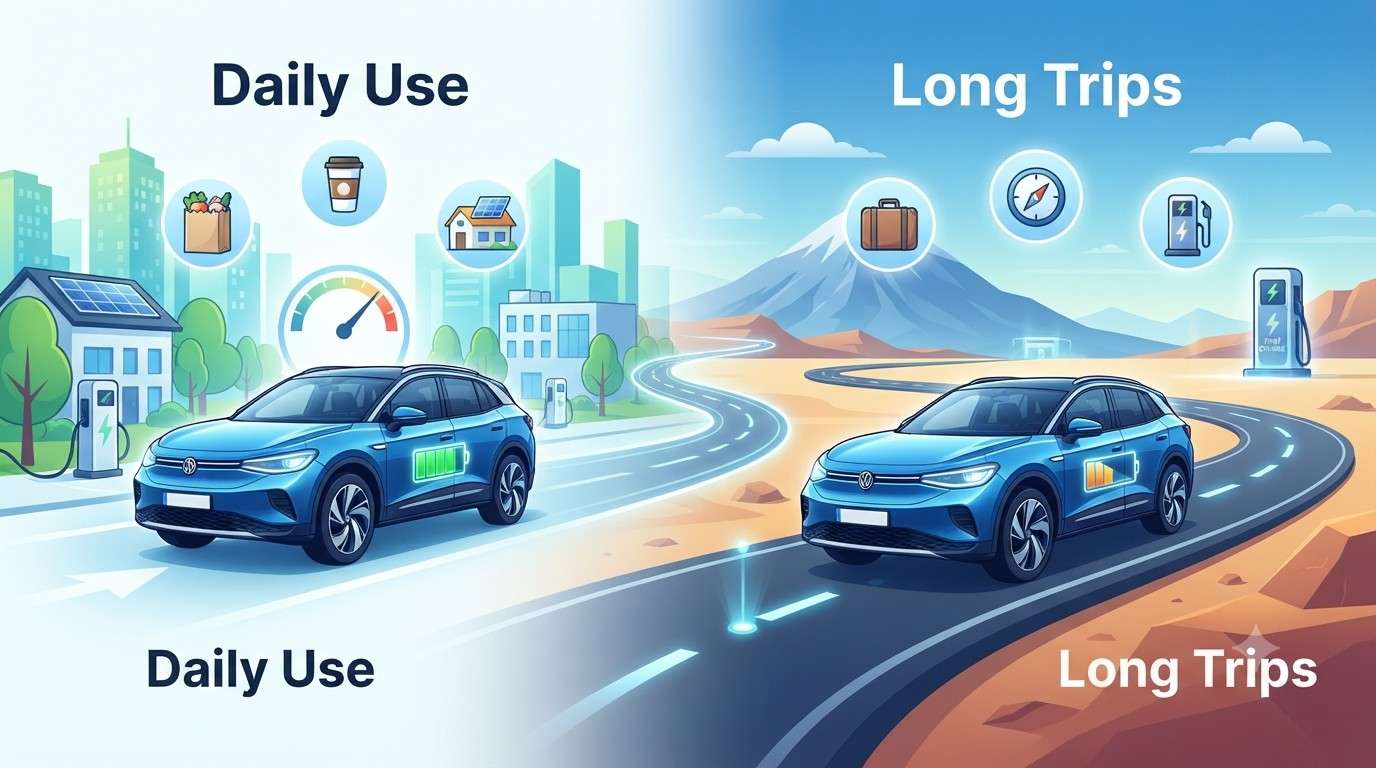
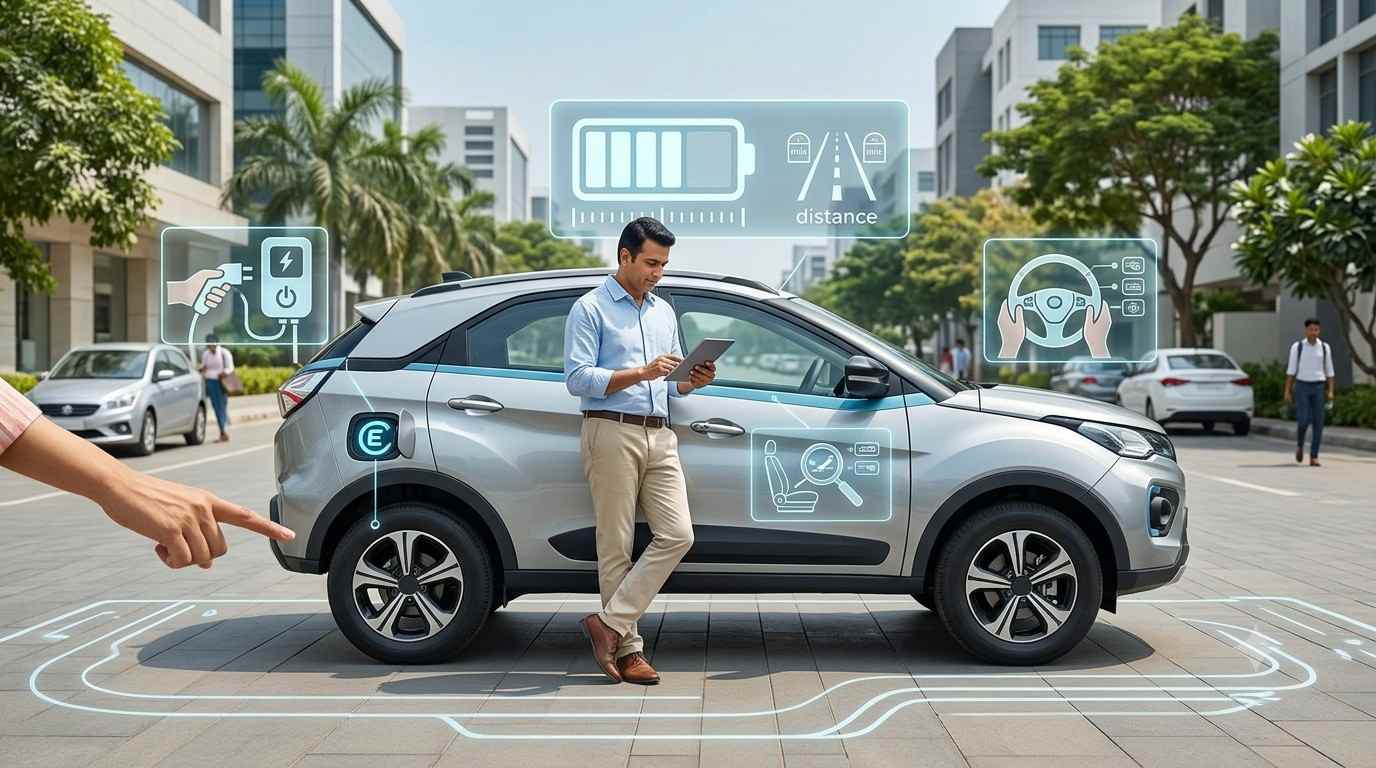
Quick answer: For most Indian city drivers travelling 30–60 km daily, around 150–200 km of real-world EV range can be enough with overnight home charging. If you frequently travel between cities, look for around 300–400 km of real-world range, along with reliable DC fast chargers on your routes.
But buying an EV with the longest advertised range isn't always the smartest decision.
Your daily commute, longest regular journey, charging access and driving conditions matter more than the number printed in a brochure. A compact EV can handle everyday travel comfortably, while a larger-battery model makes more sense for frequent highway journeys.
Here's how to calculate the range you actually need.
How Much EV Range Do You Need for Daily Use?
For most urban drivers, 150–200 km of real-world range can be sufficient for daily travel, provided they can charge regularly at home or work.
Your longest driving day matters more than your average commute. Someone who drives 30 km to work and back needs less range than someone who regularly covers 80–100 km across different parts of the city.
Use this table as a starting point:
| Daily driving |
Suggested real-world range |
| Up to 30 km |
120–160 km |
| 30–60 km |
150–200 km |
| 60–100 km |
200–250 km |
| Frequent highway journeys |
300–400 km |
These are practical Wheels42 buying guidelines, not minimum technical requirements. They assume regular charging and some flexibility for unexpected journeys.
Which Indian EVs fit different range requirements?
Independent road tests help put these numbers into perspective. Here are three examples from published Autocar India range tests.
| Electric car |
Advertised range |
Tested real-world range |
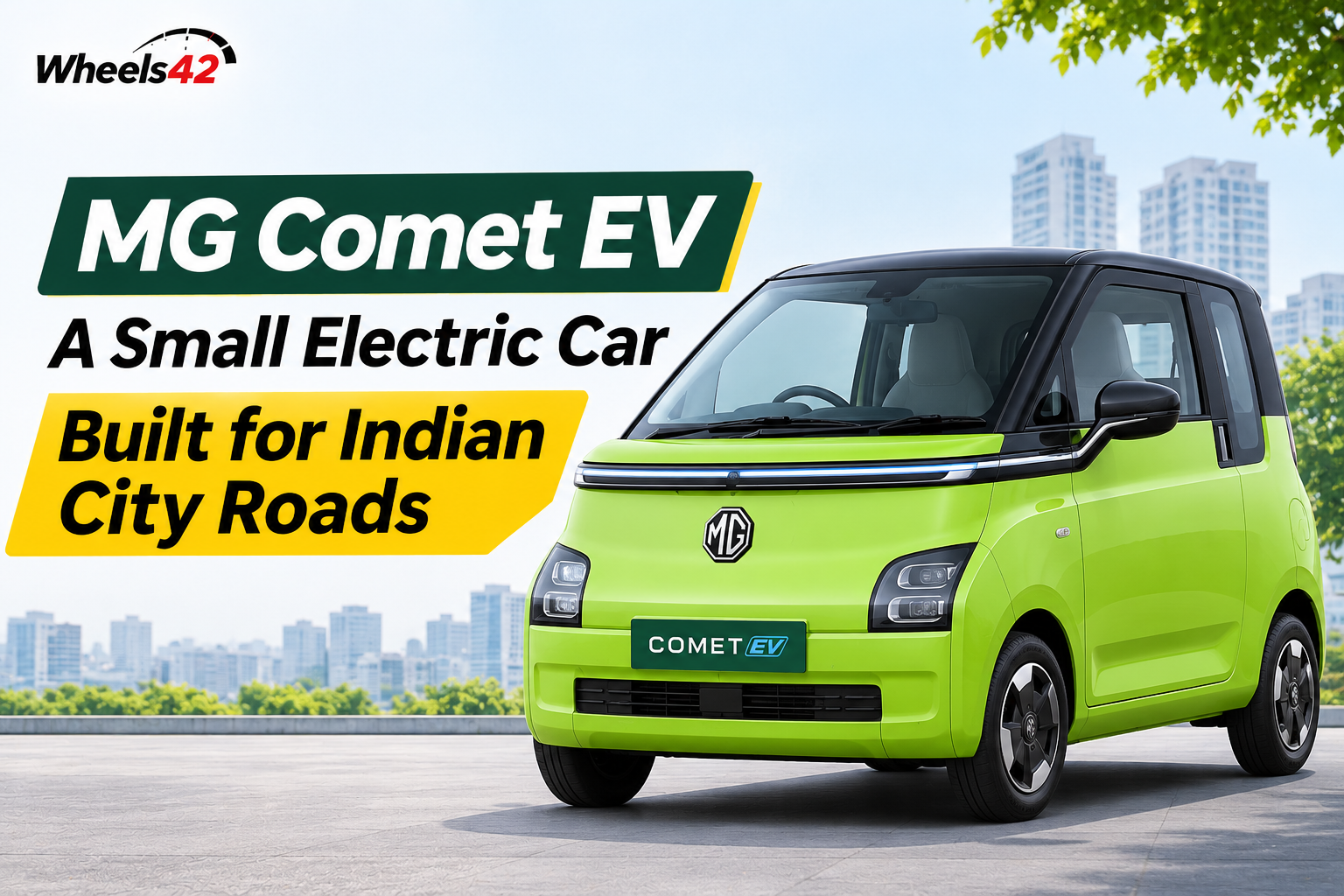
| MG Comet EV (17.3 kWh) |
230 km |
193 km |
| MG Windsor EV (38 kWh) |
332 km |
308 km |
| Tata Nexon EV 45 |
489 km |
350 km |
Figures are from published tests of the specified versions, not guaranteed results for every owner or driving condition.
The MG Comet EV is worth considering for shorter city journeys, while the Windsor EV offers more flexibility for mixed city and highway driving. The Nexon EV 45 provides a longer tested range for buyers who travel more frequently.
Notice the difference between the advertised and tested figures. This is why checking how real-world EV range differs from the manufacturer's claim should be part of your buying decision.
How to Calculate the EV Range You Actually Need
You don't need a complicated formula. Start with your actual driving habits.
Step 1: Find your longest regular driving day
Track your kilometres for two or three weeks. Include office travel, school drop-offs, shopping, weekend outings and regular family visits.
For example, your office commute might be 35 km, but your total daily driving could reach 60 km when you include other activities.
Use the longer figure.
Step 2: Add a practical safety margin
Add around 20% to your longest regular daily distance.
Example:
-
Longest regular driving day: 70 km
-
Additional 20% margin: 14 km
-
Planned range requirement: 84 km
An EV with 150 km of real-world range would comfortably cover this routine with overnight charging.
Step 3: Check the real-world range of the exact variant
Look for independent tests rather than relying only on ARAI or MIDC-certified figures. Test results should mention the route, average speed, air-conditioning use, passenger load and driving mode.
Step 4: Check how frequently you can charge
A 180 km EV can be practical when you can charge every night. The same car may become inconvenient if you depend entirely on public charging stations.
So, don't calculate range without considering where the vehicle will be parked and charged.
Why Does an EV Deliver Less Range Than Advertised?
Real-world range changes because an electric car uses different amounts of energy under different conditions.
The biggest factors include:
-
Highway speed: Air resistance increases at higher speeds, which can reduce range.
-
Air conditioning: Cooling the cabin and managing battery temperature consume energy.
-
Passengers and luggage: Extra weight increases the energy required to move the car.
-
Tyre pressure: Under-inflated tyres increase rolling resistance.
-
Road conditions: Hills, rough surfaces, headwinds and traffic diversions affect efficiency.
-
Battery condition: Gradual capacity loss reduces the energy available for driving.
A car that delivers 350 km in moderate conditions might deliver less when fully loaded and driven at high highway speeds. That difference doesn't automatically indicate a battery problem.
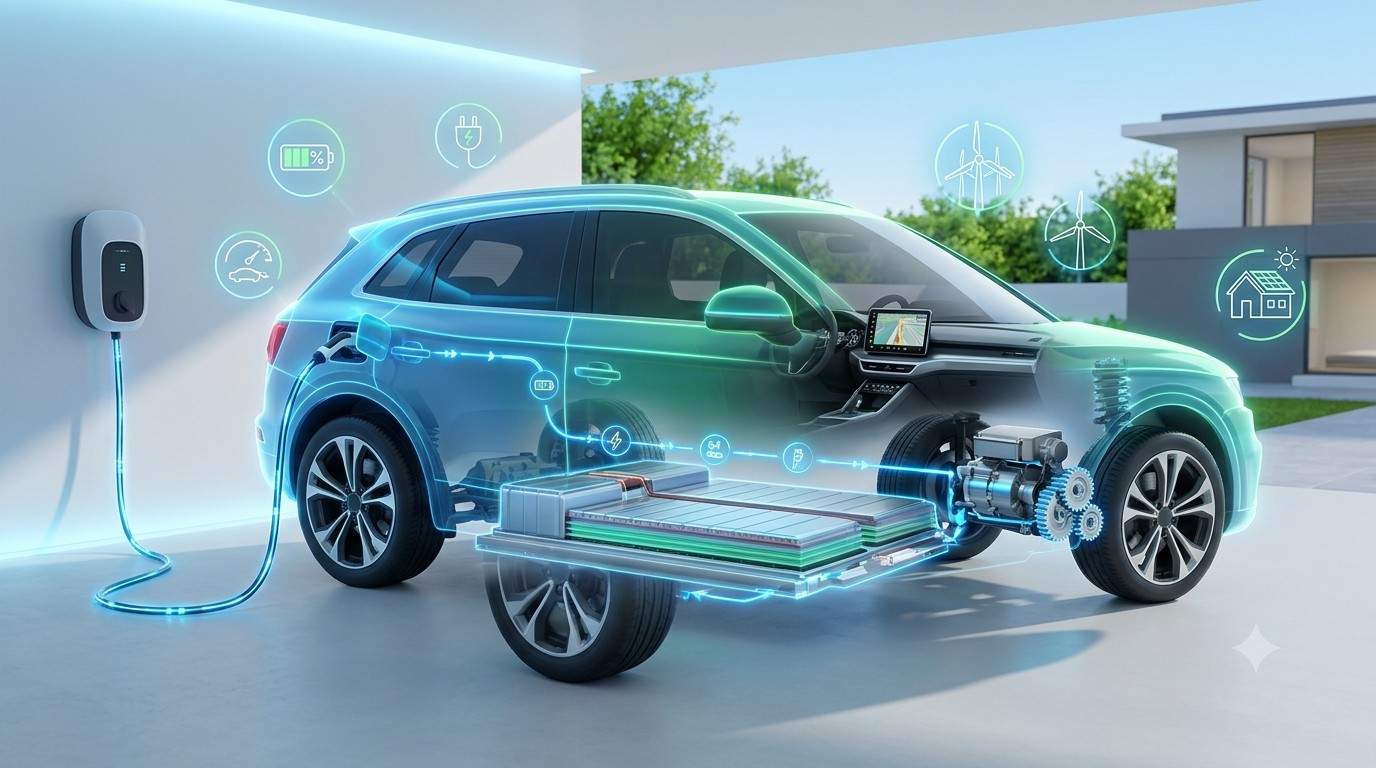
Does battery chemistry affect EV range and battery life?
Yes. Two common battery chemistries used in electric cars are LFP and NMC.
| Factor |
LFP |
NMC |
| Full form |
Lithium Iron Phosphate |
Nickel Manganese Cobalt |
| Energy density |
Generally lower |
Generally higher |
| Thermal stability |
Generally higher |
Generally lower than LFP |
| Common advantage |
Thermal stability and cycle life |
More energy in a given weight or space |
| Important consideration |
Larger pack may be needed for similar range |
Requires good thermal and battery management |
For example, the MG Windsor EV uses an LFP battery, while the Hyundai Creta Electric's 51.4 kWh version uses NMC chemistry, according to published automotive technical reports.
Neither chemistry is immune to ageing. High temperatures can accelerate battery degradation in lithium-ion batteries, which makes battery cooling and temperature management particularly important in Indian summers.
A liquid-cooled battery pack, effective Battery Management System (BMS) and sensible charging habits can help control operating conditions. Don't judge a car's battery life by chemistry alone.
What is battery State of Health (SoH), and why does it matter?
State of Health, or SoH, estimates how much usable battery capacity remains compared with when the battery was new.
For example, if a battery originally had 40 kWh of usable capacity and its measured capacity falls to 36 kWh, its approximate capacity-based SoH is 90%.
However, there is no reliable India-wide rule saying that every EV should have a particular SoH after five years. Usage, cooling, climate, charging habits and battery design all affect the result.
For a used EV, request an authorised battery diagnostic report. Check the reported SoH, usable capacity, remaining warranty and any battery-related fault history.
Tata's published warranty terms, for example, specify a 70% SoH capacity threshold for certain eligible private EV models during their warranty period. This is a warranty coverage threshold, not a claim that 70% is normal battery health for a used car.
How Much EV Range Do You Need for Long Trips?
If you frequently travel between cities, a real-world range of 300–400 km gives you more flexibility.
But battery size isn't the only deciding factor. The distance between working, compatible fast chargers can be just as important.
Suppose one electric car offers 400 km of range but has no dependable charging station along your regular route. Another offers 300 km but has multiple compatible DC fast chargers available. The second car may be easier to use.
How much usable range do you have on a highway?
You shouldn't plan a journey around consuming the entire battery. Keep an arrival reserve and calculate how far you can travel within your preferred charging window.
Use this formula:
Usable trip range = Real-world full-charge range × Usable battery percentage
For example, consider an EV with a tested real-world range of 350 km.
| Calculation |
Value |
| Estimated full-charge range |
350 km |
| Starting battery level |
90% |
| Planned arrival reserve |
15% |
| Usable battery percentage |
75% |
| Estimated usable trip range |
262.5 km |
This means you can plan approximately 262 km between charging points under similar driving conditions.
It's still an estimate. Allow for extra margin when you expect high speeds, hills, heavy loads or uncertain road conditions.
Case Study: Is the Tata Nexon EV 45 Enough for Daily and Highway Driving?
Let's take a published real-world range test and apply it to a typical Indian owner's driving pattern.
Autocar India tested the Tata Nexon EV 45, which has a 45 kWh battery and an ARAI-claimed range of 489 km. The publication recorded approximately 350 km of mixed city and highway range.
Its test included two occupants, recommended tyre pressures and climate control set to 22°C. The vehicle was driven on a fixed route covering Mumbai and adjoining state highways.
This is an independent published test, not a Wheels42 road test.
Consider this owner's driving pattern
Imagine an owner who:
-
Drives 45 km every weekday.
-
Covers around 225 km during a five-day working week.
-
Makes a 260 km one-way intercity journey once a month.
-
Has access to overnight home charging.
For daily use: The tested 350 km range is comfortably above the owner's weekday requirements. Regular home charging makes the daily routine manageable.
For highway travel: The 260 km journey needs more attention. Starting at 90% and keeping a 15% arrival reserve gives an estimated usable range of 262.5 km.
That leaves almost no room for a diversion, higher-speed driving or unexpected traffic conditions. A planned charging stop is the sensible choice.
What does this case study tell us?
An EV can be excellent for everyday commuting but still need a charging stop on an intercity journey.
Buyers should assess these two driving patterns separately rather than assume a car suitable for daily use will automatically handle every highway trip without charging.
EV Charging Infrastructure in India: Where It Stands and What's Next
India's public EV charging network is growing, but its coverage and usefulness still vary between cities and highway routes.
According to the Ministry of Heavy Industries, data from the BHEL portal showed the following figures in its 21 July 2026 update:
| Public charging infrastructure |
Reported number |
| Total public EV charging stations |
52,718 |
| Stations equipped with fast chargers for cars |
16,561 |
These two figures are different categories. Not every public charging station is a DC fast charger suitable for an electric passenger car.
What is the government doing to improve charging access?
The PM E-DRIVE scheme has earmarked ₹2,000 crore for public EV charging infrastructure.
A Ministry of Heavy Industries factsheet reported that ₹851 crore had been approved for deploying 8,147 chargers through three oil marketing companies and ten states, as of 28 September 2026.
These are approved deployment figures, not proof that all 8,147 chargers are already installed and operational. The scheme is scheduled to continue until 31 March 2028.
The Ministry of Power's 2024 charging infrastructure guidelines also provide a framework for expanding public charging access, including facilities along highways and in urban areas.
What does this mean for future EV buyers?
The next stage isn't just about adding more charging stations. Drivers need reliable equipment, compatible connectors, transparent pricing and better coverage on routes between cities.
More chargers are expected through government-supported deployment and private operators, but buyers shouldn't depend on a station that is only announced or approved.
Before purchasing an EV, check your regular routes using the e-AMRIT charging station locator. Confirm the connector, charging power and current availability through the operator's app, and keep an alternative stop in your plan.
For everyday ownership, access to a dependable home or workplace charger remains valuable. For highway travel, the location and reliability of public DC fast chargers become equally important.
How to Choose the Right EV Range for Your Lifestyle
Your final choice should depend on how you use the car, not just its battery size.
| Your driving situation |
What to look for |
| Short city commutes, daily home charging |
Compact EV with around 150–200 km real-world range |
| Mixed city driving and regular errands |
Around 200–250 km real-world range |
| Frequent city and highway use |
Around 300–400 km real-world range |
| Long highway journeys |
Longer tested range and dependable DC fast-charging access |
| No home or workplace charging |
Check public charging access before selecting battery size |
Consider a larger battery when you regularly drive long distances, encounter large gaps between charging stations or cannot charge conveniently at home.
But if your travel is predictable and your charging access is good, a smaller battery can save you money without affecting everyday convenience.
And when highway trips are frequent but charging access remains limited, compare an EV with a strong hybrid before deciding. Our guide explains which car makes more sense for city and highway driving: electric, hybrid or petrol.
You can also compare electric cars listed on Wheels42 by their battery sizes, advertised range and specifications.
Frequently Asked Questions About EV Range
1. Does frequent DC fast charging reduce an EV battery's life?
Frequent DC fast charging can contribute to faster battery degradation compared with regular AC charging, depending on the battery, temperature and charging conditions. It doesn't mean that using a fast charger occasionally will damage the battery. Use home AC charging for routine needs where practical, and follow the manufacturer's charging recommendations.
2. Does driving an EV during the Indian monsoon reduce its range?
Rain can affect energy consumption through wet road conditions, slower traffic, detours, air-conditioning and demisting. However, there's no single fixed percentage by which every EV loses range during the monsoon.
Waterlogging is a bigger concern than the range reduction itself. Follow your vehicle's specified wading limits, and never assume that a waterproof battery pack makes deep-water driving safe. Mahindra's EV owner manuals, for example, warn against driving through deep water and recommend authorised inspection when a vehicle has been submerged.
3. How do I check the actual battery health before buying a used EV?
Ask an authorised service centre for a battery diagnostic report. Check the reported State of Health, available usable capacity, battery fault history and remaining warranty. Also take a test drive with the air conditioning on and compare the energy consumed against the distance travelled. A dashboard range estimate alone isn't enough to judge battery condition.
4. Why does my EV show a different estimated range every time I charge it to 100%?
The dashboard range estimate is based partly on recent energy consumption and driving patterns. If you drove slowly in city traffic during the previous few trips, it may show a higher range. After several high-speed highway journeys, the estimate may decrease. This does not automatically mean the battery has lost capacity.
5. Will carrying a full family and luggage reduce highway range significantly?
It can. Extra weight increases the energy needed to accelerate and climb hills, while high speeds and air-conditioning add further demand. Before a long family trip, check tyre pressure, luggage load and the expected charging points. Use a more conservative range estimate than you would for a lightly loaded city commute.
Final Verdict: What EV Range Is Right for You?
For most Indian drivers with home charging, 150–200 km of genuine real-world range can cover everyday city travel. Frequent highway drivers should consider around 300–400 km, but dependable fast-charging access matters just as much.
Don't pay extra simply to get the highest advertised range. Calculate your longest regular journey, check independent range tests, understand battery condition and study the charging network on your actual routes.
The best EV isn't the one that travels the farthest on paper. It's the one that covers your daily routine and long trips without making you worry about your next charging stop.
Sources and technical references