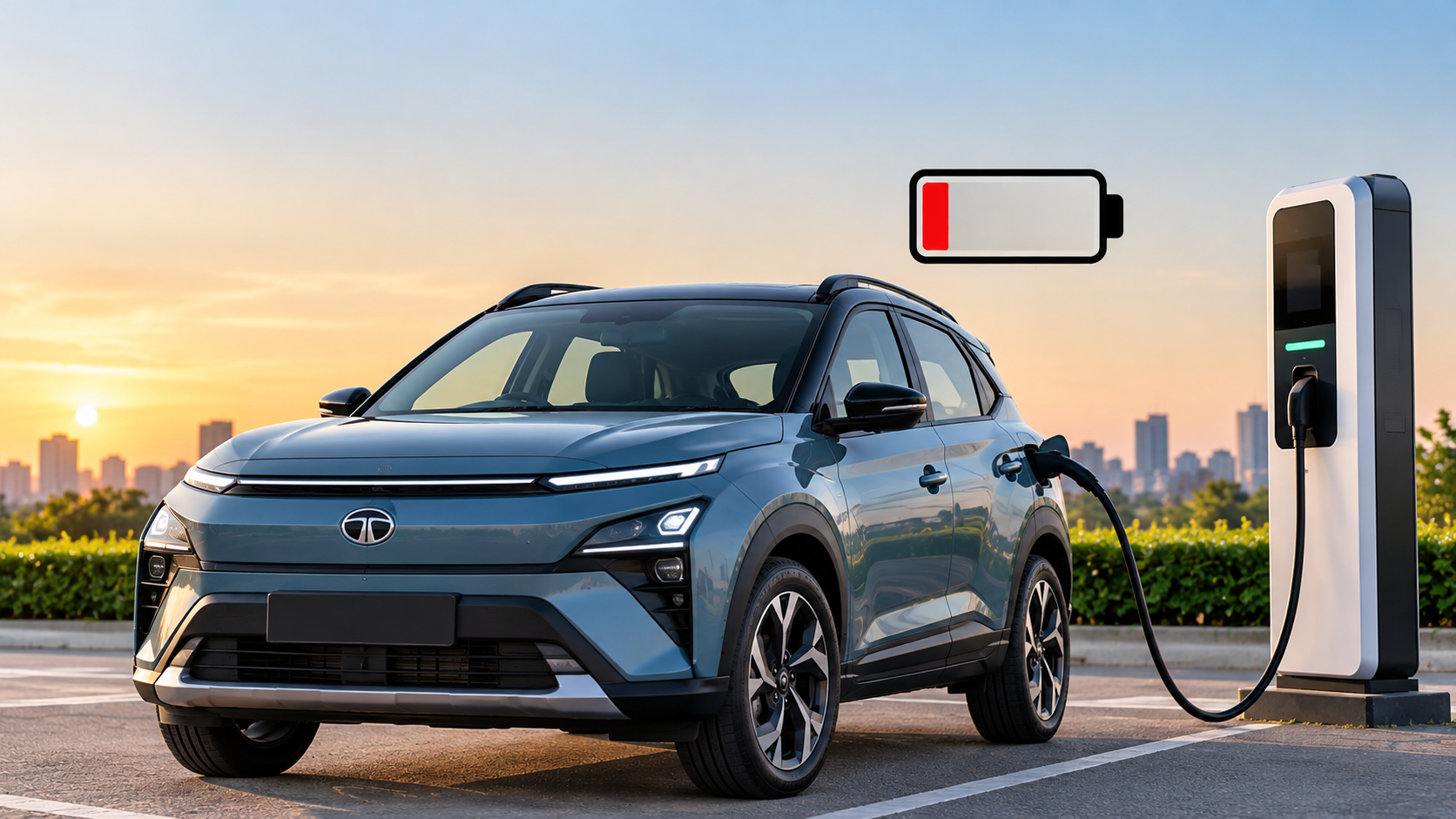
A completely discharged electric vehicle (EV) traction battery cannot be jump-started like a petrol car. While some EVs allow jump-starting when their smaller 12-volt battery goes flat, the main high-voltage battery requires proper charging equipment. Understanding the difference can help drivers avoid costly damage and handle unexpected breakdowns safely.
Electric vehicles are becoming increasingly popular in India as buyers look for lower running costs, quieter driving and alternatives to petrol and diesel cars. However, EV ownership also introduces new questions about battery maintenance, charging and roadside emergencies.
One common misconception is that an electric car with a completely flat battery can be restarted using jumper cables, just like a conventional petrol car. Although jump-starting is possible in certain EV situations, the answer depends on which battery has discharged.
Electric cars generally have two separate battery systems: a high-voltage traction battery that powers the electric motor and a low-voltage battery, commonly rated at 12 volts, that operates essential electrical systems. These batteries perform different functions and require different solutions when they run out of power.
Understanding this distinction is essential for EV owners, especially when their vehicle refuses to start or displays a low-battery warning.
Car Waiting Period: How to Get Your New Car Faster
Is It Possible to Jump-Start an EV With a Flat Traction Battery?
Myth: An EV with a completely discharged traction battery can be jump-started just like a petrol car.
Fact: A flat high-voltage traction battery cannot be restored through a conventional jump-start. It needs to be recharged using compatible EV charging equipment.

In a petrol car, a jump-start can supply enough electrical power to operate the starter motor and start the engine when the conventional 12-volt battery is discharged. Once the engine is running, the alternator helps recharge the battery.
An electric vehicle works differently. Its electric motor receives energy from a large traction battery, which is designed to store substantial amounts of electrical energy. Depending on the model, this battery may operate at several hundred volts.
Connecting jumper cables to another vehicle cannot replenish the energy stored in this high-voltage battery. The cables and conventional 12-volt battery are not designed to recharge the EV's main battery pack.
If the traction battery reaches a very low state of charge, the vehicle may display a warning, restrict performance or eventually stop being able to drive. The appropriate response is to connect it to a compatible charging station or arrange professional roadside assistance if charging is not possible.
Understanding the Two Batteries in an Electric Car
|
Feature
|
High-voltage traction battery
|
12-volt auxiliary battery
|
|
Main purpose
|
Powers the electric motor
|
Powers low-voltage electrical systems
|
|
Typical voltage
|
Several hundred volts, depending on the model
|
Usually 12 volts
|
|
Main components supported
|
Electric propulsion and associated high-voltage systems
|
Lights, locks, computers and control electronics
|
|
Can conventional jumper cables recharge it?
|
No
|
Sometimes, following the manufacturer's instructions
|
|
Correct solution when discharged
|
Compatible EV charging equipment
|
Approved jump-start procedure or battery replacement, as required
|
The traction battery is the main energy source of an EV. It stores the electricity needed to drive the vehicle and is usually the most expensive battery system in the car.
The 12-volt battery, meanwhile, supports control modules, lighting, door locks, displays and other electrical components. It also helps the vehicle's electronic systems start up and activate the high-voltage system.
This explains why an EV can refuse to enter its ready-to-drive mode even when its traction battery still has plenty of charge: the auxiliary battery may have discharged.
Hatchback vs Sedan vs SUV: Which Car Type Suits You Best?
What Happens When an EV's 12-Volt Battery Goes Flat?
A discharged 12-volt battery can cause several problems that may initially appear to indicate a major EV failure.
The vehicle might not unlock normally, its dashboard may remain blank, or it may display electrical system warnings. In some cases, the car will not enter its ready-to-drive mode even though the main battery is charged.
Certain electric vehicles allow the auxiliary battery to be jump-started using an approved 12-volt booster battery or portable jump starter.
However, the exact procedure varies by manufacturer and model. Some vehicles specify particular positive terminals and grounding points, while others impose restrictions on jump-starting or towing.
For example, the Nissan Ariya owner's manual explains that jump-starting supplies power to the 12-volt system but does not charge the lithium-ion traction battery. The vehicle must have sufficient traction-battery charge before it can be driven.
Therefore, EV owners should consult the vehicle's owner's manual before attempting any jump-start. If the procedure is unclear, contacting an authorised service centre is the safer option.
Why Jump-Starting an EV Incorrectly Can Be Dangerous
Electric vehicles contain high-voltage components, sophisticated power electronics and battery-management systems. Incorrectly connecting jumper cables or attempting to access high-voltage components can create serious safety risks.
A conventional 12-volt jump-start may be permitted on a particular EV, but that does not mean the same procedure is suitable for every electric car.
Potential risks include:
-
Damage to sensitive electronic control units.
-
Damage to the DC-DC converter or other electrical components.
-
Short circuits caused by incorrectly connected cables.
-
Battery overheating or leakage.
-
Electric shock if high-voltage components are handled improperly.
-
Injury from sparks or a damaged auxiliary battery.
The high-voltage traction battery should never be opened or serviced by an untrained person. These systems require specialist equipment and appropriately trained technicians.
Owners should also avoid using an EV as a booster vehicle for another car unless the manufacturer explicitly permits the intended procedure. Many EVs are not designed to provide the current required to jump-start a conventional vehicle.

What Should You Do When an EV Runs Out of Battery?
If your EV stops because its traction battery is depleted, follow a different procedure from the one used for a petrol car.
1. Stop in a safe location
If the vehicle displays a low-battery warning, move to a safe location as soon as possible, where permitted and practical. Avoid stopping in a dangerous traffic lane or another location where the vehicle could create a hazard.
Switch off unnecessary electrical accessories if the manufacturer's instructions recommend doing so.
2. Check the remaining battery charge
Look at the vehicle's displayed state of charge and any battery-related warning messages. A low auxiliary battery and a depleted traction battery can produce different symptoms, so do not assume that every failure to start is caused by the main battery.
If the vehicle has completely stopped responding, avoid repeated attempts to activate it without understanding the cause.
3. Find a compatible charging station
If the traction battery is depleted, arrange charging using equipment compatible with the vehicle's charging port and specifications.
Depending on the vehicle, this may involve an AC charging point or a suitable DC fast charger. Charging time will depend on the battery size, charger output, temperature and vehicle charging limits.
4. Arrange roadside assistance if necessary
If the vehicle cannot reach a charging point, contact the manufacturer's roadside assistance service or a qualified EV recovery provider.
Tell the recovery team that the vehicle is electric and that its traction battery may be depleted. Follow the manufacturer's instructions for recovery and transportation.
Some EVs require a flatbed transporter or a specific towing procedure to prevent drivetrain damage. Never assume that an EV can be towed with its driven wheels rolling on the road.
5. Investigate recurring battery problems
If the EV repeatedly refuses to start despite having traction-battery charge, the 12-volt battery or another electrical component may require inspection.
An authorised technician can test the auxiliary battery, examine the charging system and identify potential faults.
EV Traction Battery vs Petrol Car Battery: Key Differences
|
Situation
|
Petrol or diesel car
|
Electric vehicle
|
|
Main driving energy source is depleted
|
Requires fuel to operate
|
Requires traction-battery charging
|
|
12-volt battery is discharged
|
Jump-starting may help
|
Jump-starting may help if the manufacturer permits it
|
|
Conventional jump-start restores the main energy source
|
No; it only helps start the engine
|
No; it does not recharge the traction battery
|
|
Charging while driving
|
Alternator replenishes the 12-volt battery
|
A DC-DC converter generally supplies and replenishes the low-voltage system when the EV is operating
|
|
Recovery after running out of driving energy
|
Refuel the vehicle
|
Charge the traction battery or arrange suitable recovery
|
Can an EV Recharge Its Own Battery While Driving?
Electric vehicles use regenerative braking to recover some energy when the vehicle slows down. During deceleration, the electric motor can operate as a generator and send energy back to the traction battery.
However, regenerative braking does not provide a way to recover from a completely depleted battery without an external energy source. It recovers only part of the energy that would otherwise be lost during braking.
Similarly, the DC-DC converter in an EV generally converts energy from the high-voltage battery to supply the low-voltage electrical system and charge the auxiliary battery. It does not create additional energy to replenish an empty traction battery.
This is why EV drivers should plan charging stops, monitor remaining range and avoid relying on regenerative braking to solve a low-battery emergency.

Petrol vs Diesel vs CNG vs Electric Cars: How to Choose the Right Fuel Type
How to Prevent EV Battery Emergencies
A few practical habits can reduce the likelihood of becoming stranded because of a discharged battery.
Monitor the state of charge: Check the remaining range before long journeys, particularly when travelling through areas with limited charging infrastructure.
Plan charging stops: Use reliable charging applications or the vehicle's navigation system to identify compatible charging points along your route.
Maintain the 12-volt battery: Follow the manufacturer's maintenance schedule and investigate recurring low-voltage warnings.
Pay attention to alerts: Do not ignore traction-battery, auxiliary-battery or electrical-system warnings.
Keep roadside assistance details available: Save the manufacturer's helpline number and understand the correct recovery method for your vehicle.
Read the owner's manual: Identify the approved jump-start points, if applicable, and the procedures for charging and towing.
Use qualified technicians: Never attempt to repair a high-voltage battery pack yourself.
These steps can help reduce the risk of unexpected breakdowns and prevent avoidable damage to an EV's electrical systems.
Conclusion: Myth or Fact?
The statement that an EV with a flat traction battery can be jump-started like a petrol car is a myth.
A conventional jump-start can sometimes restore an EV's 12-volt auxiliary electrical system, provided the vehicle manufacturer permits it and the correct procedure is followed. It cannot replenish the energy stored in the high-voltage traction battery.
When the main battery is depleted, the vehicle needs compatible charging equipment or professional recovery assistance. Understanding the difference between the two batteries is essential for safe EV ownership.
As electric cars become more common in India, knowing how to handle low-battery warnings and breakdowns can help drivers make better decisions, avoid unnecessary repair costs and protect their vehicles.

 Khyati Sharma 2026-10-29