The Renault Triber is one of the most practical affordable family vehicles in the Indian market. Its biggest attraction is its flexible seven-seat configuration, which allows owners to accommodate more passengers without moving to a much larger MPV.
However, there is one important question that many buyers may overlook before purchasing this vehicle: How much luggage can the Renault Triber actually carry when all seven seats are occupied?
A seven-seater may sound ideal for a family holiday, but carrying seven passengers and their luggage can become challenging when the third row is in use. This is where boot space becomes an important factor.
For this practical test, we will use the same three bags across different seating layouts to understand how much luggage can fit behind the third row, how the available space changes when the rear seats are folded, and which configuration makes the most sense for everyday family use.
The objective is simple: understand whether the Renault Triber can comfortably handle a family trip with passengers and luggage or whether buyers need to make compromises.
Renault Triber Boot Space: What Do the Numbers Say?
The Renault Triber offers a flexible luggage area that changes considerably depending on how its removable and foldable third-row seats are configured.
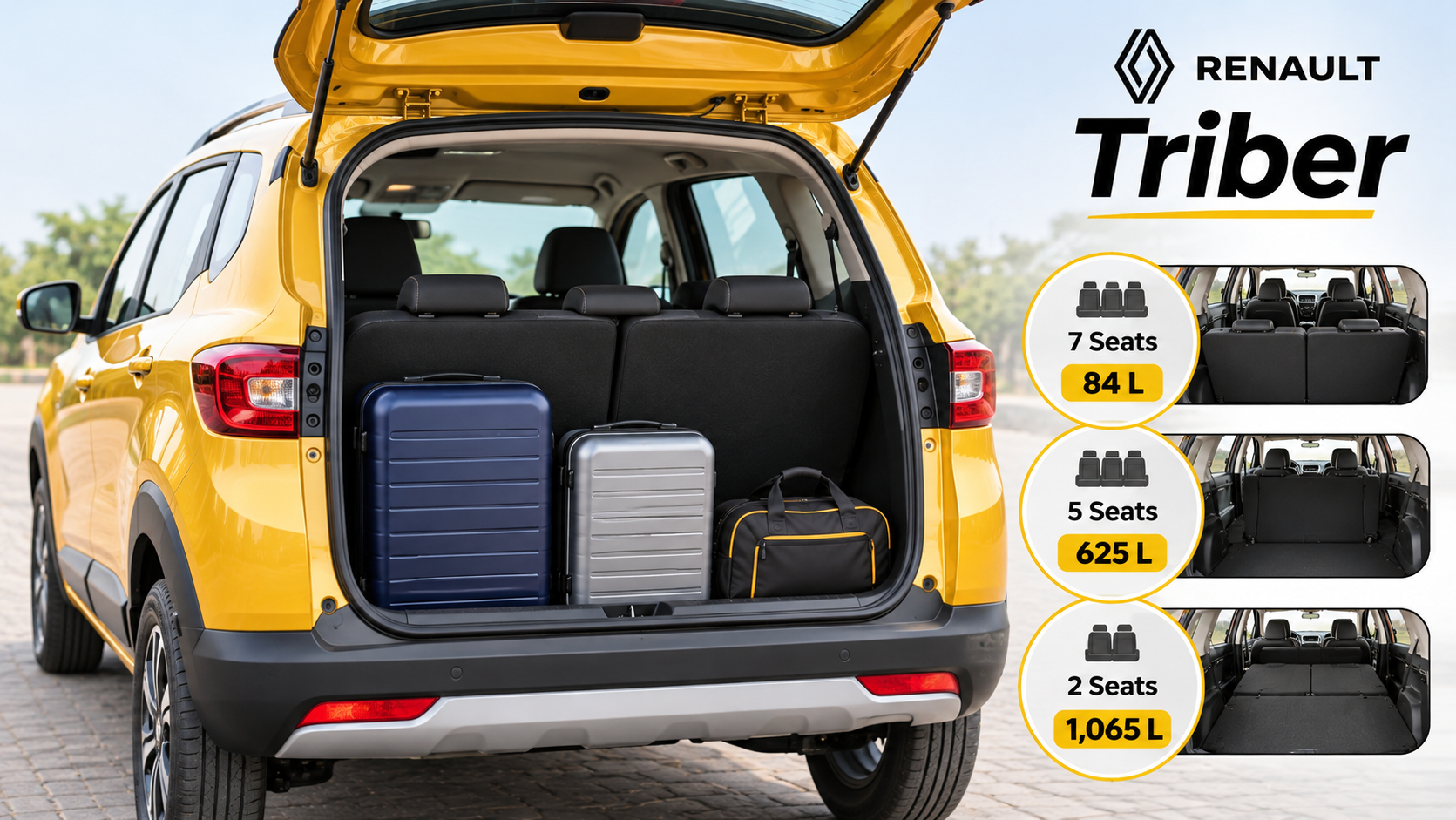
With all three rows in use, the available boot space is approximately 84 litres. This is a relatively small luggage area, particularly when compared with conventional five-seater hatchbacks and compact SUVs.
However, folding or removing the third row transforms the available luggage capacity.
The Triber is designed around modular seating, meaning owners can change the interior arrangement according to their passenger and luggage requirements.
This flexibility is one of the biggest reasons why the MPV appeals to budget-conscious families.
Fixed vs Floating Car Loan Rate: Which Is Better in India?
The Three-Bag Test: Understanding Our Luggage Setup
To make this comparison practical, we will use three commonly carried travel bags.
Rather than using different luggage combinations for every seating arrangement, the same three bags will be used throughout the test.
This makes it easier to understand which seating layout offers the best luggage flexibility.
The three bags represent a typical family travel combination:
-
Bag 1 – Large suitcase: A standard large hard-shell suitcase used for clothes and longer trips.
-
Bag 2 – Medium trolley bag: A medium-sized suitcase suitable for one or two days of travel.
-
Bag 3 – Small duffel bag: A soft travel bag that can be adjusted slightly to fit available spaces.
These bags represent practical everyday luggage rather than unusually small shopping bags.
The test will focus on whether all three bags can be accommodated without compromising passenger seating or blocking visibility and access.
Seating Configuration 1: All Seven Seats in Use
This is the most challenging configuration for luggage storage because all three rows are occupied.
With all seven seats in position, the Renault Triber offers just 84 litres of boot capacity. This means passengers get the advantage of seven seats, but luggage space becomes extremely limited.
Let's look at our three bags individually.
Bag 1: Large suitcase
A large hard-shell suitcase is unlikely to fit behind the third row. Its rectangular shape and overall height make it difficult to accommodate in such a compact luggage area.
Even if a particular slim suitcase can be positioned sideways, it could consume almost the entire available boot area.
Bag 2: Medium trolley bag
A medium-sized trolley bag may also be difficult to accommodate. Its wheels, handle and rigid structure limit how it can be positioned.
Depending on its dimensions, it may not fit upright and could require placing it horizontally.
Bag 3: Small duffel bag
The small duffel bag is the most practical option for this configuration.
Because it has a flexible body, it can be adjusted to fit into irregular spaces. A compact duffel bag or backpack is much more suitable when all seven seats are occupied.
Our observation: When travelling with seven passengers, buyers should prioritise compact soft luggage. Carrying three conventional travel bags is not a realistic expectation with all seats occupied.

Seating Configuration 2: Five Seats With the Third Row Removed
This is where the Renault Triber becomes significantly more practical.
By removing the third-row seats, owners can transform the vehicle into a five-seater with a much larger luggage compartment.
According to Renault's official specifications, the boot capacity increases from 84 litres to 625 litres in this configuration.
That is a substantial increase and makes the vehicle considerably more useful for family holidays, airport transfers and shopping trips.
Now let's consider our three bags again.
Bag 1: Large suitcase
The large suitcase should be much easier to accommodate. The expanded boot area provides enough flexibility to position it without taking up passenger seating space.
Bag 2: Medium trolley bag
The medium trolley bag can be positioned alongside the large suitcase, depending on their individual dimensions.
Bag 3: Small duffel bag
The soft duffel bag can occupy the remaining available space or be positioned above the other bags if they are secured properly.
In this five-seat configuration, carrying all three bags becomes a much more realistic arrangement.
However, the exact fit will depend on the bags' dimensions, shape and how efficiently they are positioned.
Our observation: This is arguably the best configuration for a family of four or five planning a weekend trip. Passengers retain a comfortable five-seat layout while gaining substantially more luggage capacity.
Seating Configuration 3: Two Seats With the Second and Third Rows Folded
The third configuration focuses entirely on cargo capacity.
When the third row is removed and the second row is folded flat, Renault claims a maximum luggage capacity of 1,065 litres.
This transforms the Triber into a compact vehicle capable of carrying considerably larger items.
For our three-bag comparison, this is the easiest configuration.
The large suitcase can be positioned towards the rear, while the medium trolley bag and small duffel bag can be arranged around it.
There is also additional flexibility to carry other household items, shopping bags or outdoor equipment.
This configuration is particularly useful when travelling with only the driver and front passenger.
However, it is important to remember that folding the second row removes the rear passenger seating area. Therefore, this arrangement is not suitable when travelling with a larger family.
Our observation: If luggage space is the main priority, the two-seat configuration offers the greatest flexibility.
Renault Triber: Three-Bag Test Across Different Seating Layouts
|
Seating configuration
|
Boot capacity
|
Large suitcase
|
Medium trolley
|
Small duffel
|
|
Seven seats
|
84 litres
|
Unlikely to fit
|
Difficult
|
Most practical
|
|
Five seats
|
625 litres
|
Easier to accommodate
|
Easier to accommodate
|
Can accommodate
|
|
Two seats
|
1,065 litres
|
Can accommodate
|
Can accommodate
|
Can accommodate
|
Which Renault Triber Seating Configuration Is Best for Family Trips?
The best seating arrangement depends on how many passengers are travelling and how much luggage they need to carry.
For a family of seven
If all seven seats are occupied, luggage management becomes the biggest challenge.
Passengers should consider carrying small backpacks, compact duffel bags and soft travel bags instead of multiple large suitcases.
For longer holidays involving seven passengers, additional luggage arrangements may be necessary.
For a family of five
The five-seat configuration is arguably the most practical option.
Removing the third-row seats increases the boot capacity to 625 litres, giving passengers significantly more room for suitcases and travel essentials.
This arrangement is particularly suitable for airport journeys, weekend trips and family vacations.
For couples or small families
The two-seat configuration is ideal when maximum cargo capacity is required.
With the second and third rows folded or removed, the Triber offers up to 1,065 litres of luggage capacity.
This setup can also be useful for carrying larger shopping items, outdoor equipment and household goods.
Smart Luggage-Packing Tips for Renault Triber Owners
Even though the Renault Triber offers flexible seating, packing luggage properly is important, especially when travelling with multiple passengers.
Here are some practical suggestions:
1. Prefer soft luggage: Soft duffel bags and backpacks are easier to position in limited spaces than rigid suitcases.
2. Place larger bags first: When using the five-seat configuration, place the largest suitcase towards the rear and arrange smaller bags around it.
3. Avoid blocking rear visibility: Do not stack luggage above the rear seatbacks in a way that obstructs the driver's view.
4. Use the available cabin storage: Small items such as chargers, water bottles, wallets and travel documents can be stored in the vehicle's dedicated storage compartments.
5. Secure your luggage: Heavy bags should be properly positioned and secured to prevent movement during sudden braking.
6. Check the seating arrangement before travelling: If you regularly travel with five passengers and luggage, removing the third-row seats beforehand can make journeys much easier.

What Else Makes the Renault Triber Practical?
Boot space is only one part of the Renault Triber's practicality. Its modular cabin offers several other features that make it attractive to Indian families.
Flexible Second-Row Seats
The second-row seats can slide, recline and fold. This allows passengers to adjust the available space according to their requirements.
For example, when the third row is occupied, the second row can be adjusted to provide additional legroom at the rear.
Removable Third-Row Seats
The removable third-row seats are among the Triber's biggest advantages.
Unlike conventional vehicles where the rear seats may only fold, the Triber allows owners to remove them completely to create additional luggage space.
Multiple Seating Combinations
Renault advertises more than 100 seating combinations, giving owners flexibility for different passenger and cargo requirements.
This makes the Triber suitable for families with changing daily transportation needs.
Roof Rails
The vehicle also gets roof rails with a stated load-carrying capacity of up to 50kg on applicable versions.
These can provide additional carrying flexibility, provided compatible accessories are used and the manufacturer's loading instructions are followed.
Rear Air Conditioning
The Triber offers dedicated rear air-conditioning vents for the second and third rows, helping improve passenger comfort during family journeys.
An EV’s Advertised Range Is What Every Owner Will Achieve: Myth or Fact?
Is the Renault Triber Good for Long Family Trips?
The Renault Triber can be a practical option for family trips, but buyers need to understand its seating and luggage limitations.
For a family of four or five, the Triber offers a useful combination of passenger comfort and luggage capacity when the third row is removed.
However, travelling with seven passengers changes the situation considerably. The 84-litre boot becomes a limitation, particularly when everyone needs to carry individual suitcases.
The vehicle's compact dimensions and flexible interior make it convenient for everyday city use, but buyers planning frequent seven-person road trips should carefully consider their luggage requirements.
The best approach is to choose the seating configuration according to the number of passengers rather than expecting maximum passenger capacity and maximum luggage capacity simultaneously.
Final Verdict: How Much Can the Renault Triber Carry Behind the Third Row?
The Renault Triber demonstrates why flexible seating is important in an affordable family MPV.
Its 84-litre boot with all seven seats in use is a significant limitation for luggage-heavy journeys. Three conventional travel bags are unlikely to fit comfortably in this configuration.
However, removing the third-row seats increases the luggage capacity to 625 litres, making the vehicle much more practical for families travelling with five passengers.
The maximum 1,065-litre capacity in the two-seat configuration provides even greater flexibility for carrying luggage and larger items.
Our verdict: The Renault Triber is best understood as a flexible seven-seater rather than a seven-seater with a permanently large boot. If you regularly travel with five people, its luggage capacity is impressive for its size and price category. But if all seven seats are occupied, you will need to pack light.
For buyers considering the Triber, the three-bag comparison highlights one important point: its real strength is not simply the number of seats, but how easily the cabin can be transformed to suit different family requirements.
 Khyati Sharma 2026-11-24