Khyati Sharma 2026-10-27
Electric vehicles (EVs) are becoming increasingly popular among car buyers who want lower running costs, quieter driving and a more environmentally friendly way to travel. One of the most important factors people consider before purchasing an electric car is its driving range. Manufacturers often advertise impressive figures, with some models claiming several hundred kilometres on a single charge.
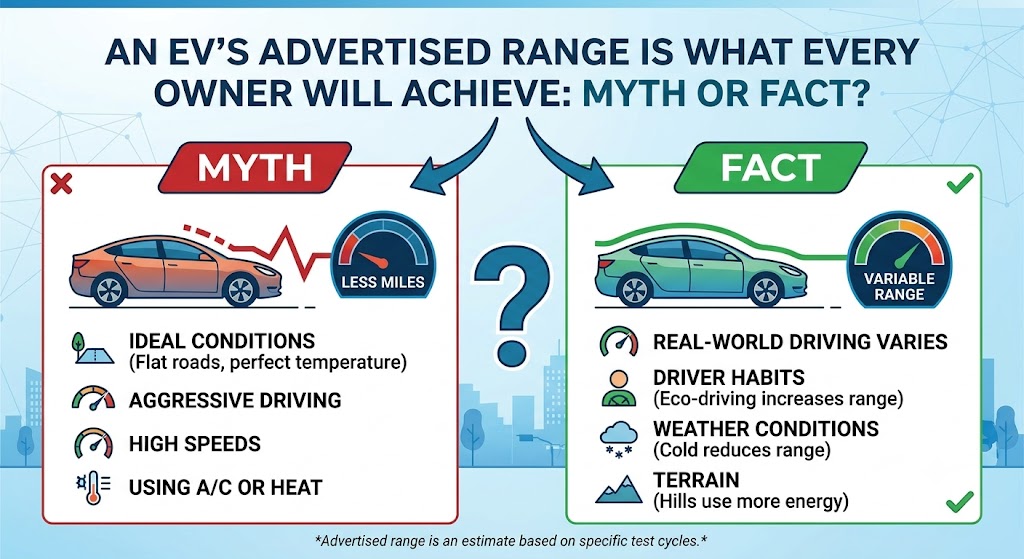
However, does an electric vehicle always travel the exact distance mentioned in its official range claim? Will every owner achieve the same number of kilometres regardless of weather, driving habits, road conditions or air-conditioning use?
The answer is myth. An EV’s advertised range is not a guaranteed distance that every owner will achieve. It is generally a certified figure measured under standardised testing conditions. Real-world range can vary considerably depending on how, where and when the vehicle is driven.
Understanding this difference is important for anyone considering an electric car, particularly people who frequently travel long distances or drive in areas with extreme temperatures, steep roads or limited charging infrastructure.
Pre-Delivery Inspection (PDI): A Checklist Before You Take Delivery
Myth. An electric vehicle's advertised range is a useful reference point, but it does not guarantee the distance every driver will achieve.
Manufacturers usually publish a range figure based on a recognised testing procedure. In India, electric passenger vehicles may have an ARAI-certified range, depending on the applicable certification requirements. Other markets use different testing cycles, such as WLTP in Europe or EPA testing in the United States.
These tests follow specific procedures designed to make vehicles comparable under controlled conditions. They do not reproduce every possible combination of traffic, weather, road surfaces, passenger loads and driving styles encountered in everyday use.
As a result, an EV that advertises a range of 450 km might deliver a different distance in real-world driving. Some owners may achieve a figure close to the official claim under favourable conditions, while others may experience a lower range during high-speed highway driving or in extreme weather.
The difference does not automatically mean the vehicle is defective. It often reflects the gap between standardised laboratory testing and real-world driving conditions.
An electric vehicle's range is closely related to its usable battery capacity and energy consumption.
Manufacturers and testing agencies evaluate a vehicle under a defined driving cycle. The test includes prescribed acceleration, deceleration, speed changes and stopping periods.
The resulting figure represents the distance the vehicle can travel under that specific test procedure before its usable battery energy is exhausted according to the test's rules.
The testing cycle matters because different procedures can produce different range figures for the same vehicle.
For example, a test that includes lower average speeds and frequent stops may produce a different result from one that places greater emphasis on higher-speed driving.
This is why buyers should compare vehicles using figures measured under the same testing standard whenever possible.
An advertised range should be viewed as a standardised comparison tool, not as a promise that every driver will achieve exactly the same distance.

Speed is one of the most important factors affecting an electric vehicle's energy consumption.
At higher speeds, air resistance increases significantly. The electric motor must use more energy to overcome this resistance, which can reduce the distance travelled on a single charge.
For example, an EV driven at a steady, moderate speed may consume less electricity per kilometre than the same vehicle travelling at sustained highway speeds.
Frequent acceleration can also increase energy consumption. Although electric motors are efficient, rapidly accelerating a vehicle requires more power from the battery.
Driving smoothly, maintaining a sensible speed and anticipating traffic conditions can help improve efficiency.
However, drivers should never compromise road safety simply to achieve a higher range figure. Maintaining safe speeds and following traffic regulations must always take priority.
Temperature can have a noticeable effect on battery performance and vehicle energy consumption.
In cold weather, battery chemistry operates less efficiently, and the vehicle may use energy to warm the battery and passenger cabin. This can reduce the distance available from a full charge.
In very hot weather, air conditioning and battery thermal management systems may also consume additional electricity.
The impact depends on the vehicle's battery chemistry, thermal management system, climate-control settings and the severity of the weather.
For drivers in India, extreme summer temperatures can increase cooling requirements, while winter conditions in northern and mountainous regions can affect battery performance and cabin-heating demand.
Some EVs offer battery preconditioning, which prepares the battery for driving or charging. When available, this function may help improve efficiency or charging performance in certain conditions.
Documents Required to Buy a New Car in India (Complete Checklist)
Unlike conventional petrol and diesel cars, which can use engine waste heat for cabin heating, battery-electric vehicles must manage cabin temperature using electrical energy.
Air conditioning, heating, ventilation and battery cooling can therefore influence the vehicle's overall energy consumption.
Using climate control at an extreme setting may increase electricity use, especially when the car is parked in very hot or cold weather.
This does not mean EV owners should avoid using air conditioning. Cabin comfort and safe driving conditions remain important.
Instead, drivers can use practical measures such as pre-cooling or pre-heating the cabin while the vehicle is connected to a charger, where supported. Using automatic climate-control settings and sensible temperature adjustments can also help manage consumption.
The effect of climate control is generally more noticeable on short journeys, where the system may use a relatively large amount of energy compared with the distance travelled.

Not every journey requires the same amount of energy.
Driving uphill requires additional power because the vehicle must gain elevation. On steep roads, energy consumption can rise considerably.
Rough surfaces, gravel roads, mud and poorly maintained routes may also increase rolling resistance and reduce efficiency.
Traffic conditions have a more complicated effect. Frequent acceleration and braking can increase energy consumption, but regenerative braking allows an EV to recover some energy when slowing down.
On downhill sections, regenerative braking may recover energy that would otherwise be lost as heat. However, the amount recovered depends on the gradient, battery charge level, system settings and vehicle design.
Consequently, a route through mountainous terrain may produce a very different range result from a relatively flat route, even if both journeys cover the same distance.
An electric vehicle must use energy to move its own weight as well as its passengers and luggage.
Carrying several passengers, heavy luggage or additional equipment increases the total load. The effect may be more noticeable during repeated acceleration and uphill driving.
Roof boxes and other external accessories can also increase aerodynamic drag, particularly at highway speeds.
These effects do not mean that EVs cannot carry heavy loads. Owners should simply understand that a fully loaded vehicle may not achieve the same range as it would when travelling with only one occupant.
Before a long journey, drivers can check the vehicle's estimated range, account for the expected passenger load and identify suitable charging stops.
Best Time of the Year to Buy a New Car in India
An EV's battery gradually changes as it ages and undergoes charging and discharging cycles.
Over time, the battery may lose some of its original energy-storage capacity. This process is commonly referred to as battery degradation.
The rate of degradation depends on several factors, including battery chemistry, operating temperature, usage patterns, charging behaviour and the vehicle's battery management system.
A relatively new EV with a healthy battery may offer a different range from an older vehicle that has accumulated substantial mileage.
Battery degradation does not occur at the same rate in every vehicle. Modern battery management systems are designed to protect the battery, but they cannot eliminate all capacity loss.
Owners should follow the manufacturer's charging and maintenance recommendations and consult an authorised service centre if they notice an unusual or sudden reduction in range.
|
Driving condition |
Illustrative range |
Main reason |
|
Moderate speeds and mild weather |
400–450 km |
Favourable energy consumption |
|
Sustained high-speed highway driving |
300–380 km |
Increased aerodynamic drag |
|
Very hot weather with heavy AC use |
330–400 km |
Additional cooling demand |
|
Cold weather with cabin heating |
280–370 km |
Battery and heating energy losses |
|
Hilly route with a heavy load |
300–380 km |
Elevation changes and additional weight |
The example shows why buyers should not assume that an advertised 450 km range means the vehicle will always travel exactly 450 km.
The same EV may deliver different results on a summer city commute, a winter mountain journey and a high-speed highway trip.
Although drivers cannot control every factor, several habits can help improve efficiency.
Drive smoothly: Gradual acceleration reduces unnecessary energy demand.
Maintain sensible speeds: Avoiding unnecessarily high highway speeds can help reduce aerodynamic losses.
Use regenerative braking effectively: Where supported, regenerative braking can recover some energy during deceleration.
Check tyre pressure: Incorrect tyre pressure can increase rolling resistance and reduce efficiency.
Precondition the cabin: If supported, pre-cool or pre-heat the cabin while connected to a charger.
Plan charging stops: Long-distance journeys should include suitable charging stations and a safety margin for unexpected delays.
Avoid unnecessary weight: Remove unused heavy items and consider the aerodynamic impact of roof accessories.
Monitor energy consumption: The vehicle's energy-consumption display can help drivers understand which conditions are reducing range.
These measures can improve efficiency, but they cannot guarantee the manufacturer's advertised range on every journey.
How Car Loan Interest Actually Works: EMI Basics Explained
Driving range should be one of several factors considered when choosing an electric vehicle.
Buyers should examine the certified range, usable battery capacity, charging speed, warranty coverage and availability of charging infrastructure.
It is also important to consider the type of driving the vehicle will perform most often. Someone who primarily travels short distances in a city may have different requirements from a driver who regularly travels long distances between cities.
Before buying, prospective owners should research real-world range tests for the exact model and variant. Results from independent road tests can help establish a realistic expectation, provided the testing conditions are clearly explained.
A buyer should also consider the distance to the nearest reliable charging stations and whether home charging is available.
Choosing a vehicle with enough range for typical daily travel, plus a reasonable reserve for unexpected trips, is often more useful than selecting a car based only on the largest advertised number.
The claim that every electric vehicle owner will achieve the advertised range is a myth.
Official range figures are calculated using standardised testing procedures that help buyers compare vehicles. Real-world performance depends on driving speed, weather, air-conditioning use, road conditions, passenger load, battery health and many other factors.
An EV advertised with a 450 km range may travel close to that distance in favourable conditions but considerably less in demanding circumstances. The difference does not automatically indicate a battery problem or a misleading claim.
The best approach is to treat the advertised range as a reference point and investigate realistic results for the vehicle and conditions that matter to you.






BMW
₹49.90 Lakh