 Khyati Sharma 2026-09-24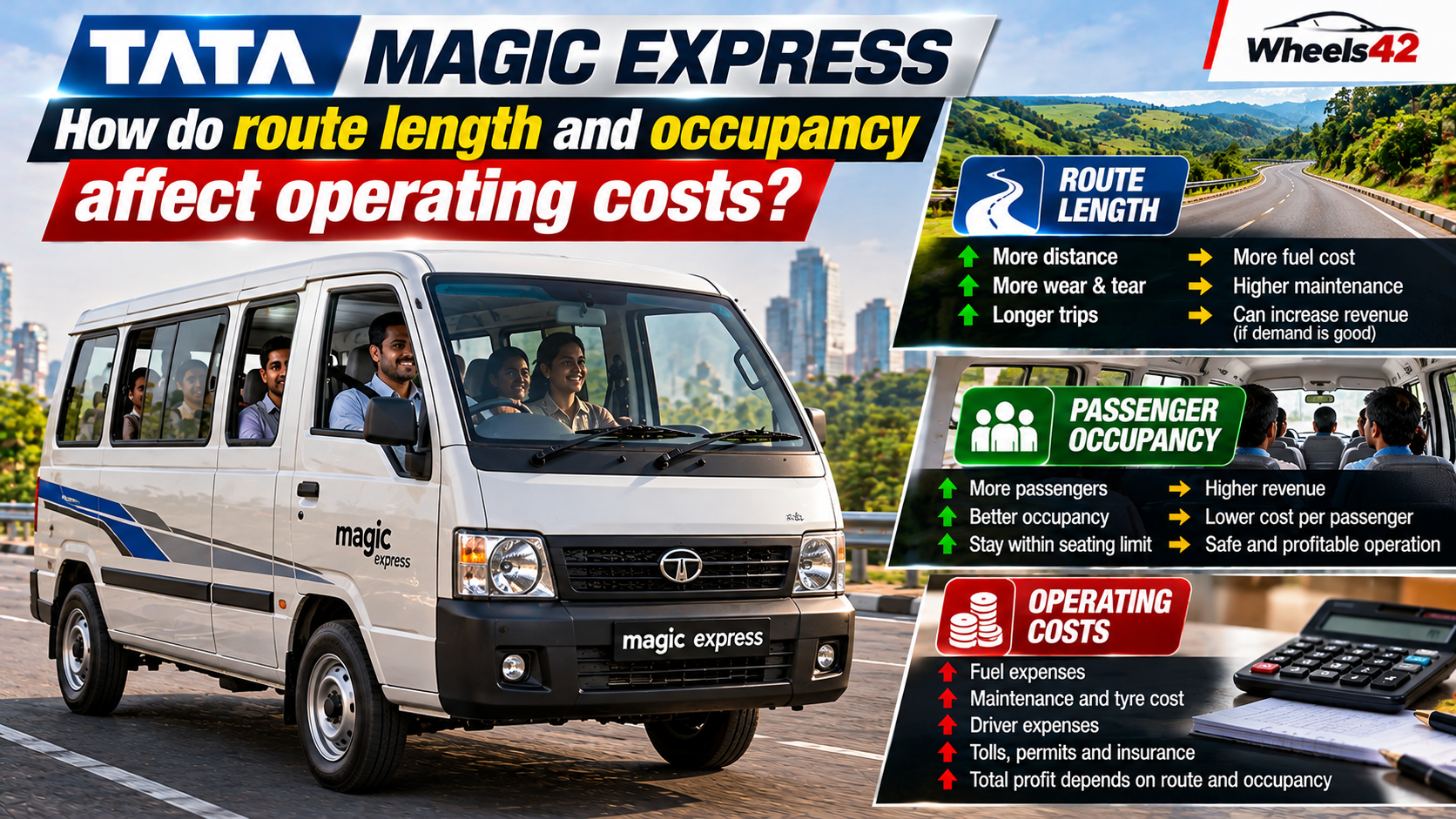
The Tata Magic Express is a small commercial passenger vehicle designed for local transportation, school services, staff transfers and short-distance passenger routes. For operators, profitability depends not only on the number of kilometres travelled but also on how many passengers pay for each journey.
A vehicle travelling a long route with only a few passengers may generate less profit than one operating a shorter route with consistently high occupancy. Understanding the relationship between route length, passenger demand, fuel consumption and maintenance expenses can help operators plan routes more efficiently.
|
Specification |
Tata Magic Express Petrol |
|
Seating configuration |
Driver + 9 passengers |
|
Engine capacity |
694 cc |
|
Maximum power |
30 HP |
|
Maximum torque |
55 Nm |
|
Claimed fuel efficiency |
Approximately 20.6 km/l |
|
Wheelbase |
2,100 mm |
|
Typical applications |
School vans, tourist vans and passenger transportation |
Route length is one of the main factors determining the daily expenses of a passenger vehicle. Every additional kilometre adds to fuel consumption and contributes to wear on components such as tyres, brakes, suspension and the clutch.
For example, an operator running a Tata Magic Express on a short neighbourhood route may complete several trips with relatively limited daily mileage. Another operator covering distant villages or connecting towns may travel significantly farther and incur higher fuel and maintenance expenses.
However, longer routes can also provide opportunities for higher revenue when fares, passenger demand and trip frequency justify the additional distance.
Main costs influenced by route length
Fuel expenses: More kilometres generally mean more fuel consumed.
Tyre wear: Longer operating distances increase tyre usage over time.
Maintenance: Regular servicing and replacement of components become more important as mileage increases.
Driver expenses: Longer working hours may increase wages or other operating allowances.
Tolls and parking: These may apply depending on the route.
Depreciation: Higher annual mileage can contribute to faster vehicle depreciation.
Operators should calculate costs using the complete journey distance, including return trips and empty kilometres when the vehicle travels without passengers.
Occupancy refers to the proportion of available passenger seats filled during a trip. A Tata Magic Express configured for nine passengers can generate more fare revenue when more seats are occupied, without necessarily requiring a proportional increase in the distance travelled.
For instance, the vehicle may use nearly the same amount of fuel on the same route whether it carries four passengers or nine. The exact fuel consumption can vary with load and driving conditions, but the key advantage of higher occupancy is that the trip's fixed and distance-related expenses are shared across more paying passengers.
Assume a one-way trip with a fare of ₹30 per passenger. These figures are examples, not actual market fares.
Route distance and occupancy should be evaluated together rather than separately. A longer route may be commercially attractive when it consistently carries enough paying passengers. However, an extended journey with low occupancy can result in high costs relative to the revenue collected.
|
Operating situation |
Likely financial effect |
What operators should consider |
|
Short route, high occupancy |
More revenue per kilometre is possible |
Maintain reliable departure times |
|
Short route, low occupancy |
Low revenue per trip |
Review demand and trip frequency |
|
Long route, high occupancy |
Higher revenue but also higher trip costs |
Calculate net earnings after expenses |
|
Long route, low occupancy |
Greater risk of weak profitability |
Consolidate demand or reassess the route |
These outcomes depend on actual fares, fuel efficiency, local demand and the number of trips completed. High occupancy alone does not guarantee profitability if fares are too low or operating expenses are unusually high.
Fuel is a major variable expense for passenger transport operators. The petrol version's published fuel-efficiency figure can be used for an initial estimate, but real-world performance should be measured over several trips.
The following formula provides a simple calculation:
Fuel required = Total distance ÷ Actual mileage
Fuel cost = Fuel required × Price per litre
For example, assume an operator travels 100 km and the vehicle achieves an illustrative real-world mileage of 15 km/l. At an assumed petrol price of ₹100 per litre, the estimated fuel requirement is approximately 6.67 litres, costing about ₹667.
These figures are only a calculation example. Actual mileage and fuel prices vary, so operators should replace the assumptions with their own records.
For the CNG variant, the same principle applies, but fuel consumption should be calculated in kilometres per kilogram and multiplied by the local CNG price per kilogram. Petrol and CNG versions should be evaluated using their respective real-world fuel costs.
Cost per passenger helps operators understand whether a route is earning enough revenue relative to its operating expenses.
The basic formula is:
Cost per passenger = Total trip operating cost ÷ Number of paying passengers
Suppose a trip costs ₹600 to operate. With six paying passengers, the cost works out to ₹100 per passenger. If the same trip carries nine paying passengers, the cost falls to approximately ₹66.67 per passenger, assuming the total trip cost remains ₹600.
This illustrates why improving occupancy can strengthen route economics. In practice, costs may rise slightly with passenger load, and the operator must also account for vehicle capacity and safety requirements.
Fuel is only one part of the total cost of running a Tata Magic Express. A more accurate assessment includes both expenses that change with usage and costs that continue even when the vehicle is idle.
| Expense | How it affects profitability |
|---|---|
| Fuel | Changes with distance and driving conditions |
| Scheduled servicing | Depends on manufacturer intervals and usage |
| Tyres | Replacement depends on distance, road surface and maintenance |
| Repairs | Vary with vehicle condition and operating conditions |
| Insurance and permits | Depend on policy, vehicle use and applicable regulations |
| Driver wages | May depend on working hours or employment terms |
| Loan or financing payments | Affect cash flow and monthly obligations |
| Depreciation | Reflects the vehicle's loss of value over time |
| Empty return trips | Add costs without generating passenger revenue |
Operators should distinguish cash expenses from accounting costs such as depreciation. Both matter, but they serve different purposes when assessing cash flow and long-term profitability.
Tata Magic Express operators can use several practical methods to control operating expenses and improve revenue per trip.
Study passenger demand: Track how many passengers board at different stops and times.
Reduce unnecessary empty kilometres: Coordinate return journeys and identify opportunities for legitimate passenger demand in both directions.
Choose suitable departure times: Align schedules with school, office or local travel requirements.
Monitor real-world mileage: Record fuel purchased, kilometres travelled and passengers carried.
Follow the maintenance schedule: Preventive servicing can help reduce unexpected breakdowns.
Compare route alternatives: Consider total journey distance, road conditions, tolls and passenger demand before changing a route.
Review fares carefully: Ensure fares cover operating costs while remaining appropriate for the local market.
Use permitted seating capacity: Never increase passenger numbers beyond the vehicle's authorised capacity.
A simple daily log recording distance, fuel expenses, passenger numbers and fare collections can reveal which routes perform best over time.