
 Khyati Sharma 2026-09-23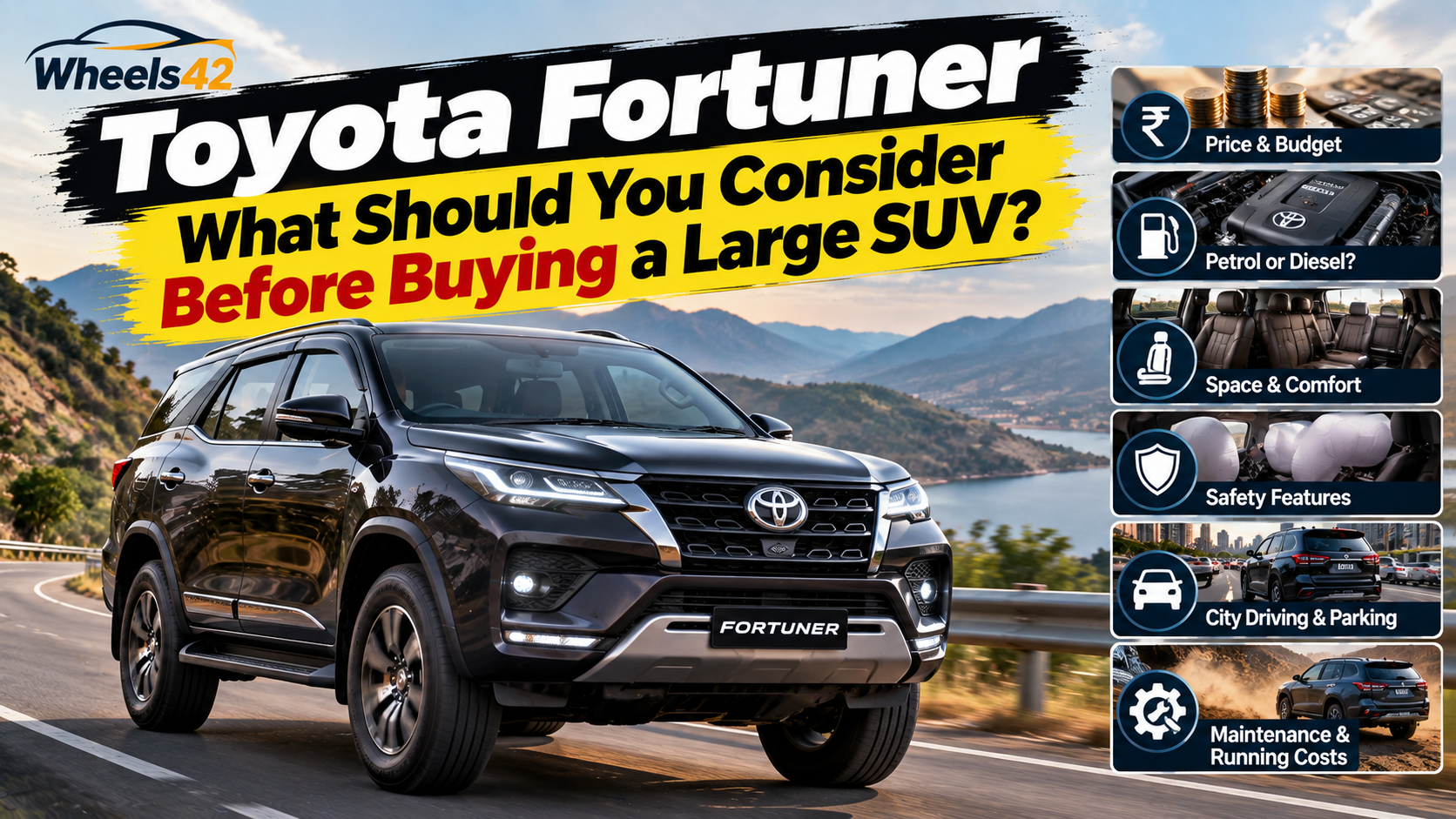
The Toyota Fortuner is one of the most recognisable full-size SUVs in India, known for its commanding road presence, powerful engine options and reputation for durability. It appeals to buyers who want a vehicle that feels substantial on highways, offers a high driving position and can handle challenging road conditions.
However, buying a large SUV cars involves more than choosing a vehicle with an imposing design. Purchase price, fuel expenses, parking requirements, ride comfort, maintenance costs and everyday usability all deserve careful consideration.
For buyers considering the Toyota Fortuner, understanding these factors can help determine whether it is the right SUV for their lifestyle or whether a smaller, more affordable alternative would make better sense.
The Toyota Fortuner sits in the premium SUV segment, making the overall purchase cost an important consideration. Buyers should look beyond the advertised ex-showroom price and calculate the complete on-road cost, including registration, insurance and other applicable charges.
The final price varies according to the selected variant, fuel type, transmission, drivetrain and location.
It is also important to consider the long-term financial commitment. A large SUV can involve higher fuel expenses, more expensive tyres and substantial insurance premiums compared with smaller vehicles.
Before booking, buyers should calculate the monthly cost of ownership and decide whether the vehicle comfortably fits within their budget without affecting other financial priorities.
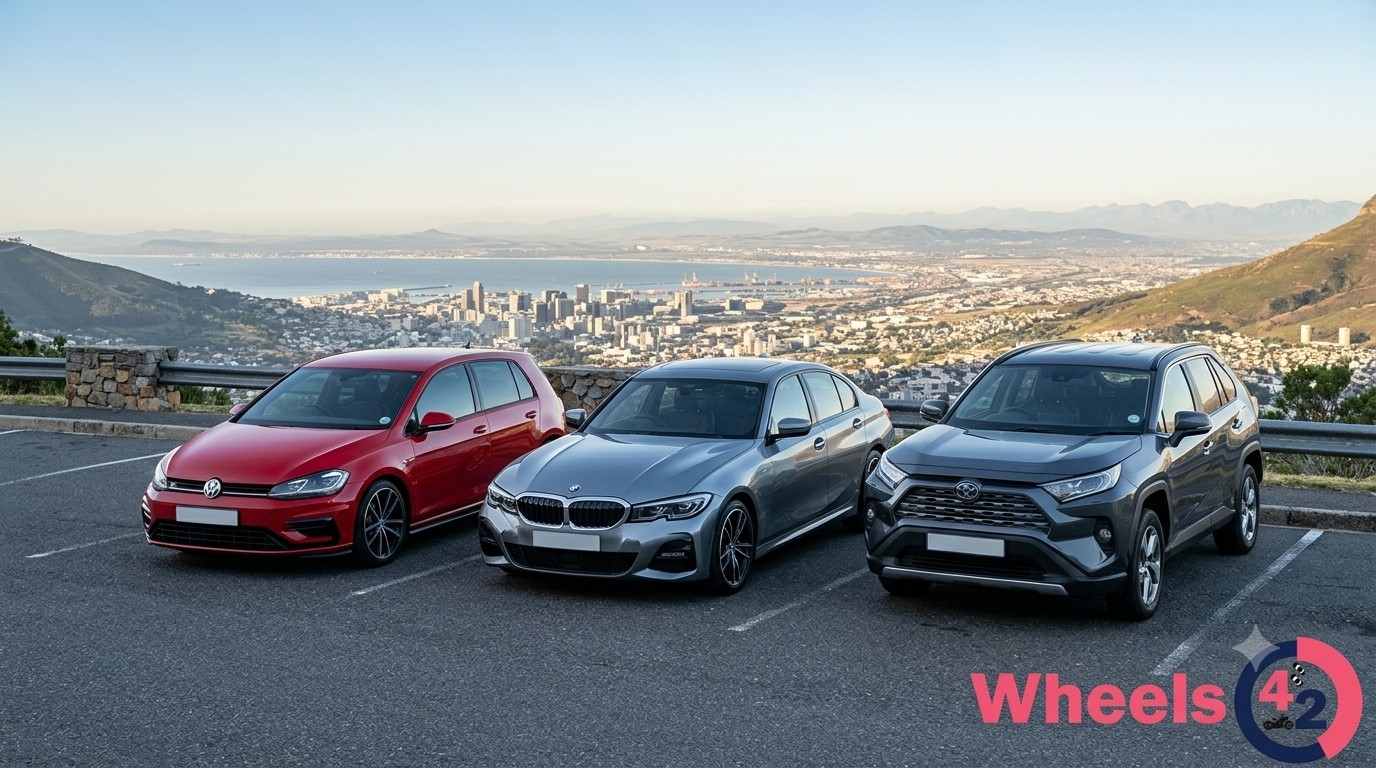
Hatchback vs Sedan vs SUV: Which Car Type Suits You Best?
The Fortuner has traditionally been offered with petrol and diesel engine options, although availability varies by model year and market.
The petrol version can appeal to buyers who prefer a petrol-powered SUV and drive moderate distances. The diesel option is often considered by customers who travel longer distances, undertake frequent highway journeys or require strong low-speed pulling power.
The diesel engine's torque delivery can be useful when carrying passengers and luggage or driving on inclines. However, the right choice depends on actual fuel costs, annual kilometres, local regulations and the purchase-price difference between variants.
|
Factor |
Petrol |
Diesel |
|
Typical use |
City driving and mixed use |
Long-distance driving and touring |
|
Fuel expenses |
Depends on local petrol prices and consumption |
Depends on diesel prices and consumption |
|
Low-speed pulling power |
Depends on engine characteristics |
Diesel torque can be advantageous |
|
Purchase cost |
Varies by variant |
Varies by variant |
|
Best approach |
Compare actual running costs |
Compare actual running costs and usage |
Petrol vs Diesel vs CNG vs Electric Cars: How to Choose the Right Fuel Type
One of the Fortuner's biggest strengths is also a potential limitation: its size.
The high seating position provides a commanding view of the road, while the large body gives the SUV a substantial presence. However, crowded streets, narrow lanes and tight parking spaces can be challenging.
Before buying, consider the following:
Parking space: Check whether your home and workplace have enough room for the SUV.
Road width: Narrow residential streets can require additional manoeuvring.
Traffic conditions: The vehicle's dimensions may make congested areas more demanding.
Turning radius: Test how easily it can make U-turns and enter tight spaces.
Visibility: Check the mirrors, blind spots and parking camera coverage.
A test drive should include familiar roads and parking situations rather than only a short trip on an open highway.
Fuel consumption is an important factor for anyone considering a large SUV. The Fortuner's actual mileage depends on the engine, transmission, drivetrain, driving style, traffic and passenger load.
Frequent acceleration, extended idling and heavy city congestion can increase fuel consumption. Highway driving at steady speeds may produce different results.
The overall running cost should include more than fuel. Owners should also account for scheduled servicing, tyres, insurance, brake components and unexpected repairs.
A useful approach is to estimate annual fuel expenses using your expected driving distance and realistic fuel economy rather than relying entirely on advertised figures.
For example, someone who drives long distances every month should pay particular attention to fuel expenditure, while an occasional driver may place greater importance on comfort, reliability and the purchase price.
The Fortuner's tall body and spacious cabin make it attractive to families who want a large vehicle for longer journeys. However, passenger comfort depends on seating position, suspension behaviour, road conditions and the number of occupants.
The front seats offer a commanding driving position, while the second row provides space for family members and adult passengers. The third row can be useful when additional seating is required, but buyers should check whether it provides sufficient comfort for the people who will regularly use it.
During a test drive, evaluate:
Front-seat support on longer journeys.
Second-row legroom and headroom.
Third-row access and seating comfort.
Ride quality over potholes and speed breakers.
Cabin noise at highway speeds.
Air-conditioning effectiveness for all rows.
Families who frequently travel with six or seven occupants should pay particular attention to luggage capacity when every seat is in use.

A large SUV should provide appropriate safety equipment alongside its size and performance. Buyers should examine the safety specifications of the exact variant rather than assuming that every version offers identical features.
Important equipment to check includes airbags, anti-lock braking with electronic brake-force distribution, electronic stability control, hill-assist functions, parking sensors and a reversing camera.
Depending on the model year and variant, additional convenience or driver-assistance features may also be available.
It is worth confirming which features are standard and which are restricted to higher variants. Buyers should also check the vehicle's published safety information and ensure that the selected version meets their expectations.
The choice between two-wheel drive and four-wheel drive depends on how the SUV will be used.
A two-wheel-drive version may be sufficient for customers who mainly drive on city roads and highways. It can avoid the need to pay for four-wheel-drive equipment that may rarely be used.
Four-wheel drive may be more suitable for buyers who regularly travel on rough terrain, encounter challenging road conditions or enjoy off-road driving.
However, four-wheel drive does not eliminate the need for appropriate tyres, safe driving techniques or an understanding of the vehicle's capabilities.
Buyers should also check the exact drivetrain configuration and equipment available on the current Fortuner variants.
Long-term ownership costs can significantly influence whether the Fortuner is a sensible purchase.
Toyota cars has an established service presence in India, which can be an advantage for owners who travel between cities. Nevertheless, service costs vary according to the vehicle's condition, maintenance schedule, variant and replacement parts required.
Before buying, ask the dealership for a scheduled maintenance estimate and check warranty coverage.
Resale value is another factor buyers often consider. The Fortuner has historically enjoyed strong demand in India's used-SUV market, but resale prices depend on age, mileage, service records, condition, ownership history and prevailing market demand.
Maintaining service records and following the recommended maintenance schedule can help preserve the vehicle's condition.
The Fortuner may suit buyers who value a large SUV's road presence, elevated seating position, long-distance capability and versatility.
It may be less suitable for people who primarily drive through narrow city streets, have limited parking space or want the lowest possible daily running costs.
|
Buyer profile |
Suitability |
|
Frequent highway travellers |
Worth considering |
|
Families needing a large SUV |
Worth considering |
|
Buyers who regularly drive on rough roads |
Depends on drivetrain and requirements |
|
Daily city commuters with tight parking |
Requires careful evaluation |
|
Buyers prioritising low running costs |
Compare smaller alternatives |
|
Drivers who rarely need a large vehicle |
May be more vehicle than necessary |
A proper test drive can reveal practical limitations that may not be obvious from specifications or photographs.
Try the vehicle on the types of roads you normally use. Check low-speed manoeuvring, braking response, steering effort, visibility and ride comfort over uneven surfaces.
If possible, take family members along to assess rear-seat comfort and entry and exit. Test the parking assistance systems and check whether the vehicle fits comfortably into your usual parking space.
Also compare the petrol and diesel versions, where both are available, if you are uncertain about which powertrain best matches your needs.
Finally, obtain a written quotation showing the complete on-road price, insurance, warranty details and any optional packages.



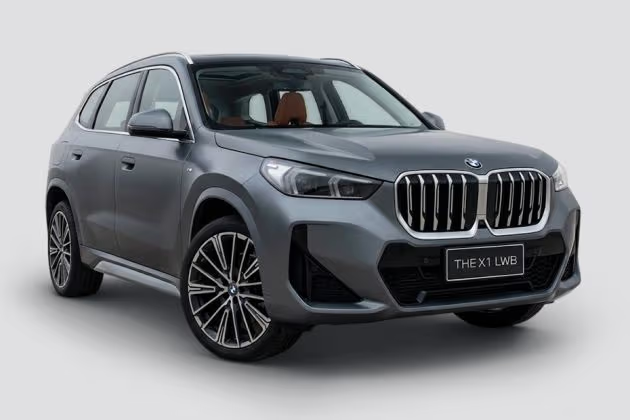
BMW
₹49.90 Lakh