
 Khyati Sharma 2026-06-17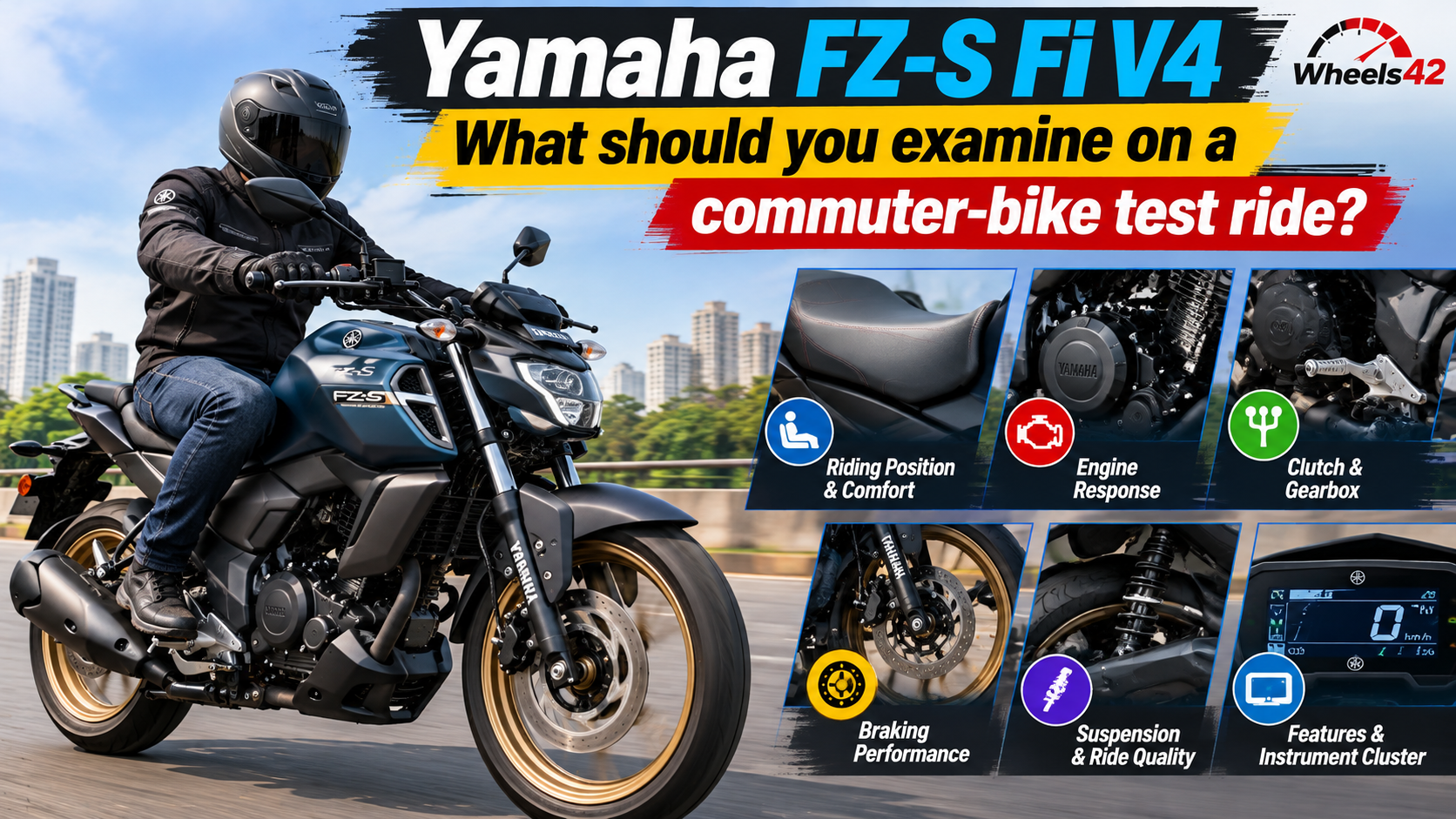
The Yamaha FZ-S FI V4 is a commuter motorcycle designed for riders who want everyday practicality, comfortable riding manners and sport bikes street-bike styling. Before purchasing it, taking a proper test ride is essential to understand how the motorcycle performs in real-world traffic, handles different road conditions and fits your daily commuting needs.
While specifications and features can help narrow down your choices, a test ride reveals important details about riding comfort, engine response, braking performance, clutch operation and overall ease of use. Here is what you should examine when taking the Yamaha FZ-S FI V4 for a test ride.
Start by checking the riding position. Sit on the Yamaha FZ-S FI V4 and see whether the handlebar, seat and footpegs feel comfortable and naturally positioned.
The motorcycle's street-oriented design should be evaluated according to your height, arm reach and riding style. Check whether you can reach the handlebar without stretching too much and whether your knees feel comfortable around the fuel tank.
Also, assess the seat height and your ability to place your feet securely on the ground when stopping at traffic signals. Riders who spend considerable time commuting should pay attention to seat cushioning and posture, as these factors can influence comfort during longer journeys.
A commuter motorcycle needs predictable power delivery and smooth acceleration. During the test ride, observe how the FZ-S FI V4 responds when accelerating from a standstill and moving through slow-moving traffic.
Check whether the engine feels smooth at low speeds and whether it responds predictably when you open the throttle. Try accelerating gradually through the gears and observe whether the power delivery suits your everyday requirements.
Avoid judging the motorcycle only by quick acceleration. For daily use, smooth low-speed behaviour, manageable throttle response and confidence when overtaking are equally important.

The clutch and gearbox play a major role in everyday riding comfort, especially in congested urban areas.
During the test ride, check whether the clutch lever feels comfortable to operate and whether the engagement point is easy to understand. Repeated clutch operation in slow traffic can become tiring if the lever feels too heavy for your preference.
Shift through the gears and look for smooth, consistent gear changes. Notice whether the gearbox responds properly during both acceleration and deceleration.
A short ride may not reveal every characteristic, so take enough time to understand how the clutch and transmission behave under normal commuting conditions.
Braking performance is one of the most important aspects to examine before buying a commuter motorcycle.
Test the front and rear brakes separately at a safe, low speed, where permitted, and then evaluate how they work together during controlled stops. The brakes should feel predictable and provide confidence without unexpected behaviour.
Check the lever feel, pedal operation and how easily you can control the motorcycle while slowing down. If the particular variant is equipped with ABS or another braking-assistance feature, ask the dealer to explain its operation and limitations.
Never perform emergency-braking experiments in public traffic. Use a safe, open area and follow the dealer's instructions.
Indian roads often include speed breakers, potholes, uneven surfaces and broken patches. A commuter motorcycle should feel manageable over these conditions.
During the test ride, observe how the suspension responds to ordinary road imperfections. Pay attention to excessive bouncing, harsh impacts or a loss of confidence when travelling over uneven surfaces.
If possible, ride on a familiar road with a combination of smooth and slightly rough sections. This will help you judge whether the suspension setup suits your regular commute.
Do not deliberately hit potholes or cross speed breakers at high speeds to test the suspension.
A motorcycle used for daily commuting should be easy to control in narrow streets, crowded intersections and parking areas.
Check how the Yamaha FZ-S FI V4 responds to gentle turns and low-speed direction changes. Observe whether you can balance it comfortably while moving slowly and whether the handlebar movement feels natural.
Try a few controlled U-turns in a suitable open area. Also, consider how manageable the motorcycle feels when moving it in and out of a parking space.
The motorcycle's weight and balance may feel different from those of your current bike, so allow yourself time to become familiar with its handling.
Before completing the test ride, familiarise yourself with the instrument cluster and available equipment on the specific variant.
Check the visibility of the display in daylight and whether the essential information is easy to read while stationary. Understand how to access the trip meter, fuel-related information and other available readings.
Depending on the model year and variant, equipment may differ. Ask the dealer to demonstrate any Bluetooth connectivity, smartphone-related functions, riding information or other electronic features included with the motorcycle.
Do not assume that every feature advertised for the broader FZ range is available on every FZ-S FI V4 version.
A short test ride can help you understand the motorcycle's general refinement.
Pay attention to vibrations through the handlebar, seat and footpegs as engine speed increases. Notice whether the engine sounds consistent and whether any unusual rattling or mechanical noise occurs.
After riding in normal traffic, consider whether the heat you experience around your legs feels acceptable for your riding conditions. Engine temperature and fan behaviour, where applicable, should be assessed according to the manufacturer's guidance.
If you notice an unusual noise, warning light or abnormal behaviour, stop safely and ask the dealer to inspect the motorcycle.
Mirrors, lighting and instrument visibility matter when riding every day.
Adjust both mirrors before moving and check whether they provide a useful view of traffic behind you. Make sure the riding position allows you to look around comfortably without excessive strain.
If the dealer permits it, assess the headlight's operation in a safe, suitable environment. Also consider whether the fuel tank shape, seat and overall dimensions work well for your body type.
Think about your actual commuting needs, including parking, carrying a small bag and travelling through congested roads.
Before making a booking, ask the dealer about the following:
The on-road price, including insurance, registration and applicable charges.
The exact model year and variant being offered.
The service schedule and estimated routine maintenance costs.
The warranty coverage and any applicable conditions.
The availability and cost of commonly replaced consumables.
The availability of spare parts and authorised service centres near your location.
The availability of finance options, if required.
The features included in the particular motorcycle being offered.
Also, confirm whether the test-ride motorcycle has the same specification as the variant you intend to purchase.
|
Item to examine |
What to look for |
|
Riding position |
Comfortable posture and handlebar reach |
|
Seat and height |
Secure footing and suitable cushioning |
|
Engine response |
Smooth, predictable acceleration |
|
Clutch and gearbox |
Manageable clutch effort and consistent shifts |
|
Brakes |
Predictable braking and comfortable controls |
|
Suspension |
Confidence over normal road imperfections |
|
Handling |
Easy turns and low-speed manoeuvrability |
|
Instrument cluster |
Clear display and easy-to-understand information |
|
Refinement |
No unusual noise or excessive vibration |
|
Mirrors and lights |
Useful visibility and proper operation |
|
Ownership costs |
Service expenses, warranty and on-road price |
The Yamaha FZ-S FI V4 is worth considering if you prefer a street-style commuter motorcycle and want to evaluate comfort, handling and everyday usability alongside its styling and features.
However, the right choice depends on your daily distance, traffic conditions, road quality, riding posture and ownership budget. A motorcycle that feels comfortable during a short ride may feel different after an hour of commuting, so assess the areas that matter most to your routine.