BMW i5 LWB
79.6 Lakh*

 Khyati Sharma 2026-09-26

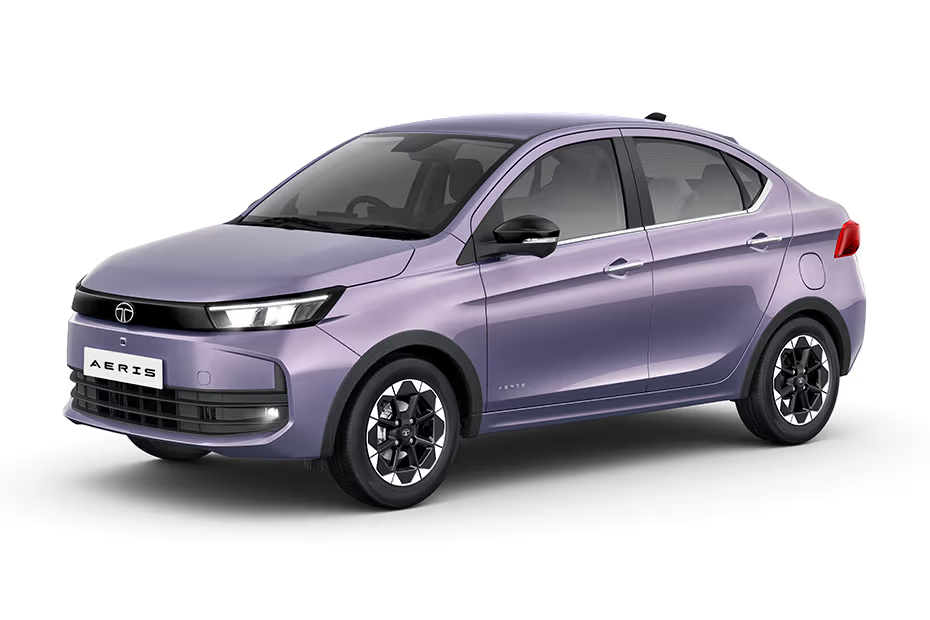
The compact sedan segment in India has a new contender. Tata Motors has introduced the Aeris, replacing the Tigor in its passenger-car lineup, and it enters the market directly against established models such as the Maruti Suzuki Dzire.
Both cars follow the same basic formula: compact dimensions, petrol and CNG powertrains, automatic options and family-friendly cabins. However, their approach to pricing, features, performance and practicality is different.
The Tata Aeris has been launched at an introductory ₹5.29 lakh ex-showroom, while the Maruti Suzuki Dzire starts at around ₹6.31 lakh ex-showroom.
This gives the Aeris a notable starting-price advantage. Tata offers the Aeris in five trims — Smart, Pure, Pure+, Creative and Accomplished — with petrol and CNG options and manual or AMT transmissions depending on the variant.
|
Specification |
Tata Aeris |
Maruti Suzuki Dzire |
|
Starting price |
₹5.29 lakh* |
₹6.31 lakh* |
|
Length |
3,995 mm |
3,995 mm |
|
Width |
1,684 mm |
1,735 mm |
|
Height |
1,532 mm |
1,525 mm |
|
Wheelbase |
2,450 mm |
2,450 mm |
|
Petrol engine |
1.2-litre, 3-cylinder |
1.2-litre, 3-cylinder |
|
Petrol power |
86 hp |
81.58 PS |
|
Petrol torque |
113 Nm |
111.7 Nm |
|
Boot space |
419 litres |
382 litres |
|
CNG |
Yes |
Yes |
|
Automatic |
5-speed AMT |
5-speed AGS |
The Aeris uses a 1.2-litre three-cylinder petrol engine producing 86hp and 113Nm. Its CNG version produces 75.5hp and 96.5Nm. Both powertrain options are available with manual and AMT transmissions across the range, depending on variant.
The Dzire also uses a 1.2-litre petrol engine, with Maruti Suzuki quoting 81.58 PS and 111.7Nm in petrol form. It is offered with a five-speed manual and AGS automatic, while the CNG version is also available.
The Dzire has a stronger focus on fuel efficiency, with Maruti Suzuki quoting up to 24.79km/l for petrol manual, 25.71km/l for AGS and 33.73km/kg for CNG.
The Aeris gets features such as an 8-inch or 10.25-inch touchscreen depending on variant, wireless Android Auto and Apple CarPlay, connected-car technology, a 360-degree camera, automatic climate control, cruise control, ventilated front seats and wireless charging on higher variants.
The Dzire counters with a 9-inch SmartPlay Pro+ infotainment system, electric sunroof, 360-degree camera, wireless charger, automatic climate control, rear AC vents and Suzuki Connect, depending on variant.
Interestingly, both sedans have the same 3,995mm length and 2,450mm wheelbase. However, the Dzire is wider at 1,735mm, while the Aeris is slightly taller.
The biggest practical difference comes in the boot. The Aeris offers 419 litres, compared with 382 litres in the Dzire. That extra capacity could be useful for families carrying larger bags or luggage on weekend trips.
Both cars offer six airbags and electronic safety systems, while the Dzire has a 5-star Global NCAP rating according to Maruti Suzuki.
The Aeris also gets six airbags as standard along with ESP, traction control, ABS with EBD and ISOFIX child-seat mounting points.
The Tata Aeris brings a lower entry price, more boot space and a strong equipment list, making it an interesting new option in the compact-sedan segment.
The Maruti Suzuki Dzire, meanwhile, continues with a strong focus on fuel efficiency, established market presence and a broad feature and powertrain package.
For buyers comparing the two, the decision will largely come down to purchase budget, fuel economy expectations, features, boot requirements and long-term ownership priorities