
 Khyati Sharma 2026-09-15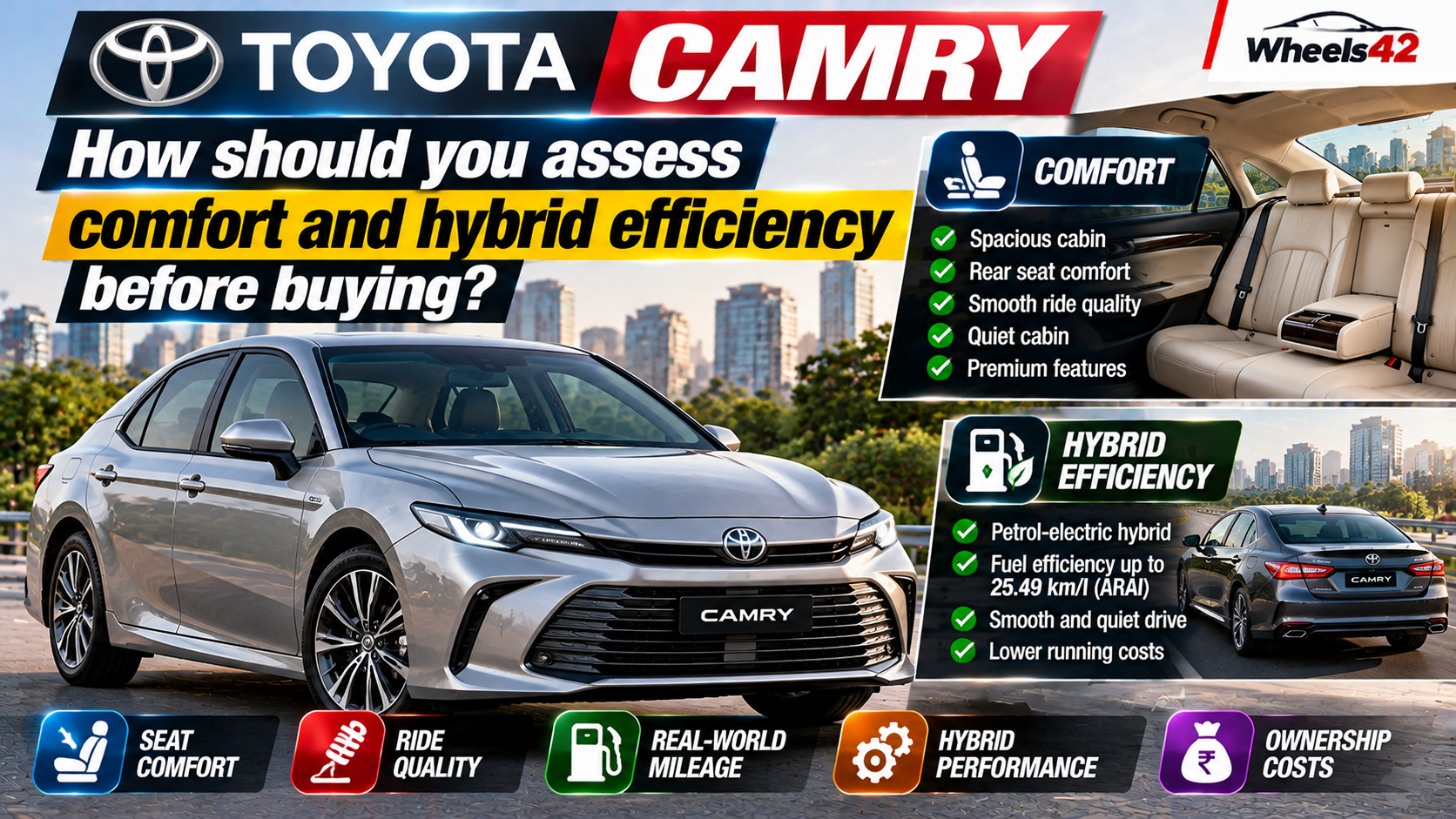
The Toyota Camry is designed for buyers who want a premium sedan that combines a spacious cabin, relaxed driving experience and the fuel-saving benefits of hybrid technology. Its appeal extends to professionals, families and chauffeur-driven owners who spend considerable time travelling in city traffic or covering long highway distances.
However, choosing a premium hybrid sedan requires more than checking its claimed mileage or reviewing its equipment list. Buyers should assess seating comfort, suspension performance, cabin noise, rear-seat amenities and actual fuel consumption under their usual driving conditions.
Here is how to evaluate the Toyota Camry before deciding whether it suits your needs.
|
Specification |
Toyota Camry Hybrid |
|
Engine |
2.5-litre petrol engine |
|
Hybrid system |
Fifth-generation strong hybrid |
|
Combined maximum power |
230 PS |
|
Transmission |
e-CVT |
|
Fuel type |
Petrol-electric hybrid |
|
Claimed fuel efficiency |
25.49 km/l |
|
Length |
4,920 mm |
|
Width |
1,840 mm |
|
Height |
1,455 mm |
|
Wheelbase |
2,825 mm |
|
Seating capacity |
5 passengers |
|
Drive layout |
Front-wheel drive |
The first step is to spend enough time in the driver's seat during a test drive. A premium sedan should provide supportive seating, convenient controls and a driving position that remains comfortable during extended journeys.
The Camry offers electrically adjustable and ventilated front seats, helping occupants adjust their position and remain comfortable in warm weather. However, seat comfort is subjective, so buyers should check whether the seat cushion, backrest and available adjustments suit their body type.
During the test drive, consider the following:
Does the seat provide adequate thigh and lower-back support?
Can you adjust the seat and steering wheel to achieve a natural driving position?
Are the pedals and major controls easy to reach?
Is the seat comfortable after 20–30 minutes of continuous driving?
Can you enter and exit the car comfortably?
Also check the visibility from the driver's seat, particularly when parking or manoeuvring in narrow urban spaces.
Hatchback vs Sedan vs SUV: Which Car Type Suits You Best?
Rear-seat comfort is one of the Toyota Camry's major attractions, particularly for buyers who frequently travel with family members or use a chauffeur.
Its 2,825 mm wheelbase helps provide a spacious cabin, while the rear seating area offers generous legroom and headroom. Features such as powered rear-seat recline, rear sunshades and controls integrated into the centre armrest can make longer journeys more convenient.
Before buying, sit in the rear seat rather than relying only on photographs or specification sheets.
Check whether there is sufficient knee room behind your preferred front-seat position. Taller passengers should also assess headroom, while families should consider how easily occupants can enter and exit the rear cabin.
If the car will regularly carry three adults in the back, check shoulder room and seating comfort with all three occupants present. The centre seating position may feel different from the two outer seats.

The Toyota Camry combines a 2.5-litre petrol engine with an electric motor and a lithium-ion battery. Its hybrid system can use electric power at suitable operating conditions and coordinate the petrol engine and electric motor to improve efficiency.
Unlike a plug-in hybrid, the Camry does not need to be connected to an external charger for routine driving. Its battery is charged through the hybrid system, including regenerative braking.
The e-CVT transmission is designed to provide smooth acceleration, particularly in stop-and-go traffic. Buyers who are accustomed to conventional automatic gearboxes should test-drive the car to understand how engine speed and acceleration feel during hard acceleration.
The hybrid system is particularly worth considering if your driving includes frequent traffic signals, slow-moving traffic and regular deceleration. However, efficiency also depends on driving style, traffic, air-conditioning use, road conditions and trip length.
Toyota quotes a fuel efficiency figure of 25.49 km/l for the India-specification Camry Hybrid. This is a useful reference point, but it should not be treated as a guaranteed everyday result.
Actual fuel consumption can differ considerably between city and highway driving. The hybrid system can recover energy during deceleration, but high speeds, heavy acceleration and demanding road conditions can increase fuel consumption.
Use the following checklist during your assessment:
City driving: Observe how smoothly the vehicle moves through slow traffic and how often the hybrid system uses electric power.
Highway driving: Check fuel consumption during steady-speed cruising.
Mixed driving: Consider your actual weekly mix of traffic, highways and short trips.
Air-conditioning: Test the vehicle with the climate control operating as you would normally use it.
Driving style: Compare results using a consistent, relaxed driving approach.
For a more meaningful comparison, calculate fuel consumption over several refuelling cycles rather than relying on one short test drive or a single dashboard reading.
Manual vs Automatic Car: Pros and Cons Explained
A premium sedan should remain comfortable over broken roads and at highway speeds. The Camry uses MacPherson strut front suspension and double-wishbone rear suspension, with a setup intended to balance ride comfort and stability.
During a test drive, include roads with speed breakers, uneven surfaces and rough patches where safe. Observe how the suspension absorbs bumps and whether the cabin remains composed over repeated undulations.
Pay attention to tyre noise, wind noise and engine sound. Hybrid operation can be particularly quiet at low speeds, but the petrol engine may become more noticeable during strong acceleration.
A longer test drive is more useful than a short loop around the dealership because it provides a better sense of ride comfort, seat support and cabin refinement.
Hybrid efficiency can help reduce fuel expenditure, but the Camry's purchase price and other ownership expenses should also be included in your decision.
|
Ownership factor |
What to check |
|
Fuel expenditure |
Estimate annual kilometres and realistic mileage |
|
Purchase price |
Compare the final on-road quotation |
|
Insurance |
Obtain an actual annual premium quotation |
|
Servicing |
Check scheduled maintenance costs |
|
Hybrid battery |
Understand warranty terms and coverage |
|
Tyres |
Compare replacement costs for the specified tyre size |
|
Resale value |
Consider your expected ownership period |
|
Daily usage |
Assess whether the car fits your parking and driving needs |
A useful method is to estimate annual fuel costs using your expected distance and realistic mileage, then add insurance, servicing, tyres and other ownership expenses. Compare the result with alternative cars you are considering.
Do not assume that better fuel efficiency alone will automatically make a more expensive car cheaper to own. The outcome depends on purchase price, kilometres driven and how long you keep the vehicle.
The Camry may suit buyers who prioritise rear-seat comfort, quiet low-speed operation, premium-sedan refinement and reduced fuel consumption compared with many conventional petrol-powered cars.
It is worth shortlisting if you frequently travel with passengers, cover substantial distances or want a premium sedan without depending on external charging.
However, buyers seeking a sporty driving experience should assess acceleration response and handling carefully. Those who primarily make very short journeys should also consider their annual mileage and overall ownership costs before paying a premium for hybrid technology.