
2026-11-15
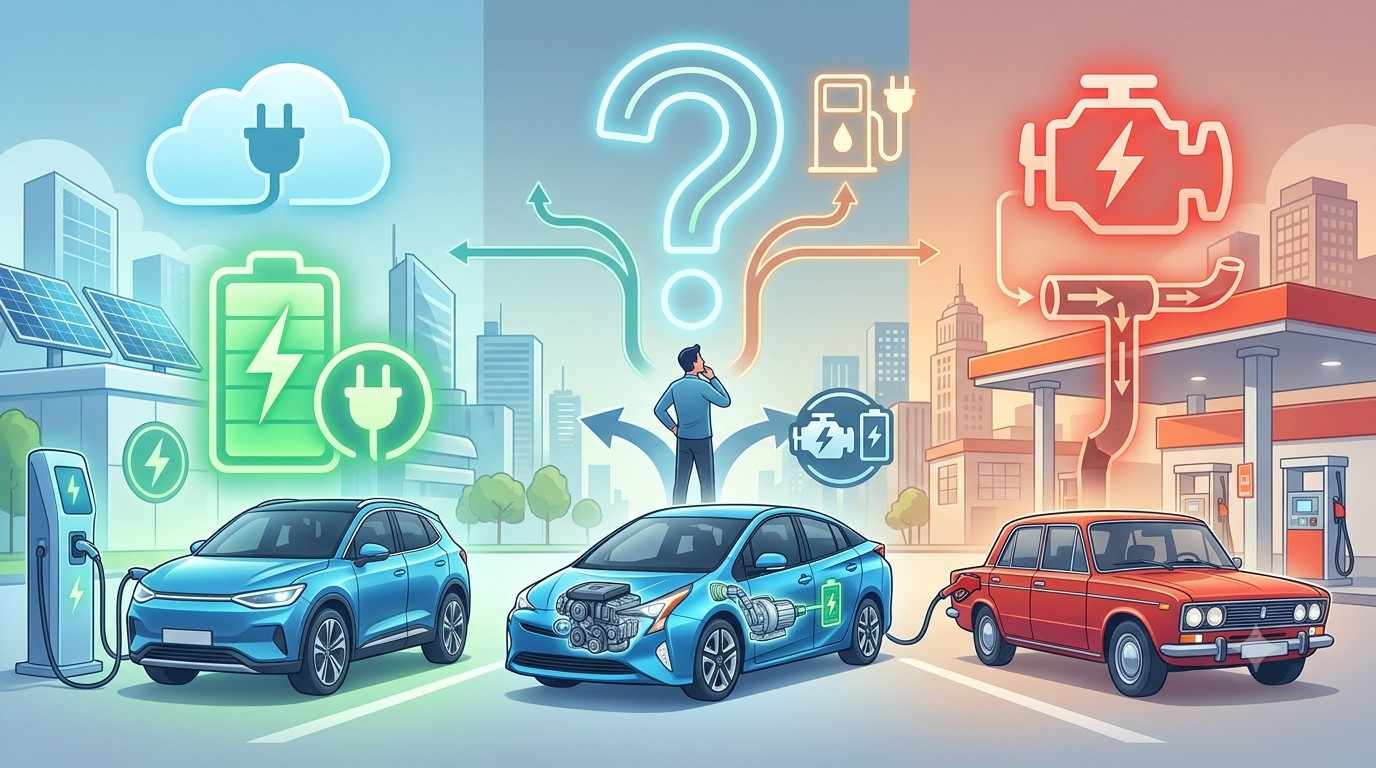
Pick by how you drive and where you can charge. Choose an EV if you can charge at home or work and drive enough kilometres to repay the price gap. Choose a strong hybrid if you can’t charge reliably but drive a lot in the city and want lower fuel bills without a plug. Choose petrol if you drive little, want the lowest price, or take long trips on routes without fast chargers. Your yearly kilometres and the price gap decide it more than the badge on the boot.
| Your situation | Best fit | Why |
| Home or work charging, 12,000+ km a year | Electric | Lowest running cost, 5% GST |
| No charging, 12,000+ km a year, mostly city | Strong hybrid | Fuel savings without a plug |
| No charging, frequent long trips | Strong hybrid or petrol | No dependence on chargers |
| Under about 6,000 km a year | Petrol | Premiums take too long to repay |
| Two cars at home | EV for daily use, petrol or hybrid for trips | Each does what it does best |
A petrol car burns fuel to move. An electric car runs on a battery you plug in. A hybrid does both, in different mixes, and the mix matters a lot.
The word hides three very different cars.
| Type | What it does | Plugs in? | Drives on electric alone? | In India |
| Mild hybrid | A small motor assists the engine and restarts it | No | No |
Common on mainstream petrol cars, with a modest fuel saving |
| Strong hybrid | The motor can move the car alone at low speeds and recovers energy when you brake | No | Yes, for short low-speed stretches |
A handful of models, such as the Toyota Hyryder, Maruti Grand Vitara and Honda City e:HEV |
| Plug-in hybrid (PHEV) | A larger battery you charge, giving an electric range before petrol takes over | Yes | Yes, for tens of kilometres | Few models, mostly premium |
So a strong hybrid charges itself from the engine and braking, and you never plug it in. That’s the most common mix-up we see in comparisons, and it matters because it decides whether you need a charger at home at all.
Delhi charges 10% road tax on cars above ₹10 lakh ex-showroom. So a full waiver on a ₹12 lakh EV removes about ₹1.2 lakh from the price gap. Your state can move the gap by lakhs, so compare on-road prices, not ex-showroom ones.
The table uses stated assumptions, not claims: petrol at ₹100 a litre, and real-world figures that run below the ARAI numbers. Strong hybrid claims sit around 23 to 28 km per litre on paper, so use an owner’s figure.
| Powertrain | Assumption | Cost per km | Cost for 12,000 km |
| Petrol | 14 km per litre | ₹7.1 | ₹85,700 |
| Strong hybrid | 22 km per litre | ₹4.5 | ₹54,500 |
| EV, home charging | 0.15 kWh per km at ₹8 a unit | ₹1.2 | ₹14,400 |
| EV, public fast charging | 0.15 kWh per km at ₹20 a unit | ₹3.0 | ₹36,000 |
The hybrid’s gain is biggest in stop-start city traffic, where the motor does the low-speed work and braking recovers energy. On a steady highway, the gap narrows.
This table assumes a ₹2.5 lakh premium for the hybrid and ₹4 lakh for the EV, both over the petrol car, with home charging for the EV.
| Yearly driving | Hybrid saving per year | Hybrid payback | EV saving per year | EV payback |
| 6,000 km | ₹15,600 | About 16 years | ₹35,700 | About 11 years |
| 12,000 km | ₹31,200 | About 8 years | ₹71,300 | About 5.6 years |
| 20,000 km | ₹51,900 | About 4.8 years | ₹1,18,900 | About 3.4 years |
Here’s the catch. An EV without home charging pays back no faster than a strong hybrid. At ₹3 per km on public chargers, the EV saves about ₹49,700 a year at 12,000 km, which gives a payback of about 8 years, the same as the hybrid. So charging access, not the technology, decides the EV’s edge. For the longer version of this maths, read are electric cars really worth it, which sets the payback against the evidence on common worries.
Ask for a service cost estimate and an insurance quote for each car you’re weighing. Those two numbers vary by model more than by powertrain.
An EV if you can charge, a strong hybrid if you can’t. Both recover energy when you brake and use little or no fuel at low speeds. Petrol gets nothing back, which is why it costs the most per km here.
Petrol or an EV with fast chargers on your route. A strong hybrid’s advantage shrinks at steady speeds, because the engine does most of the work.
A strong hybrid is the least fuss. An EV works if your routes have fast chargers and you accept the stops. On a 600 km day, a car with a 40 kWh battery needs roughly 56 kWh from fast chargers, about an hour of charging in total, usually split across two or three stops.
Petrol. At 4,000 km a year, neither premium repays within the life of the car.
Five checks catch most bad choices:
If an EV is on your shortlist, the checks run deeper. The complete EV buying guide for India covers charging access, warranty, insurance and documents in one place.
Some do and some don’t. Each belief below matches a concern buyers voice in surveys, and each has a data point behind the answer.
Not for strong hybrids. Only plug-in hybrids take a plug, and in India those are mostly premium models. So a strong hybrid buyer doesn’t need a home charger.
They don’t. EVs pay 5% GST, while strong hybrids pay 18% to 40%, like petrol cars. State road tax varies, as the Uttar Pradesh and Delhi cases above show. Check your state before you assume a waiver.
This is the top worry among hesitant buyers. In the PulseAI survey of 1,300 Indian consumers, 23.2% of reluctant shoppers cited battery replacement cost. Here’s what the data shows:
Those last two aren’t India-specific figures. Out-of-warranty replacement estimates vary widely, from roughly ₹4 lakh to ₹10 lakh or more. For an owner of five to eight years, the warranty covers most of that risk.
In the same survey, 20.9% of hesitant buyers cited battery safety or fire. Sweden’s civil contingencies agency counted 0.004% of EVs catching fire in 2022, against 0.08% of petrol and diesel cars. But EV fires can reignite and need trained responders, India-specific data is thin, and US analyses based on crash-board and recall data put hybrids highest per car sold. So fire risk doesn’t separate these three powertrains clearly. Check each model’s safety rating and the service network.
Not quite. An IIT Roorkee and ICCT review of six Indian studies found that battery EVs emit up to 38% less CO2e per km than petrol cars, and that they beat both petrol and hybrid cars on life-cycle emissions. An earlier ICCT paper put the lifetime saving for a medium car in India at 19% to 34%. The opposite claim, that EVs have no emissions at all, is just as shaky. Whether an EV produces no emissions anywhere in its life cycle covers both sides.
Aarti, Manoj and Farah are hypothetical buyers, not real customers. They use the assumptions above: a ₹2.5 lakh hybrid premium, a ₹4 lakh EV premium, and costs per km from the table.
| Buyer | Driving | Charging | Best fit | Why, in numbers |
| Aarti | 15,000 km a year, mostly city | Home charger | EV |
Saves about ₹89,000 a year, with payback in about 4.5 years |
| Manoj | 18,000 km a year, city plus monthly 400 km trips | None at home | Strong hybrid |
Saves about ₹47,000 a year, with payback in about 5.4 years |
| Farah | 4,000 km a year, mostly weekends | Not needed | Petrol |
Hybrid payback about 24 years, EV about 17 years |
Aarti ends up about ₹46,000 ahead after five years. Manoj’s EV on public chargers would also pay back in about 5.4 years, the same as the hybrid, but he’d have to plan every trip around chargers he doesn’t have at home. He plans to keep the car seven years, which puts him about ₹77,000 ahead with the hybrid. Farah saves almost nothing from either premium.
The same three prices produced three different answers. Their kilometres and charging decided it, not the technology. These figures are illustrative and ignore insurance, financing and resale.
If an EV wins your test, compare prices, range and battery sizes across electric cars listed on Wheels42. Then run your own kilometres through the payback table for each car. If a hybrid wins, ask each dealer for the real-world mileage owners get, not the ARAI figure.
A quick checklist:
The one that does the daily, predictable trips. An EV’s savings come from the kilometres you drive at about ₹1.2 each, and short regular drives charged at home deliver that. Keep the other car, petrol or hybrid, for long irregular trips, where public charging costs about ₹3 per km and takes time. Don’t replace the car that does your highway runs.
If you can charge at home, the EV. With no price gap to repay, you save about ₹3.3 per km from day one against the hybrid’s ₹4.5. If you can’t charge reliably, take the hybrid. Compare like with like, though: a full road-tax waiver on a ₹12 lakh car in Delhi can erase about ₹1.2 lakh of the gap, so make sure both quotes are on-road and for the same variant level.
Usually only if the real-world gain is large. A mild hybrid can’t drive on electric alone, and its battery is small. Say the mild hybrid variant costs ₹60,000 more and moves from 14 to 15.5 km per litre. That saves about ₹0.69 per km, or about ₹8,300 a year at 12,000 km, which is a payback of about 7 years. Ask for the owner-reported gain, and check how much of the extra price is features.
Only if you can plug in every night and the premium fits. PHEVs in India are mostly premium models, with electric ranges of tens of kilometres. If you rarely plug in, you carry a bigger battery for nothing and run as a heavier petrol car. A simple test: if you can’t name where you’ll plug in every night, skip it.
Treat the premium as at risk. Resale for EVs and hybrids is still uncertain, because the used market is young and public data is thin. Run the payback with a conservative assumption: you won’t recover the premium at resale, and the running savings alone must beat it within your holding period. If they don’t, petrol is the safer choice. If you do buy a hybrid or EV, pick a popular model with a transferable warranty and keep every service record.
This article gives general information, not personal financial or technical advice. Prices, tax rates and state policies change, so confirm current figures with your dealer and state transport department. For a purchase this size, speak with a qualified advisor.
Sources: Business Today reporting on GST for EVs and strong hybrids (April and June 2026); Autocar Pro and Outlook India on Delhi’s EV policy and Uttar Pradesh’s road tax waiver; PulseAI Research, “The Great Indian Switch” (October 2026); Swedish Civil Contingencies Agency fire statistics (2022); IIT Roorkee and ICCT life-cycle review (India); Recurrent and Geotab battery studies.