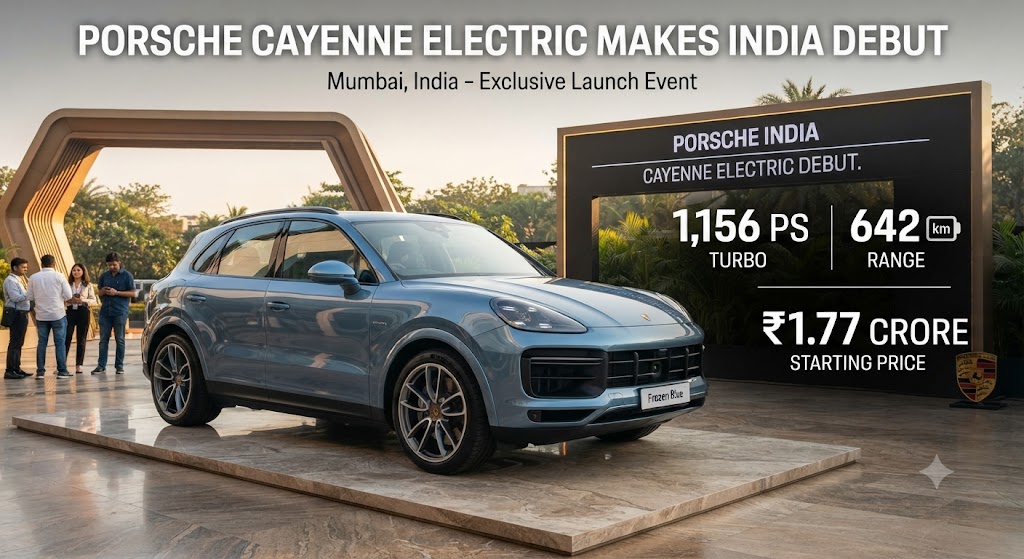
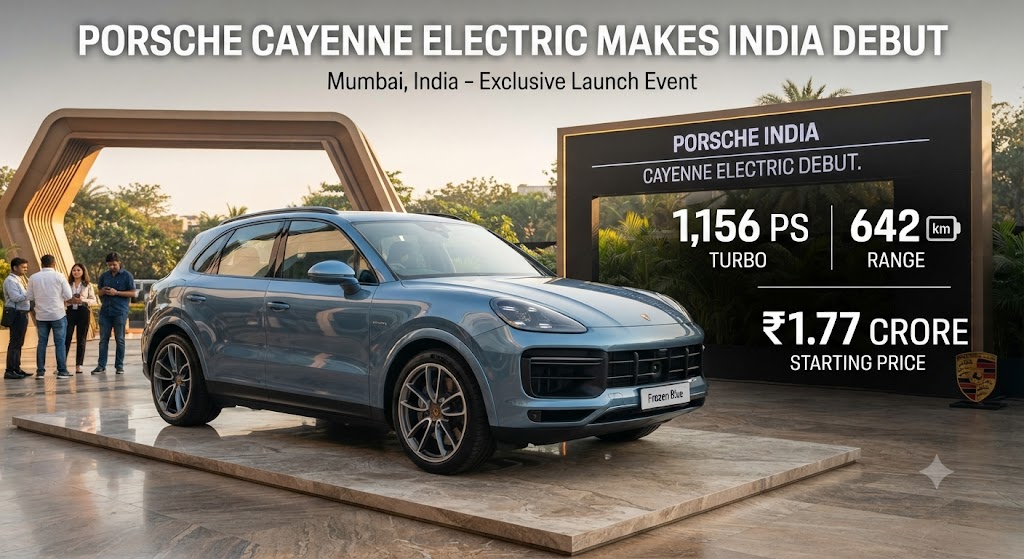
Porsche has officially brought the all-electric Cayenne to India, adding a new high-performance electric SUV to its luxury portfolio. The Cayenne Electric is offered in two versions at launch — the Cayenne Electric and Cayenne Turbo Electric — combining all-wheel drive, rapid charging technology and sports-car levels of performance.
The standard Cayenne Electric starts at ₹1.77 crore, while the Cayenne Turbo Electric is priced from ₹2.28 crore, with both prices including VAT on Porsche India's current model listings.
Rather than simply converting the Cayenne into an EV, Porsche has developed the electric version around a dedicated high-voltage architecture designed to deliver strong acceleration, long-distance capability and quick charging.
Here are the five major highlights of the new Porsche Cayenne Electric.
1. Sports-Car Performance From an Electric SUV
Performance remains central to the Cayenne Electric's identity.
The standard Cayenne Electric produces up to 442 PS with Launch Control, while its normal operating output is 408 PS. It can accelerate from 0-100 km/h in 4.8 seconds and has a top speed of 230 km/h.
The Cayenne Turbo Electric takes performance to another level. It develops up to 1,156 PS and 1,500 Nm with Launch Control, allowing it to sprint from 0-100 km/h in just 2.5 seconds. Its top speed is electronically limited to 260 km/h.
Both versions use all-wheel drive, with Porsche's electronic traction management system distributing power between the axles.
2. Large Battery and Long Driving Range
The Cayenne Electric gets a 113kWh high-voltage battery, giving the SUV the energy capacity required for both performance and long-distance driving.
Porsche's published WLTP figures put the standard Cayenne Electric's combined range at up to around 643 km, depending on configuration and measurement specification. The Turbo Electric offers a WLTP range of up to around 624 km in Porsche's current international data.
The actual range experienced by an owner will depend on factors such as driving style, speed, temperature, road conditions, wheel selection and use of climate-control systems.
Nevertheless, the combination of a large battery and high-voltage architecture gives the Cayenne Electric a strong long-distance focus.
3. 800V Architecture Enables Extremely Fast Charging
One of the most important technologies underneath the Cayenne Electric is its 800-volt electrical architecture.
The SUV can accept DC charging at up to 390kW under suitable conditions. Porsche says the battery can be charged from 10% to 80% in around 16 minutes when connected to a sufficiently powerful compatible charger and when the battery is at the required temperature.
Porsche also states that the Cayenne can add roughly 325 km of WLTP range in 10 minutes under optimal charging conditions.
This technology could make the Cayenne Electric more convenient for long-distance journeys, although achieving the maximum charging performance requires a compatible high-power charging installation.
4. Technology-Focused Luxury Cabin
The cabin of the Cayenne Electric moves further toward a digital experience while retaining the premium character expected from a Porsche.
The SUV features a digital instrument display and a large 14.5-inch curved central infotainment touchscreen. An optional passenger display and augmented-reality head-up display are also available.
Depending on specification, buyers can also get electrically adjustable front seats, ventilated seats, four-zone climate control and a panoramic glass roof.
The result is a cabin that combines performance-oriented controls with the technology and comfort expected from a high-end electric SUV.
5. Advanced Chassis and Driver Assistance Technology
The Cayenne Electric isn't focused only on straight-line acceleration. Porsche has equipped it with an advanced chassis designed to balance performance with everyday usability.
Adaptive air suspension with Porsche Active Suspension Management (PASM) is standard on both launch variants. Rear-axle steering is available to improve manoeuvrability and high-speed stability, while the Turbo Electric adds further chassis hardware aimed at controlling its substantial performance output.
The SUV also offers a range of driver-assistance technologies, including systems for parking, lane changes, braking warnings, speed-limit assistance and surrounding-area monitoring.
These features are intended to make the Cayenne Electric easier to use during everyday driving while preserving its performance-oriented character.
Porsche Cayenne Electric: Key Specifications
|
Specification
|
Cayenne Electric
|
Cayenne Turbo Electric
|
|
Power with Launch Control
|
Up to 442 PS
|
Up to 1,156 PS
|
|
Maximum Torque
|
Up to 835 Nm
|
Up to 1,500 Nm
|
|
Battery
|
113 kWh
|
113 kWh
|
|
Drive
|
All-wheel drive
|
All-wheel drive
|
|
0-100 km/h
|
4.8 seconds
|
2.5 seconds
|
|
Top Speed
|
230 km/h
|
260 km/h
|
|
WLTP Range
|
Up to ~643 km*
|
Up to ~624 km*
|
|
Maximum DC Charging
|
Up to 390 kW
|
Up to 390 kW
|
|
10-80% DC Charging
|
Around 16 minutes*
|
Around 16 minutes*
|
|
India Price
|
From ₹1.77 crore
|
From ₹2.28 crore
|
A New Electric Direction for the Cayenne
The arrival of the Cayenne Electric gives Porsche a high-performance electric SUV positioned above the Macan Electric in size and with a distinctly different character.
Its combination of all-wheel drive, rapid acceleration, a large battery, 800V charging technology, adaptive air suspension and a technology-heavy cabin makes it one of the most significant electric additions to the Cayenne family.
For buyers considering an ultra-luxury EV, the Cayenne Electric's appeal is not based solely on its electric range. Porsche has attempted to retain the performance-focused character associated with the Cayenne while using electrification to deliver instant torque, fast charging and a highly digital driving experience.
With the Turbo Electric producing up to 1,156 PS and reaching 100 km/h in just 2.5 seconds, the electric Cayenne demonstrates just how far high-performance luxury SUVs have moved into the EV era.

 Khyati Sharma 2026-09-30