_11zon.webp)

 Khyati Sharma 2026-10-07
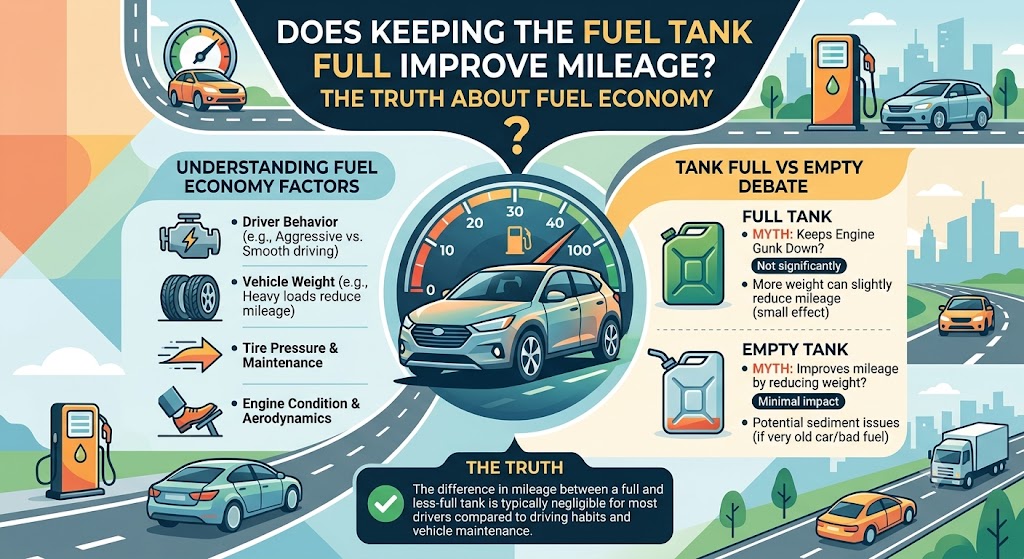
Many drivers believe that keeping their car's fuel tank full helps improve mileage, protects the engine and makes every litre of petrol or diesel last longer. Some motorists fill their tanks completely whenever they visit a fuel station, while others prefer to refill only when the fuel level becomes low.
But which approach is better for your car?
The truth is that keeping the fuel tank full does not directly improve fuel efficiency. Your car's mileage mainly depends on the engine, driving habits, traffic conditions, tyre pressure, vehicle maintenance and the amount of weight the vehicle carries. In fact, a completely full tank adds slightly more weight to the car than a partially filled tank.
However, that does not mean you should always drive with very little fuel. Maintaining a reasonable fuel level can help you avoid running out of fuel, reduce the risk of being stranded and provide a practical safety margin during long journeys.
Let's understand whether a full tank improves mileage, how fuel weight affects your car and when you should refill.
Documents Required to Buy a New Car in India (Complete Checklist)
No, keeping your fuel tank full does not automatically improve your car's mileage.
Mileage refers to the distance a vehicle travels using a particular amount of fuel. In India, petrol and diesel cars are commonly evaluated in kilometres per litre (km/l), while CNG vehicles are often measured in kilometres per kilogram (km/kg).
Your car's fuel efficiency depends on how effectively its engine converts fuel energy into movement. Filling the tank to its maximum capacity does not change the engine's basic efficiency or increase the energy available in each litre of fuel.
A full tank can make driving more convenient because you need fewer fuel-station stops. It can also be useful before a long journey, especially when fuel stations are far apart. However, convenience should not be confused with better mileage.
For everyday driving, maintaining a sensible fuel level and following good driving habits are more important than filling the tank completely.

One important factor that many drivers overlook is the weight of the fuel itself.
Petrol and diesel both have weight. When you fill a tank, you add more mass to the vehicle. The engine must move this additional weight whenever you accelerate, climb a hill or repeatedly start and stop in traffic.
For example, a car with a 40-litre fuel tank carries more fuel when the tank is full than when it is half-full. The additional fuel weight is not enormous compared with the total weight of the car, but it does add to the load.
The effect is generally small during normal driving. You should not expect a dramatic mileage improvement simply by driving with half a tank instead of a full tank.
The difference may become more noticeable over repeated journeys involving frequent acceleration, stop-and-go traffic or hilly roads. Even then, driving style and traffic conditions usually have a much greater effect on fuel consumption.
A full tank offers convenience and provides a larger reserve of fuel. A half-full tank carries less fuel weight but requires more frequent visits to fuel stations.
|
Factor |
Full Fuel Tank |
Half-Full Fuel Tank |
|
Fuel weight |
Higher |
Lower |
|
Mileage |
Does not automatically improve |
May offer a very small weight-related benefit |
|
Fuel-station visits |
Less frequent |
More frequent |
|
Long-distance travel |
Convenient when stations are far apart |
Requires more planning |
|
Risk of running out of fuel |
Lower if the fuel range is sufficient |
Higher if refuelling is delayed |
|
Best use |
Long trips and areas with fewer fuel stations |
Routine driving with convenient fuel access |
There are several reasons why this belief continues to circulate among motorists.
1. Fewer Visits to the Fuel Station
When the tank is full, drivers can travel longer before needing to refuel. This can create the impression that the car is delivering better mileage.
However, a longer distance between refills does not necessarily mean that the vehicle is consuming less fuel per kilometre. It simply has more fuel available at the beginning of the journey.
To calculate mileage accurately, compare the distance travelled with the amount of fuel consumed rather than judging performance by how long the tank lasts.
2. Fuel Gauge Readings Can Be Misleading
A car's fuel gauge does not always move at a perfectly uniform rate. The shape of the fuel tank, the gauge design and the vehicle's fuel-level calculation system can affect how the reading changes.
For example, the gauge may remain near full for some time before gradually dropping. This does not prove that the vehicle is using less fuel at the beginning of the journey.
Similarly, the gauge may fall faster near certain points because of the tank's shape or the way the display estimates the remaining fuel.
Best Time of the Year to Buy a New Car in India
3. Different Driving Conditions
A driver may fill the tank before a highway journey and notice better mileage than during the previous week of city driving.
However, the improvement may result from smoother traffic, a more consistent speed, fewer stops and less frequent acceleration. It is not necessarily caused by the full tank.
To compare fuel economy properly, similar driving conditions are needed.

Although keeping the tank full does not improve mileage, regularly allowing it to become nearly empty is not a good habit either.
1. You May Run Out of Fuel Unexpectedly
Traffic jams, road diversions and long stretches without fuel stations can increase fuel consumption or extend a journey unexpectedly. If you start with very little fuel, you may not have enough reserve to reach the next station.
This is particularly important when travelling on highways, through remote areas or in hilly regions.
2. Fuel Pumps Need Proper Operating Conditions
In many petrol vehicles, the in-tank fuel pump is cooled and lubricated partly by the surrounding fuel. Repeatedly running the vehicle with an extremely low fuel level can increase the risk of fuel-pump overheating or damage in some designs.
The exact risk depends on the vehicle's fuel-system design, so the owner's manual should guide your refuelling habits.
3. Fuel Delivery Problems Can Occur
If a vehicle runs out of fuel, the engine may stop unexpectedly. Restarting it may require additional steps on some diesel vehicles, and running out can be particularly inconvenient for modern fuel-injection systems.
Avoid treating the low-fuel warning as a signal to delay refuelling for as long as possible.
4. Long Journeys Require More Planning
On unfamiliar routes, a reasonable fuel reserve gives you more flexibility if a station is closed or unavailable. This is a practical safety consideration rather than a mileage trick.
Filling the tank to its designed capacity is generally normal when done correctly. The problem is not filling the tank; it is continuing to add fuel after the pump nozzle has automatically stopped.
Modern petrol vehicles have systems designed to manage fuel vapours. Overfilling can interfere with the vapour-control system and may allow liquid fuel to enter components that are intended to handle vapour.
For this reason, stop refuelling when the nozzle clicks off automatically. Do not repeatedly top up the tank to squeeze in extra fuel.
This advice is particularly relevant to petrol vehicles equipped with evaporative-emissions control systems. Always follow the vehicle manufacturer's refuelling instructions.
How to Get the Best Discount on a New Car in India
Instead of worrying about whether the tank is full, concentrate on habits that can make a more meaningful difference to fuel economy.
Maintain Correct Tyre Pressure
Underinflated tyres increase rolling resistance, which means the engine needs more energy to keep the vehicle moving. Check tyre pressure regularly and use the manufacturer's recommended figures.
Remember that the recommended pressure may differ depending on passenger load and driving conditions.
Drive Smoothly
Hard acceleration and sudden braking waste energy. Anticipate traffic, accelerate gradually and maintain a safe, consistent speed whenever conditions permit.
Smooth driving is especially helpful in busy urban traffic, where repeated acceleration can increase fuel consumption.
Avoid Unnecessary Idling
Leaving the engine running while parked or waiting can consume fuel without covering any distance. Switch off the engine when appropriate, following the vehicle manufacturer's guidance and local traffic rules.
Remove Unnecessary Weight
Heavy items in the boot increase the amount of energy required to move the car. Remove unnecessary luggage, tools or other objects that you do not need for your journey.
The effect of reducing weight varies by vehicle and driving conditions, but removing avoidable loads is a sensible habit.
Keep Up With Maintenance
Dirty air filters, worn spark plugs, incorrect engine oil and certain mechanical problems can affect fuel economy. Follow the recommended service schedule and investigate any sudden change in mileage.
Plan Your Journey
Combining multiple errands into one trip, avoiding heavy traffic where practical and selecting an efficient route can help reduce unnecessary fuel consumption.
Petrol vs Diesel vs CNG vs Electric Cars: How to Choose the Right Fuel Type
If you want to know whether your car is delivering good mileage, use a consistent measurement method rather than relying entirely on the fuel gauge.
A simple approach is the full-tank method:
Fill the tank until the pump nozzle automatically clicks off. Do not overfill it.
Reset the trip meter.
Drive normally for a reasonable distance.
Refill the tank using the same stopping method.
Divide the distance travelled by the litres of fuel required to refill the tank.
For example, if you travel 450 kilometres and the next refill requires 30 litres, your calculated mileage is 15 km/l.
This method provides an estimate. Results can vary because of traffic, temperature, route conditions, pump shut-off differences and driving style. Comparing several refills usually gives a more useful picture than relying on one reading.
Keeping your fuel tank full is not a proven way to improve mileage. A full tank adds some weight to the vehicle, although the effect on everyday fuel economy is generally small.
A half-full tank carries less fuel weight, but the potential mileage benefit is usually modest. For most drivers, it is not worth making frequent fuel-station trips or risking an empty tank simply to reduce weight.
The smarter approach is to maintain a reasonable fuel reserve, refuel before long journeys and stop when the pump nozzle automatically clicks off. Focus on tyre pressure, smooth driving, regular servicing and avoiding unnecessary loads for more practical fuel-efficiency benefits.











Kia Cars
₹11.02 Lakh