
 Khyati Sharma 2026-09-03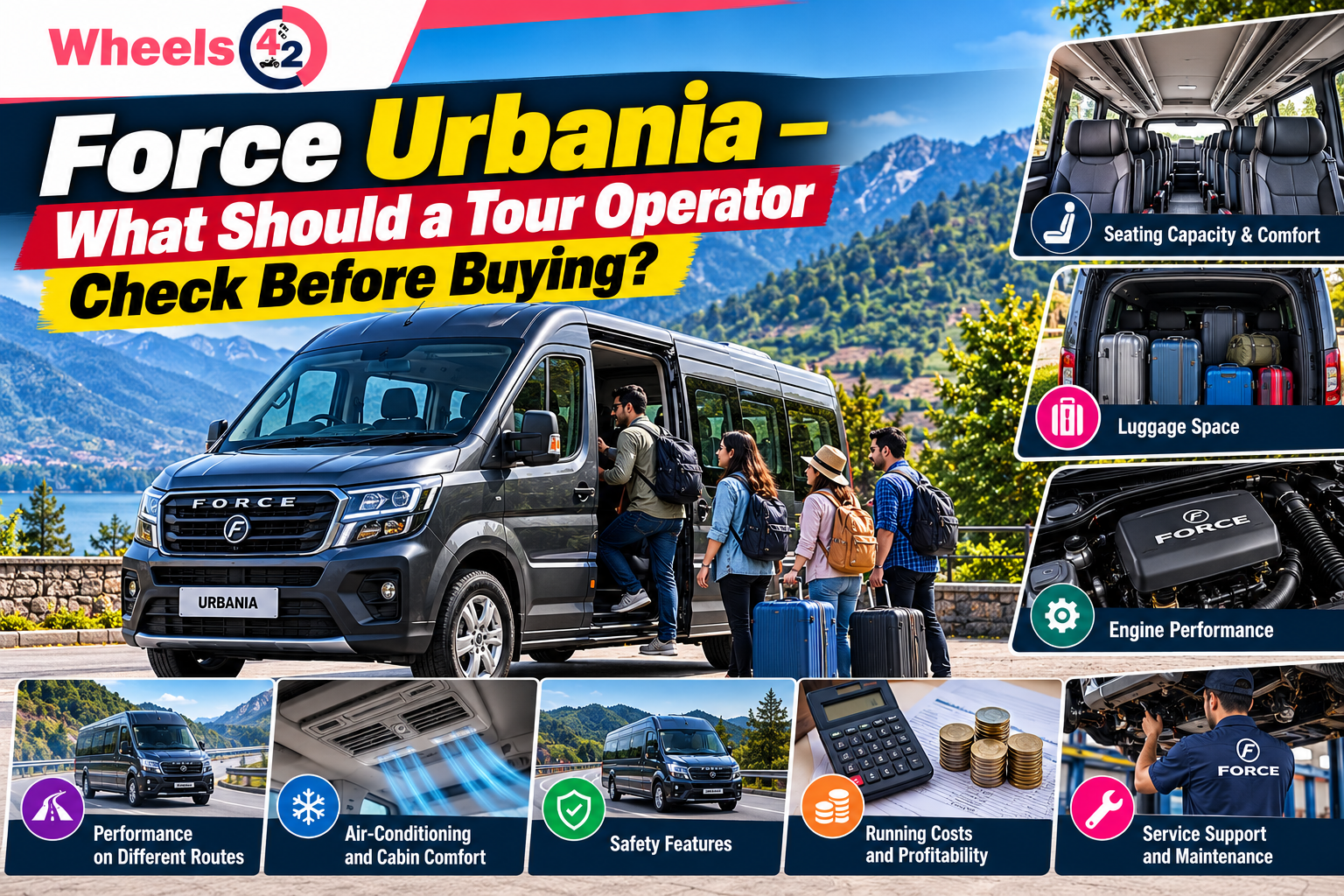
For a tour operator, buying a passenger van is not simply about choosing the vehicle with the most features. The vehicle needs to work as a business asset, carrying passengers comfortably while keeping operating costs, maintenance requirements and downtime under control.
The Force Urbania is positioned as a premium shared-mobility vehicle and is available in multiple seating and wheelbase configurations. With the latest Urbania DX, Force Motors currently offers configurations ranging from 9+D to 16+D, giving tour operators flexibility depending on the type of trips they operate.
But before signing the purchase order, there are several important factors that a tour operator should evaluate.
The first question should be: How many passengers do you normally carry?
The Urbania is available with different wheelbases and seating layouts. The current range includes 9+D, 10+D, 12+D, 13+D and 16+D configurations, depending on the version.
A smaller configuration could make more sense for premium airport transfers, corporate travel or small-group tours. Larger versions can be more appropriate for family groups, pilgrimage tours and larger tourist groups.
Choosing a vehicle that is consistently underutilised can hurt profitability, while an undersized vehicle can force operators to arrange additional vehicles.
Tour operators spend a lot of time building their reputation around the passenger experience.
The Urbania has been designed around premium shared mobility, with a monocoque construction, spacious cabin and recliner-style seating with additional legroom. The Urbania platform also features individual passenger comfort-oriented equipment such as dedicated AC vents.
However, operators should still conduct an actual passenger trial before buying.
Pay attention to:
Seat width and cushioning
Legroom
Entry and exit convenience
Air-conditioning performance
Interior noise
Luggage requirements
Passenger visibility
Ease of movement inside the cabin
For long-distance tours, these factors can be more important than the vehicle's exterior appearance.

The latest Urbania DX uses a 2.6-litre four-cylinder turbo-diesel engine producing 100 kW (134 hp) and 350 Nm of peak torque. The stronger output is intended to improve pickup and drivability, particularly when the vehicle is carrying passengers and luggage.
For a tour operator, the important question is not simply horsepower.
The operator should test how the vehicle performs when:
Fully loaded with passengers
Carrying luggage
Climbing hills
Driving on highways
Operating in stop-and-go traffic
Overtaking slower vehicles
A vehicle that feels comfortable with a full passenger load can be much more valuable to a tour business than one that looks impressive on paper.
The purchase price is only the beginning of the investment.
The current Urbania DX price list shows ex-showroom prices ranging from roughly ₹28.97 lakh to ₹34.38 lakh, depending on the wheelbase, seating configuration and specification.
A tour operator should calculate the complete ownership cost, including:
|
Cost Area |
What to Check |
|
Purchase price |
Ex-showroom and on-road cost |
|
Finance |
EMI, interest and down payment |
|
Fuel |
Expected monthly consumption |
|
Maintenance |
Scheduled service and wear items |
|
Insurance |
Annual commercial vehicle premium |
|
Tyres |
Replacement cost and expected life |
|
Driver cost |
Salary and allowances |
|
Permits |
Applicable commercial/tourist permits |
|
Downtime |
Lost revenue during repairs |
|
Resale |
Expected value after several years |
Passenger seating is only half the equation for a tour business.
A tourist travelling for several days may carry multiple bags. Airport transfers can also involve large suitcases, while pilgrimage and holiday tours can involve additional luggage.
Therefore, operators should physically test the luggage arrangement with the intended seating configuration.
Before purchasing, check whether the vehicle can comfortably accommodate:
Suitcases
Backpacks
Travel bags
Driver's luggage
Emergency equipment
A vehicle that carries 16 passengers but cannot accommodate their luggage effectively may not be practical for long-distance tourism.
Safety should be one of the biggest buying considerations when passengers are paying for transportation.
The latest Urbania Deluxe specification includes three-point seat belts for passengers, driver and co-driver airbags, all-wheel disc brakes, ABS, EBD, ESP and Engine Drag Torque Control.
For an operator, these systems can be particularly valuable because the vehicle may operate for long hours and across different road conditions.
Before purchasing, ask the dealer for the exact safety equipment applicable to the specific configuration being ordered.
For Indian tourism operations, air conditioning can directly influence customer satisfaction.
A tour operator should test the AC with the vehicle fully occupied rather than evaluating it with an empty cabin.
The test should ideally include:
Hot afternoon conditions
Highway operation
City traffic
Rear-seat cooling
Individual vent performance
Cooling recovery after frequent door opening
Passengers sitting at the rear should receive adequate cooling even when the vehicle is fully loaded.
The newer Urbania offers a more feature-rich cabin, including a TFT instrument cluster and a 9-inch HD touchscreen infotainment system with smartphone connectivity, navigation, reverse-camera functionality and Bluetooth calling. USB Type-A and Type-C charging ports are also available across the seating rows on the upgraded version.
For tour operators, these features can improve the passenger experience, particularly on longer journeys.
A reverse camera can also be useful when manoeuvring a large van in crowded tourist locations, hotels and parking areas.
A tour operator cannot afford frequent downtime.
Before buying, check the availability of authorised service support along the routes where the vehicle will operate.
This becomes particularly important if your tours regularly cover:
Remote tourist destinations
Mountain routes
Inter-state highways
Pilgrimage circuits
Long-distance routes
Ask the dealer about service intervals, roadside assistance, parts availability and expected turnaround time for common repairs.
The latest Urbania is also offered with Force Care support, which includes i-Pulse telematics, a five-year/5 lakh km warranty, three-year sensor warranty and three years of roadside assistance, according to the launch information.