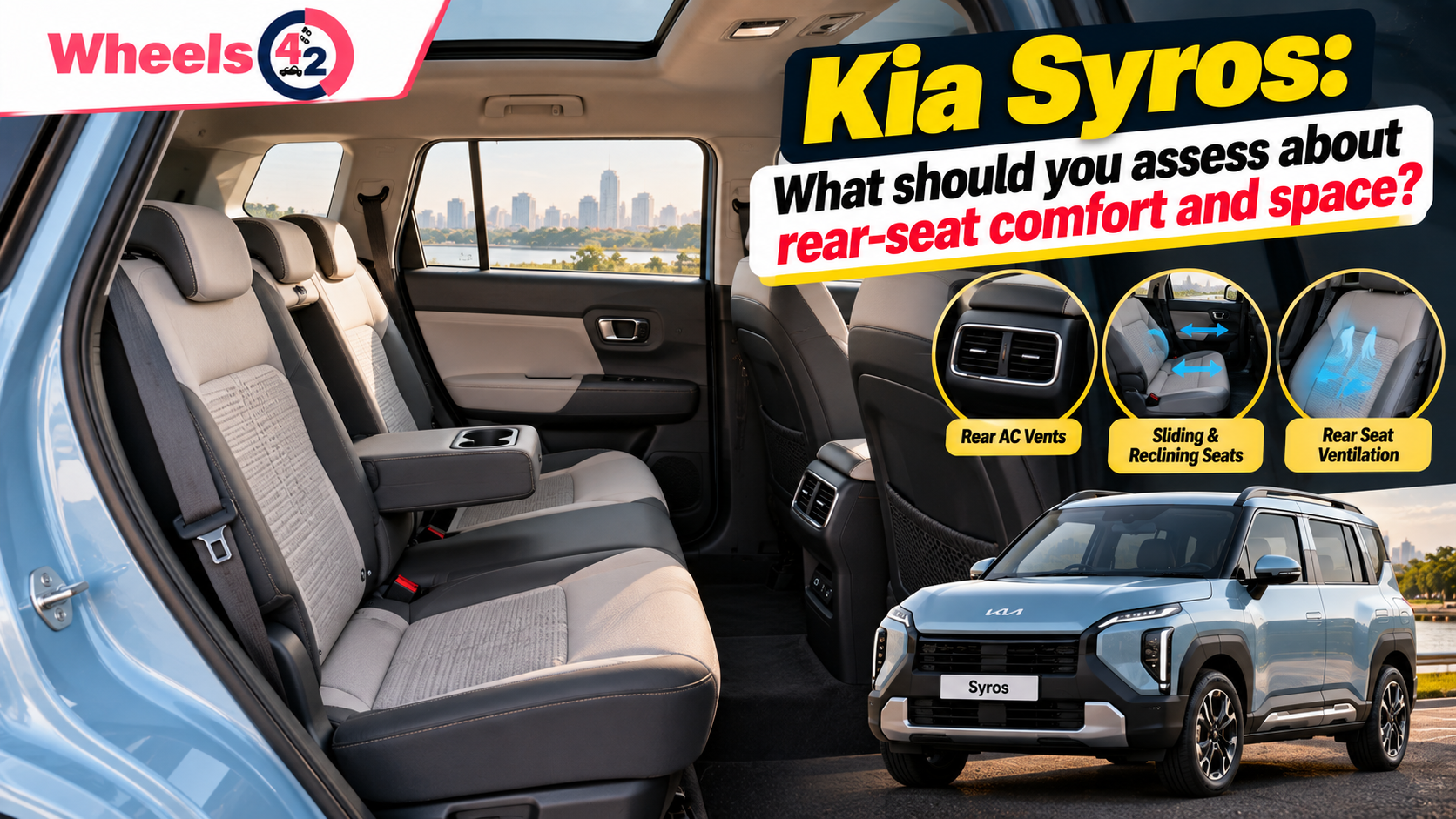
The Kia Syros takes a different approach to the compact SUV segment. Instead of focusing only on exterior styling and front-seat features, Kia has designed the Syros with a strong emphasis on rear-seat space, comfort and flexibility.
Its tall-boy body style and 2,550mm wheelbase help create a spacious cabin, while the sliding and reclining rear bench allows passengers to adjust the available legroom and backrest angle. The Syros also offers rear-seat ventilation on higher variants, along with features such as rear AC vents, sunshades and USB Type-C charging points.
But if you are considering the Syros as a family car, simply looking at the feature list is not enough. Here are the important areas you should assess before choosing it.
1. Check Rear Legroom First
Rear legroom is one of the biggest strengths of the Kia Syros.
The SUV cars has a 2,550mm wheelbase, which is longer than several other compact SUVs in the segment. Combined with its tall-boy proportions, this gives rear passengers generous legroom and headroom.
The rear bench can also slide forwards and backwards. This means you can prioritise either passenger space or luggage capacity depending on your requirements.
For a family that frequently carries adults in the second row, this flexibility can be particularly useful.
Before buying, sit in the rear seat with the front seat adjusted for your normal driving position. Check whether there is enough knee room for taller passengers rather than judging space only from the showroom walk-around.
2. Assess the Sliding Rear Seat
The Syros' sliding rear seat is one of its most useful practicality features.
Passengers can move the second-row bench to create additional legroom, or slide it forward when more boot space is required. The rear seat also gets a split-folding function.
This makes the Syros more flexible than a compact SUV with a fixed rear bench.
For example, if four people are travelling with large luggage, you can move the rear bench forward to increase cargo capacity. On a normal family trip with limited luggage, the seats can remain further back for improved passenger comfort.
Best Time of the Year to Buy a New Car in India
3. Check the Rear Seat Recline Function
Rear passengers can also adjust the seatback angle, allowing them to find a more comfortable seating position on longer journeys. Kia provides multiple recline positions, and the seatback can be locked securely after adjustment.
This is particularly useful for passengers who spend considerable time sitting in the second row.
However, buyers should physically try the recline mechanism before purchasing. The ideal position can vary depending on a passenger's height, preferred seating posture and whether the front seats are pushed far back.

4. Don't Ignore Thigh Support
The Syros offers impressive overall rear space, but thigh support should still be evaluated during a test drive.
The ICE version generally provides a comfortable rear-seat experience, with good legroom and a seating position that works well for adults. However, the newer Syros EV has a slightly raised rear floor because of its battery pack, which reduces under-thigh support compared with the petrol and diesel version.
Therefore, if you are considering the Syros EV, spend some time sitting in the rear rather than assuming the ICE and EV versions will feel identical.
5. Look at Rear-Seat Ventilation
One of the Syros' standout comfort features is rear-seat ventilation.
On higher variants, the rear seat base gets ventilation, which can be particularly useful in India's hot weather. Kia's 2026 brochure lists rear ventilated seats on the HTX(O), with ventilation specified for the seat thigh/base area.
There is an important distinction here: the rear backrest is not ventilated. Kia has explained that packaging the blower system into the backrest while retaining the required sliding and reclining movement presented engineering challenges.
So buyers should not assume that the Syros offers full seat ventilation similar to the front seats.
6. Check Rear AC Performance
Rear passengers also benefit from rear AC vents, which are available even on lower variants according to Kia cars current brochure.
This is an important consideration for family use because rear passengers can receive direct airflow rather than relying entirely on the front dashboard vents.
During a test drive, check how quickly the rear area cools down after the car has been parked in the sun. This can give you a better idea of real-world comfort than simply checking whether rear vents are present.
7. Examine the Rear Sunshades
The Syros also offers rear door sunshade curtains, helping reduce direct sunlight entering the second row.
This can be especially useful when children or older passengers regularly travel in the back.
Combined with the tall cabin and available panoramic sunroof, the sunshades give the rear compartment a more premium and airy feel without making it excessively exposed to sunlight.
8. Check the Rear Centre Seat
If you regularly carry five people, don't judge the Syros only by its outer rear seats.
Sit three adults across the second row and check:
-
Shoulder room
-
Seat width
-
Centre-seat cushioning
-
Knee clearance
-
Footwell space
-
Centre passenger comfort
-
Access to the seat belt
The Syros is primarily designed as a five-seater, so the practical comfort of the centre passenger matters if the vehicle will frequently be used by a full family.
9. Check Rear Amenities
The Syros offers several features designed to make the second row more convenient.
Depending on the variant, these include rear AC vents, Type-C USB ports, a rear centre armrest with cupholders, adjustable rear headrests and rear sunshades.
Higher variants add more premium touches, including rear-seat ventilation.
For families, these details can matter more in everyday use than some of the headline technology features on the dashboard.
10. Balance Passenger Space Against Boot Space
One of the Syros' biggest advantages is the ability to change the balance between passenger and luggage space.
The boot offers approximately 390 litres with the rear seats positioned fully back, increasing to around 465 litres when the rear bench is moved forward.
This gives owners a useful choice.
Maximum passenger comfort
Keep the rear seats further back and give passengers more legroom.
Maximum luggage capacity
Slide the rear seats forward and increase available boot space.
This is particularly useful for families because luggage requirements can change considerably between everyday commuting and weekend trips.
11. Consider Ride Comfort Too
Rear-seat comfort is not determined by space alone.
The Syros has a relatively firm ride setup. Reviews have noted that the suspension can transmit sharper impacts into the cabin when the vehicle encounters large potholes or sharp road edges.
Therefore, a proper test drive should include uneven roads rather than only smooth showroom surroundings.
Ask the rear passengers to sit in the second row while driving over typical roads in your area. This will provide a much better indication of whether the suspension suits your family.
12. Check the Cabin Experience on Longer Trips
The Syros' rear seat works particularly well for passengers because of the combination of space, reclining functionality and convenience features.
Long-term driving experience has also highlighted the generous knee and headroom, rear ventilation, sunshades, armrest with cupholders, rear AC vents and USB Type-C connectivity as useful family-oriented features.
However, the cabin can become noisier at higher speeds, according to road-test observations.
If highway journeys are a regular part of your usage, spend some time evaluating cabin noise along with seat comfort.
Kia Syros Rear-Seat Comfort: What Should You Check?
|
Area
|
What to Assess
|
|
Legroom
|
Excellent,with sliding rear bench
|
|
Headroom
|
Strong due to tall-boy design
|
|
Seat adjustment
|
Sliding and reclining
|
|
Rear ventilation
|
Available on higher variants;seat-base/thigh area
|
|
Rear AC
|
Rear AC vents available
|
|
Sunshades
|
Available
|
|
Rear armrest
|
Available on applicable variants
|
|
USB charging
|
Rear Type-C ports
|
|
Boot space
|
390-465 litres depending on seat position
|
|
Three-adult comfort
|
Should be personally tested
|
|
Ride comfort
|
Firm over sharp bumps
|
|
Highway comfort
|
Good space,but check cabin noise
|
Which Kia Syros Variant Makes Sense for Rear-Seat Comfort?
If rear-seat comfort is your main priority, the HTK+ and higher variants deserve particular attention because this is where the sliding and reclining rear seats become available. The HTK+ also gets the 60:40 split rear seats, adjustable rear headrests and rear centre armrest with cupholders.
The HTX(O) adds rear-seat ventilation, making it the more feature-rich choice for families that regularly carry passengers in the second row.
However, buyers should choose the variant based on actual needs rather than selecting a higher trim solely for one feature.
Final Verdict
The Kia Syros is one of the more rear-seat-focused compact SUVs in its segment.
Its 2,550mm wheelbase, tall cabin, sliding and reclining rear bench and generous headroom give it a strong advantage for families. The ability to move the rear seats also makes the Syros more practical because owners can choose between additional passenger space and additional boot capacity.
The higher variants add useful features such as rear-seat ventilation, sunshades, rear AC vents and a centre armrest, making the cabin more comfortable for longer journeys.
However, buyers should still check thigh support, three-adult seating comfort, ride quality and cabin noise during a real-world test drive. If you regularly carry adults in the rear, these factors will matter more than the number of features listed in the brochure.
For families looking for a compact SUV where rear passenger space and comfort are major priorities, the Syros deserves to be on the shortlist.

 Khyati Sharma 2026-09-06