 Khyati Sharma 2026-11-22
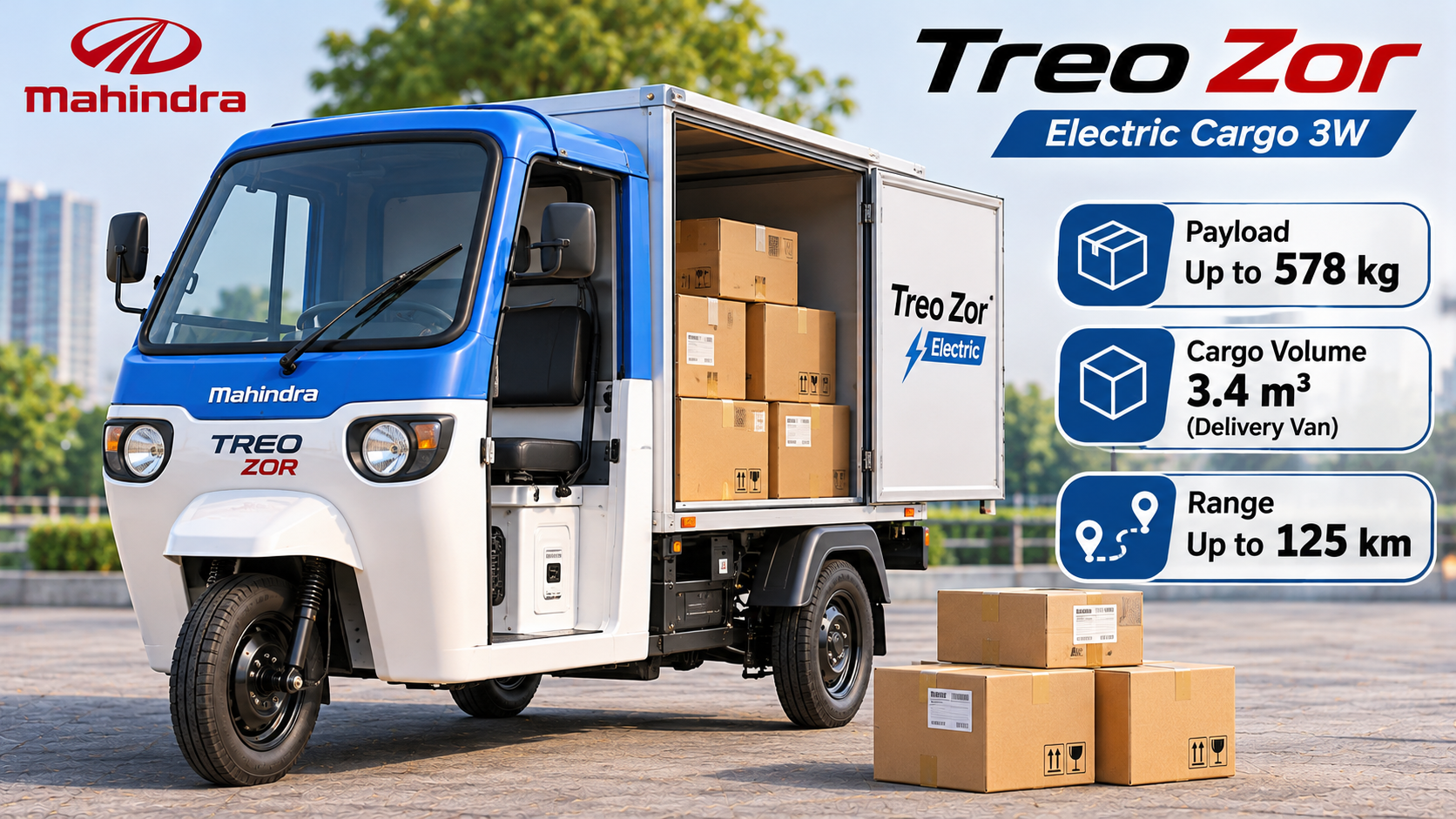
The growth of online shopping, quick-commerce services and local delivery businesses has increased the demand for affordable last-mile commercial vehicles in India. Electric cargo three-wheelers are becoming an attractive option for businesses that need to transport parcels, groceries, small packages and other goods through busy city roads. Among these options, the Mahindra Treo Zor is designed to support daily commercial delivery operations with its electric powertrain and multiple cargo body configurations.
But an important question for business owners is how many parcels can the Mahindra Treo Zor actually carry on a typical delivery route? The answer depends on the vehicle variant, parcel dimensions, individual package weight, loading arrangement and the total permissible payload.
The Treo Zor is available in Pickup, Flatbed and Delivery Van configurations. Each version serves a different type of cargo requirement. While the Pickup and Flatbed are suitable for open cargo, the Delivery Van offers an enclosed storage area that can be useful for courier companies and businesses transporting boxed goods.
Does a Bigger Truck Always Earn More Money? Understanding Truck Size, Costs and Profitability
Mahindra cv introduced the Treo Zor as an electric cargo three-wheeler for last-mile transportation. Its three configurations allow businesses to select a body style according to the type of goods they regularly transport.
The Pickup variant is designed for general cargo that can be loaded and unloaded from an open tray. It can be useful for grocery distributors, local shops, small suppliers and businesses carrying cartons or other packaged products.
The Flatbed variant provides an open loading platform. It is suitable for bulky or irregularly shaped items that may not fit easily inside a conventional enclosed cargo box. Furniture components, construction supplies and larger packages are examples of goods that may benefit from this configuration.
The Delivery Van variant is more relevant to courier companies, e-commerce businesses and organised parcel delivery operators. Its enclosed cargo compartment helps protect packages from direct exposure to rain, dust and road conditions.
According to the original Treo Zor specifications, the Pickup offers a payload capacity of 550 kg, the Flatbed offers 578 kg and the Delivery Van offers 500 kg. These figures are important because the maximum parcel count is not determined by cargo space alone. The vehicle must also remain within its permitted payload limit.

The cargo dimensions are particularly important for businesses transporting parcels of different shapes and sizes. A vehicle may have sufficient payload capacity but still be unable to accommodate a large number of packages if its cargo compartment is not arranged efficiently.
The Treo Zor Pickup has an internal cargo tray measuring approximately 1,500 mm in length, 1,400 mm in width and 278 mm in height. The Flatbed offers a loading platform measuring approximately 1,570 mm in length and 1,460 mm in width.
The Delivery Van has an enclosed cargo box measuring approximately 1,564 mm in length, 1,452 mm in width and 1,494 mm in height. Its listed cargo volume is around 3.4 cubic metres.
These dimensions make the Delivery Van the more suitable configuration for carrying stacked cartons and parcels. The Pickup and Flatbed can carry different types of goods, but their open loading arrangements may require additional securing and protection.
The original brochure specifications also list a loading height of approximately 675 mm, helping reduce the effort required when placing and removing goods.
Mahindra+1
The actual parcel count depends on the dimensions and weight of each package. There is no single fixed parcel capacity because courier packages can range from small envelopes to large household-product cartons.
For a practical example, consider a standard medium-sized parcel measuring 400 mm × 300 mm × 200 mm. Its volume is approximately 24 litres.
The Delivery Van's listed cargo volume of 3.4 cubic metres is equivalent to around 3,400 litres. Dividing the available volume by the volume of one parcel gives a theoretical maximum of approximately 141 parcels.
However, this is only a mathematical volume estimate. It assumes that the entire cargo compartment can be filled without gaps and that every parcel can be positioned perfectly. Real-world loading is less efficient because cartons have different dimensions, some packages cannot be stacked, and space is needed to accommodate irregular shapes.
A more realistic planning estimate would be around 80–100 medium-sized parcels, provided their combined weight remains within the vehicle's 500 kg payload limit. This is an illustrative estimate, not a manufacturer-certified parcel capacity.
For example, if each parcel weighs an average of 5 kg, 80 parcels would weigh 400 kg, while 100 parcels would reach 500 kg. The second example would use the entire stated payload allowance before accounting for any additional cargo-related equipment or other applicable loading considerations.
This demonstrates why businesses should calculate both the available cargo volume and the total package weight before deciding how many deliveries to load. If parcels are heavier, the vehicle may reach its payload limit while a considerable amount of cargo space remains unused.
|
Variant |
Cargo arrangement |
Payload capacity |
Best suited for |
|
Treo Zor Pickup |
Open tray, approximately 1,500 × 1,400 × 278 mm |
550 kg |
Grocery cartons, shop supplies and general packages |
|
Treo Zor Flatbed |
Open platform, approximately 1,570 × 1,460 mm |
578 kg |
Bulky goods, large packages and irregular cargo |
|
Treo Zor Delivery Van |
Enclosed box, approximately 1,564 × 1,452 × 1,494 mm |
500 kg |
Courier parcels, e-commerce packages and protected deliveries |
For a courier operator, the Delivery Van is likely to be the most convenient choice because its enclosed body makes it easier to organise parcels by delivery location. The Pickup can be more practical for businesses carrying mixed goods, while the Flatbed is useful when the cargo is too large or awkwardly shaped for a closed box.
The number of trips required depends on the number of parcels collected from a warehouse, their average weight and the distance between delivery locations.
Consider a small courier business that needs to deliver 150 medium-sized parcels in one working day. If the operator plans to carry approximately 75–80 parcels per load, two trips may be required. This is only a planning example: the actual number will depend on parcel dimensions, weight and how efficiently the cargo can be arranged.
A business carrying 200 smaller parcels may be able to complete the work in fewer trips if the packages are lightweight and compact. However, a smaller number of heavy parcels can fill the vehicle's payload capacity much sooner.
For example, imagine a local distribution business transporting packaged grocery products. If the average package weighs 8 kg, loading 60 packages would result in a total cargo weight of 480 kg. This would be close to the Delivery Van's stated 500 kg payload limit.
By comparison, a courier business carrying lightweight clothing packages may be limited by the available cargo space rather than weight. This is why businesses should record the average parcel dimensions and weight before deciding on a daily loading target.
A well-planned route can also reduce unnecessary trips. Grouping deliveries by neighbourhood, arranging packages in delivery order and avoiding repeated journeys to the warehouse can help improve daily productivity.
Pickup and Mini-Truck Maintenance: Daily Walkaround Checklist Every Driver Should Follow Before Dispatch
Cargo capacity is only one part of a commercial vehicle's performance. For delivery operators, driving range, charging time and operating efficiency are equally important.
The original Mahindra Treo Zor comes with an 8 kW electric motor producing 42 Nm of peak torque. It uses a 48V lithium-ion battery with a listed capacity of 7.37 kWh. The vehicle features direct-drive technology and does not require conventional gear shifting.
Mahindra announced a certified driving range of 125 km at the vehicle's launch. Actual range can vary depending on the load, traffic, road gradient, driving style, weather and battery condition. A fully loaded vehicle operating in congested urban traffic may not achieve the same range as a lightly loaded vehicle travelling on a smoother route.
Mahindra+1
The original specifications also list a charging time of approximately 3 hours and 50 minutes under standard conditions. The vehicle can be charged using a compatible 15-amp socket and the supplied charging equipment.
For a business operating several delivery routes each day, charging arrangements should be planned around working hours. Charging overnight or during a scheduled break can help reduce interruptions to delivery operations.
Loading a cargo vehicle is not simply about fitting as many packages as possible. The way parcels are arranged can affect vehicle stability, loading time and the safety of the goods.
For the Delivery Van, heavier cartons should generally be placed lower in the cargo compartment, with lighter packages positioned above them where safe. This helps maintain a more stable load and reduces the possibility of lighter packages being crushed.
Packages should also be grouped according to their delivery sequence. If the first delivery is placed at the back of the cargo area, the driver may have to move several other packages before reaching it. This increases unloading time and can slow down the entire route.
The Pickup and Flatbed variants need particular attention because their cargo is exposed. Packages should be secured properly using suitable restraints and covered when required. Loose cartons can shift during braking or cornering, potentially damaging the goods or affecting vehicle stability.
Businesses should also avoid stacking goods beyond the safe height or dimensions of the cargo body. The maximum theoretical volume should never be treated as permission to overload or carry unsecured cargo.

The Treo Zor can support several types of small and medium-sized delivery operations.
1. E-commerce and courier companies
The Delivery Van configuration is suitable for transporting boxed orders, online shopping packages and smaller consumer products. Its enclosed body helps protect parcels during regular urban deliveries.
2. Grocery and supermarket deliveries
The Pickup variant can be useful for transporting grocery cartons, packaged food products and supplies between shops, warehouses and customers. Operators should use suitable packaging and protection for goods that need special handling.
3. Local wholesalers and retailers
Small distributors can use the Treo Zor to move inventory between wholesale markets, storage facilities and retail shops. Its electric powertrain can be useful for businesses making frequent short-distance journeys.
4. Pharmaceutical and packaged-product distribution
The enclosed Delivery Van can transport appropriately packed pharmaceutical products and other small goods. Businesses carrying temperature-sensitive medicines must use a suitable temperature-controlled arrangement; a standard cargo compartment should not be assumed to provide refrigeration.
5. Small manufacturing businesses
Manufacturers can use the Pickup or Flatbed configuration to move components, finished products and supplies between production units and nearby customers.
Before starting a delivery route, operators should check the total cargo weight and ensure that the vehicle remains within its permitted payload. The weight of all goods and any additional equipment must be considered.
Parcel dimensions should also be checked against the usable cargo space. Large cartons may not fit through the cargo opening even when the total volume appears sufficient. This is especially important when transporting irregularly shaped packages.
The driver should ensure that the cargo is distributed evenly and secured properly. Overloading can affect braking, handling, tyre wear and vehicle performance. It can also create safety risks for the driver and other road users.
Businesses should additionally consider the condition of the battery, tyre pressure, brakes and charging equipment before beginning regular commercial operations. A vehicle that is maintained properly is more likely to deliver consistent performance throughout its working life.
Should You Buy a New or Used Car in India? Compare the Real Cost of Ownership.
The Mahindra Treo Zor offers a practical electric cargo platform for businesses that need to move goods over short and medium urban routes. Its three configurations provide flexibility, allowing operators to select an open Pickup, a Flatbed or an enclosed Delivery Van according to their requirements.
For parcel delivery companies, the Delivery Van is the most relevant configuration because of its enclosed cargo compartment. Its 500 kg payload and approximately 3.4 cubic metres of listed cargo volume provide a useful combination of weight capacity and storage space.
The Pickup and Flatbed versions offer higher stated payload capacities of 550 kg and 578 kg respectively, making them more suitable for certain types of general and bulky cargo.
However, businesses should not select a vehicle based only on its maximum payload or cargo volume. The best option depends on the average parcel size, package weight, delivery distance, daily trip requirement and the availability of charging facilities.
The Mahindra Treo Zor can be a useful option for last-mile delivery businesses, particularly those transporting parcels, grocery packages and small commercial goods. Its Delivery Van variant has a listed cargo volume of around 3.4 cubic metres and a payload capacity of 500 kg.
Based on an illustrative medium-parcel size of 400 × 300 × 200 mm, operators could use approximately 80–100 parcels as an initial planning estimate, subject to package weight and actual loading conditions. The theoretical volume calculation is higher, but real-world space utilisation and the payload limit determine the practical capacity.
Ultimately, the Treo Zor's usefulness depends on choosing the correct variant and planning each load carefully. For businesses looking to reduce repeated warehouse trips and organise daily urban deliveries, understanding both parcel dimensions and total cargo weight is essential.