 Khyati Sharma 2026-11-25
For many Indian motorcycle buyers, a basic commuter bike is the first choice because it offers affordable pricing, good fuel efficiency and low running costs. Motorcycles such as the Hero Splendor Plus and Honda Shine 100 are designed primarily for everyday transportation, making them suitable for office journeys, college commutes and regular city travel.
However, as riders gain experience, their expectations often change. Some start looking for better acceleration, stronger road presence, improved braking confidence, modern technology and a more engaging riding experience. This is where sporty 125cc motorcycles become attractive.
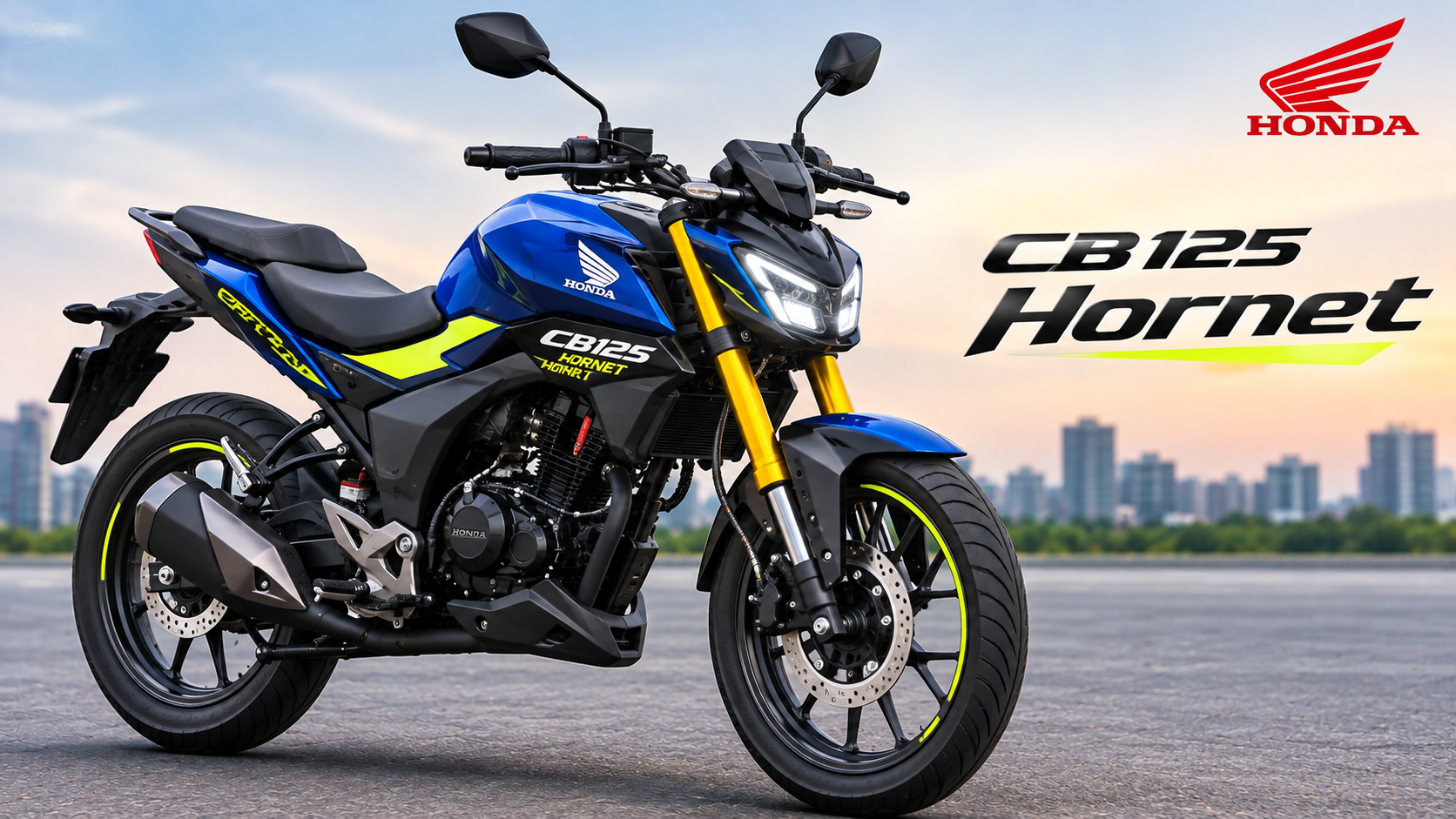
The Honda CB125 Hornet is one such motorcycle that aims to offer more than basic daily transportation. It combines a 123.94cc engine with aggressive streetfighter styling, golden upside-down front forks, a digital TFT instrument display, Bluetooth connectivity and single-channel ABS.
Motorcycle ABS Prevents Every Kind of Skid: Myth or Fact?
The first noticeable upgrade is the engine performance. Basic commuter motorcycles generally focus on delivering sufficient power for everyday transportation rather than sporty acceleration.
The Honda CB125 Hornet uses a 123.94cc, single-cylinder, air-cooled, fuel-injected engine producing approximately 11 bhp at 7,500 rpm and 11.2 Nm of torque at 6,000 rpm.
It is paired with a five-speed manual gearbox.
This setup provides a more engaging riding experience, particularly when accelerating from traffic signals, overtaking slower vehicles or riding on open city roads.
The engine has a smooth low-speed response and a stronger mid-range performance, making it easier to find acceleration when required.
For someone moving from a basic 100cc commuter, the additional performance can make everyday journeys feel less demanding.
However, the CB125 Hornet is still a 125cc motorcycle. It should not be considered a high-performance sports bike. Its main purpose remains everyday commuting with an additional dose of performance and style.
Another major difference is the motorcycle's appearance.
Basic commuter motorcycles generally follow a simple design approach with conventional body panels, smaller fuel tanks and practical styling.
The Honda CB125 Hornet takes a completely different direction. Its muscular fuel tank, sharp tank extensions, angular LED headlamp and sporty split-seat design give it the appearance of a larger street motorcycle.
The golden upside-down front forks are among its most noticeable design elements. They make the motorcycle look more premium and help distinguish it from conventional commuter bikes.
Honda also offers attractive colour combinations, including Pearl Siren Blue with Athletic Blue Metallic and Pearl Igneous Black.
For younger riders who want their motorcycle to reflect their personality, the CB125 Hornet offers a more distinctive appearance than a traditional commuter.
The styling upgrade does not directly improve fuel efficiency or reduce travel time, but it can make ownership more enjoyable.

One of the biggest highlights of the Honda CB125 Hornet is its 37mm golden upside-down front suspension.
Most basic commuter motorcycles use conventional telescopic front forks. These are generally sufficient for everyday city riding, but the CB125 Hornet gets a more premium suspension arrangement.
The USD forks help provide front-end stability and contribute to the motorcycle's sporty handling character.
The rear suspension uses a five-step adjustable monoshock absorber, allowing the setup to be adjusted according to riding requirements.
For daily commuters, the practical benefit is not simply the premium appearance. The suspension arrangement also contributes to the motorcycle's handling and overall riding character.
However, more expensive suspension hardware does not automatically mean a softer ride. Sharp potholes and large speed breakers can still be uncomfortable, and road conditions play an important role in suspension performance.
A major technology upgrade comes from the motorcycle's 4.2-inch colour TFT instrument console.
Basic commuter motorcycles generally offer analogue meters or simple digital displays that show essential information such as speed, fuel level, trip distance and odometer readings.
The CB125 Hornet provides a more modern display experience.
Its TFT screen supports Honda RoadSync smartphone connectivity through Bluetooth. Compatible smartphones can be connected to access supported connected functions.
The display offers useful information and features, including:
Turn-by-turn navigation support.
Incoming call notifications.
SMS alerts.
Vehicle information.
Different display themes.
Smartphone connectivity.
For riders who regularly travel through unfamiliar areas, navigation support can be particularly useful.
The display also gives the motorcycle a more premium feel compared with conventional commuter instruments.
However, riders should remember that connected functions depend on smartphone compatibility, application setup and connectivity availability.
Lighting is another area where the CB125 Hornet moves beyond traditional commuter motorcycles.
The motorcycle features an all-LED lighting setup, including a distinctive twin-signature LED headlamp with daytime running lights and LED indicators.
Many entry-level commuter motorcycles still use simpler lighting arrangements, although LED lighting is becoming increasingly common across newer models.
The benefits of LED lighting include a modern appearance, efficient power consumption and clear illumination when the road is dark.
For riders travelling early in the morning or returning home after work, good lighting is an important everyday feature.
The CB125 Hornet's sharp headlamp design also contributes to its streetfighter appearance, making it look more premium than a conventional 125cc commuter.
A Bike’s Seat Height Alone Decides Whether a Rider Can Manage It: Myth or Fact?
Safety is one of the most important reasons to consider upgrading from a basic commuter motorcycle.
The Honda CB125 Hornet comes equipped with single-channel ABS, which operates on the front wheel. It helps prevent front-wheel lock-up during hard braking and can improve steering control during emergency braking situations.
The motorcycle gets a 240mm front petal disc brake and a rear drum brake.
For riders who regularly encounter unpredictable traffic, sudden braking situations and wet roads, ABS can be a valuable addition.
However, ABS does not eliminate every braking risk. Tyre condition, road surface, braking technique and riding speed remain important.
The motorcycle also features a side-stand engine cut-off system, which prevents the engine from operating when the side stand is engaged and a gear is selected.
Compared with a basic commuter without ABS, these additions provide another layer of braking and operational safety.
Smartphones have become essential for navigation, communication and daily activities. Keeping a phone charged during longer journeys is therefore important for many riders.
The Honda CB125 Hornet addresses this requirement with a universal USB Type-C charging port.
This allows riders to charge compatible smartphones and other small electronic devices while travelling, using a suitable cable.
For office commuters, college students and delivery riders who depend on their phones throughout the day, this feature can be genuinely useful.
It is a small addition, but one that can make regular motorcycle usage more convenient.

The Honda CB125 Hornet is designed to offer a balance between sporty handling and everyday practicality.
Its kerb weight is approximately 124kg, making it relatively manageable in city traffic. The motorcycle also gets a diamond-type frame, 17-inch alloy wheels and a five-speed gearbox.
The relatively light weight helps riders manoeuvre through congested streets, make U-turns and park in tight spaces.
The handlebar and footpeg positioning offer a slightly sporty riding posture without making the motorcycle excessively aggressive for everyday use.
The broad seat also provides good support for regular commuting.
According to Autocar India's road test, the motorcycle offers a light clutch action, smooth gear shifts and nimble handling. Its engine is particularly comfortable at city speeds, while vibrations become more noticeable when pushed beyond approximately 80kmph.
For someone upgrading from a basic commuter, these characteristics can make everyday journeys more enjoyable.
Using Only the Rear Brake Is the Safest Way to Stop a Motorcycle: Myth or Fact?
One interesting aspect of the CB125 Hornet is that riders do not need to move to a 150cc or 160cc motorcycle to access several premium features.
The motorcycle combines a relatively small engine with equipment usually associated with more expensive sporty motorcycles.
Its golden USD forks, TFT instrument console, Bluetooth connectivity, all-LED lighting, adjustable rear monoshock and ABS make it a feature-rich option in the 125cc category.
This is particularly useful for riders who want a motorcycle that feels modern and sporty without necessarily choosing a larger-displacement machine.
However, premium equipment also contributes to the purchase price. Buyers should consider whether they will actually use these features before spending more.
Fuel efficiency remains one of the biggest priorities for Indian commuter motorcycle buyers.
Moving to a sporty 125cc motorcycle does not necessarily mean sacrificing fuel efficiency completely.
The CB125 Hornet has a reported real-world fuel economy of approximately 50–55kmpl in general ownership estimates. In Autocar India's controlled road test, it delivered 59.8kmpl in the city and 69.3kmpl on the highway.
Actual mileage depends on traffic, riding style, maintenance, road conditions and passenger load.
The motorcycle also gets a 12-litre fuel tank, providing a useful riding range between refuelling stops.
However, buyers should consider more than fuel efficiency. Insurance, servicing, replacement tyres, brake components and other maintenance expenses also contribute to ownership costs.
The CB125 Hornet has a three-year or 42,000km standard warranty, whichever comes first, according to Honda's official product information.
For someone upgrading from a basic commuter, the additional purchase cost and ownership expenses should be considered alongside the extra features.
|
Feature |
Basic Commuter |
Honda CB125 Hornet |
|
Engine category |
Usually 100cc–110cc |
123.94cc |
|
Performance |
Basic daily commuting |
Sportier acceleration |
|
Design |
Simple commuter styling |
Streetfighter styling |
|
Front suspension |
Conventional telescopic forks |
Golden USD forks |
|
Rear suspension |
Twin shock absorbers on many models |
Adjustable monoshock |
|
Instrument cluster |
Analogue or basic digital |
4.2-inch TFT |
|
Smartphone connectivity |
Usually limited or unavailable |
Honda RoadSync |
|
Headlight |
Depends on model |
LED |
|
Braking |
Usually drum or disc with CBS |
Front disc with single-channel ABS |
|
Charging port |
Depends on model |
USB Type-C |
|
Riding character |
Comfort-focused commuting |
Sporty everyday commuting |
A motorcycle may look sporty and offer impressive features, but comfort remains important when it is used every day.
The Honda CB125 Hornet gets a broad seat with a split-seat design. Its riding position combines slightly forward-set handlebars with reasonably neutral footpeg positioning.
This arrangement provides a balance between sporty riding and everyday comfort.
The relatively manageable weight also makes it easier to handle in crowded city conditions. Riders can filter through traffic without feeling that they are controlling a particularly heavy motorcycle.
However, there are a few considerations. The seat height is approximately 796mm, which may feel slightly tall for shorter riders. The suspension can also feel firm over sharp potholes and uneven roads.
Therefore, buyers should take a test ride before making a purchase, particularly if they regularly travel on poorly maintained roads or carry a pillion passenger.
A Wider Rear Tyre Improves Every Motorcycle’s Handling: Myth or Fact?
The CB125 Hornet is not necessarily the right motorcycle for every commuter. Its value depends on what a rider expects from a two-wheeler.
It makes sense for riders who:
Want better acceleration than a basic 100cc commuter.
Prefer aggressive streetfighter styling.
Want a modern TFT instrument display.
Regularly use smartphone navigation.
Value front-wheel ABS for additional braking confidence.
Want premium suspension hardware.
Enjoy a slightly sporty riding experience.
Want a practical motorcycle that also looks distinctive.
It may not be the ideal choice for someone whose only priorities are the lowest possible purchase price, minimum maintenance expenses and maximum simplicity.
For such buyers, a conventional commuter can remain a more sensible option.

Upgrading to a more feature-rich motorcycle also involves certain compromises.
First, the purchase price is higher than that of most basic commuter motorcycles. The CB125 Hornet sits in a more premium part of the 125cc category.
Second, its sporty styling and equipment do not automatically make it suitable for every road condition. The suspension may feel firm over broken surfaces, and riders who frequently travel on rough rural roads should evaluate its comfort.
Third, while its engine offers better performance than many entry-level commuters, it is still a 125cc powertrain. Riders looking for strong highway acceleration or sustained high-speed touring may prefer a larger motorcycle.
Finally, additional electronics and premium components can make replacement parts more expensive than those of simpler commuter motorcycles.
Understanding these limitations helps buyers make a more realistic decision instead of choosing a motorcycle only because it has more features.
The Honda CB125 Hornet was launched in India in August 2025 at an introductory ex-showroom price of Rs 1.12 lakh in Gurugram.
Its price was subsequently revised. Autocar India's October 2026 listing shows an ex-showroom starting price of approximately Rs 1.15 lakh, although buyers should confirm the latest dealership price in their city.
At this price point, the CB125 Hornet offers several premium features that distinguish it from conventional commuter motorcycles.
The golden USD forks, 4.2-inch TFT display, Honda RoadSync connectivity, USB Type-C charging and single-channel ABS contribute to its overall value.
It also competes with sporty 125cc motorcycles such as the TVS Raider 125 and Hero Xtreme 125R.
The final buying decision should depend on the features a rider values most, the local on-road price and the comfort experienced during a test ride.
The Honda CB125 Hornet demonstrates how much more a rider can get by moving beyond a conventional commuter motorcycle.
It offers a stronger and more engaging engine, sporty streetfighter styling, premium USD front forks, a monoshock rear suspension, a colour TFT instrument console, smartphone connectivity, LED lighting and single-channel ABS.
Some of these features, such as smartphone navigation and USB charging, can make everyday commuting more convenient. Others, including the suspension setup and additional engine performance, improve the overall riding experience.
However, a basic commuter still makes sense for buyers who prioritise affordability, simplicity and low running costs above everything else.
The CB125 Hornet is better suited to riders who want their everyday motorcycle to offer something extra without moving into a larger engine category.