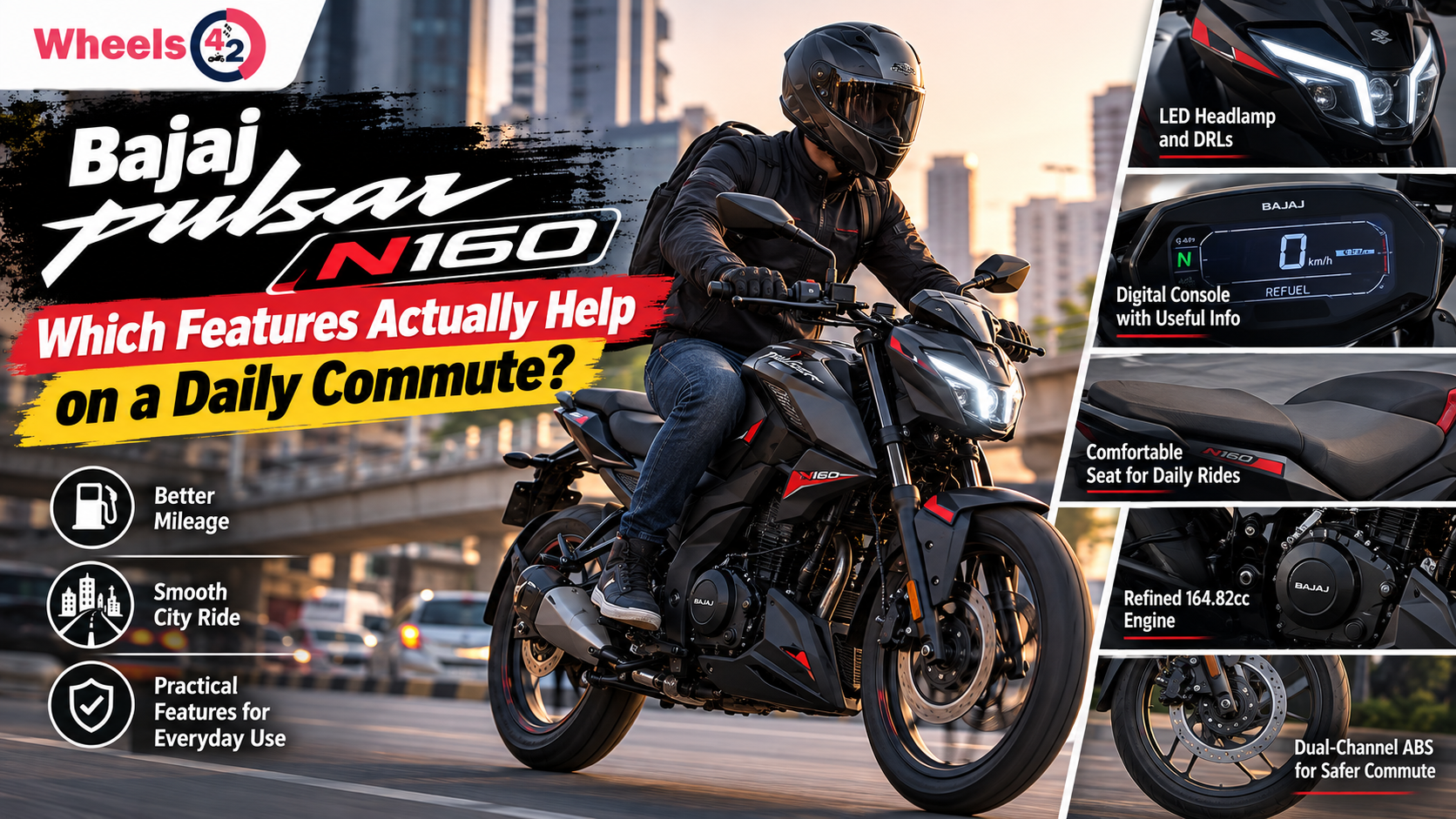
A commuter motorcycle does not have to be boring. For riders who want something more energetic than a conventional commuter but still need a motorcycle that works every day, the Bajaj Pulsar N160 sits in an interesting space.
The N160 combines the styling of a street-oriented motorcycle with features aimed at making everyday riding easier. But when you are using a bike for office runs, college trips, traffic, errands and occasional longer rides, which of those features actually make a difference?
Let's look at the Pulsar N160 from a daily-use perspective.
1. A 160cc Engine Gives the Rider Some Extra Breathing Room
The Pulsar N160 is powered by a 164.82cc, single-cylinder, air-cooled petrol engine.
It produces around 16 PS of maximum power and 14.65 Nm of peak torque, with a five-speed gearbox.
For daily commuting, the benefit isn't necessarily about riding at high speeds. The additional performance can be useful when merging into faster traffic, climbing flyovers or carrying a passenger.
It also gives riders more flexibility when a regular city commute occasionally turns into a longer highway journey.
2. Five Gears Make Mixed Riding Easier
The five-speed gearbox allows the N160 to adapt to different road conditions.
Lower gears can be useful in congested areas, while the higher gears help the motorcycle settle into a more relaxed rhythm once traffic clears.
This becomes particularly useful for riders whose daily route includes a combination of:
- Stop-and-go traffic
- City roads
- Flyovers
- Open stretches
- Ring roads
- Occasional highway sections
A motorcycle that can handle these changes without requiring constant effort can make a daily commute less tiring.
3. Upright Riding Position Helps During Longer Commutes
The riding position is an important consideration that is often overlooked when buying a motorcycle.
The Pulsar N160 has a relatively upright street-bike riding posture rather than an aggressive, forward-leaning setup.
For a daily commuter, this can be useful because the rider may spend significant time sitting on the motorcycle.
Whether the journey takes 15 minutes or an hour, a comfortable riding position can have a bigger impact on the ownership experience than a long list of electronic features.
4. LED Lighting Is Useful Beyond Styling
The N160 gets LED lighting, including LED headlamps and LED tail lamps.
While LED lighting also contributes to the motorcycle's modern appearance, its practical benefit becomes more noticeable when riding early in the morning, after sunset or in poorly lit areas.
The stronger and more visible lighting setup can make it easier for the rider to see the road and for other road users to notice the motorcycle.
5. Digital Instrument Cluster Keeps Important Information Visible
The Pulsar N160 comes with a digital instrument cluster.
Depending on the variant, the display provides information such as speed, fuel level, trip information and other riding data.
Higher-spec versions offer additional connected features.
For everyday use, the most useful part of a digital display is not necessarily the technology itself. It is having important information presented clearly while riding.
6. Bluetooth Connectivity Can Be Convenient
The higher-spec Pulsar N160 gets Bluetooth connectivity and smartphone-related functionality.
For commuters, this can be useful when the motorcycle is used frequently rather than occasionally.
Depending on the system and variant, riders can access features such as call or notification information through the instrument display.
It does not change the motorcycle's core riding characteristics, but it can reduce the need to constantly reach for a smartphone during a journey.
7. Dual-Channel ABS Adds an Important Safety Layer
One of the most useful features for everyday riding is dual-channel ABS.
City traffic can change quickly. A car may suddenly stop, a pedestrian may cross the road or the rider may encounter a wet or slippery section.
ABS helps reduce the likelihood of wheel lock during hard braking when conditions trigger the system.
The Pulsar N160's dual-channel ABS setup gives braking assistance to both wheels.
For a motorcycle that is used every day, this is arguably more meaningful than many cosmetic features.
8. Disc Brakes Provide Strong Braking Hardware
The Pulsar N160 uses disc brakes at both ends, with ABS assistance.
The front brake does most of the work during heavy braking, while the rear brake contributes to stability and speed control.
For daily commuting, good brakes become particularly important because city riding involves frequent braking.
Traffic signals, speed breakers, pedestrians and sudden lane changes can all require the rider to slow down quickly.
9. 17-Inch Wheels Suit Indian Road Conditions
The N160 rides on 17-inch alloy wheels.
This wheel size is common among street motorcycles and works well for a variety of road conditions.
Indian urban roads can include broken surfaces, speed breakers, uneven patches and potholes.
Wheel size alone does not determine ride quality, but the overall chassis and suspension setup can help the motorcycle deal with everyday road imperfections.
10. Suspension Is More Important Than It Looks
The N160 uses a telescopic front fork and a rear monoshock setup.
For a commuter, suspension has a direct effect on comfort.
A well-controlled suspension setup helps keep the motorcycle stable over bumps while also reducing the impact transferred to the rider.
This becomes particularly important for people who ride through poorly maintained roads every day.
11. A Relatively Manageable Size Helps in Traffic
A daily commuter needs to be easy to position on the road.
The Pulsar N160 is a street motorcycle rather than a large touring machine, making it easier to manoeuvre through normal city traffic.
This can help when navigating:
- Narrow lanes
- Busy intersections
- Parking areas
- Crowded markets
- Slow-moving traffic
The motorcycle's physical dimensions also matter when it needs to be parked in a limited space.
12. Fuel Capacity Supports Longer Commuting Intervals
The Pulsar N160 has a fuel tank capacity of around 14 litres.
For a motorcycle used regularly, a reasonably large tank can reduce the frequency of fuel-station visits.
Actual range will depend on riding conditions and fuel efficiency, but the larger tank gives riders some flexibility when planning their weekly commute.
13. The N160 Can Handle More Than Just Office Runs
One advantage of choosing a 160cc motorcycle over a smaller commuter is versatility.
The Pulsar N160 can be used for more than a simple home-to-office route.
It can also work for:
Daily commuting → Weekend rides → City errands → Short highway trips → Occasional two-up riding
This versatility can be important for buyers who want one motorcycle to perform several roles.
14. Styling Can Be a Practical Ownership Factor Too
Looks may not improve fuel economy or braking performance, but they still matter to many motorcycle buyers.
The Pulsar N160 follows the modern Pulsar design language, with a muscular fuel tank, sharp bodywork and a street-focused appearance.
For riders who want the practicality of a commuter but do not want a traditional commuter-bike design, this styling can be part of the appeal.
Daily-Use Feature Check
|
Feature
|
Daily-Commute Benefit
|
|
164.82cc engine
|
Useful performance for city and open roads
|
|
5-speed gearbox
|
Better flexibility across different speeds
|
|
Dual-channel ABS
|
Additional braking assistance
|
|
Front & rear disc brakes
|
Strong braking hardware
|
|
LED lighting
|
Better visibility and modern lighting
|
|
Digital console
|
Easy access to riding information
|
|
Bluetooth connectivity
|
Added smartphone convenience on higher variants
|
|
17-inch alloy wheels
|
Suitable for everyday street use
|
|
Monoshock rear suspension
|
Helps with ride control
|
|
14-litre fuel tank
|
Fewer fuel stops depending on mileage
|
Which Features Matter Most in Real Life?
Not every feature has the same value during a daily commute.
For most riders, the practical priorities are likely to be:
1. Dual-channel ABS
Useful when unexpected braking situations occur.
2. Comfortable ergonomics
Important when riding every day.
3. Engine and gearbox combination
Helps the motorcycle cope with both traffic and open roads.
4. Suspension setup
Particularly relevant on uneven urban roads.
5. Fuel capacity and efficiency
Can reduce the frequency of fuel stops.
6. Lighting and visibility
Helpful during early-morning and night riding.
Features such as Bluetooth connectivity are convenient, but they are secondary to the motorcycle's fundamental riding characteristics.
Is the Pulsar N160 Practical Enough for Everyday Use?
The Pulsar N160 is aimed at riders who want more performance and equipment than a basic commuter motorcycle without moving into a much larger street bike.
Its combination of a 160cc engine, five-speed gearbox, ABS, disc brakes, upright ergonomics and modern equipment makes it suitable for a wide range of daily riding situations.
However, it is worth remembering that a 160cc motorcycle may not be the right fit for every commuter. Riders who prioritise the lowest possible running costs may prefer a smaller-capacity motorcycle, while those who primarily want long-distance touring may look at larger motorcycles.

 Khyati Sharma 2026-09-26