(1).avif)

 Khyati Sharma 2026-09-16
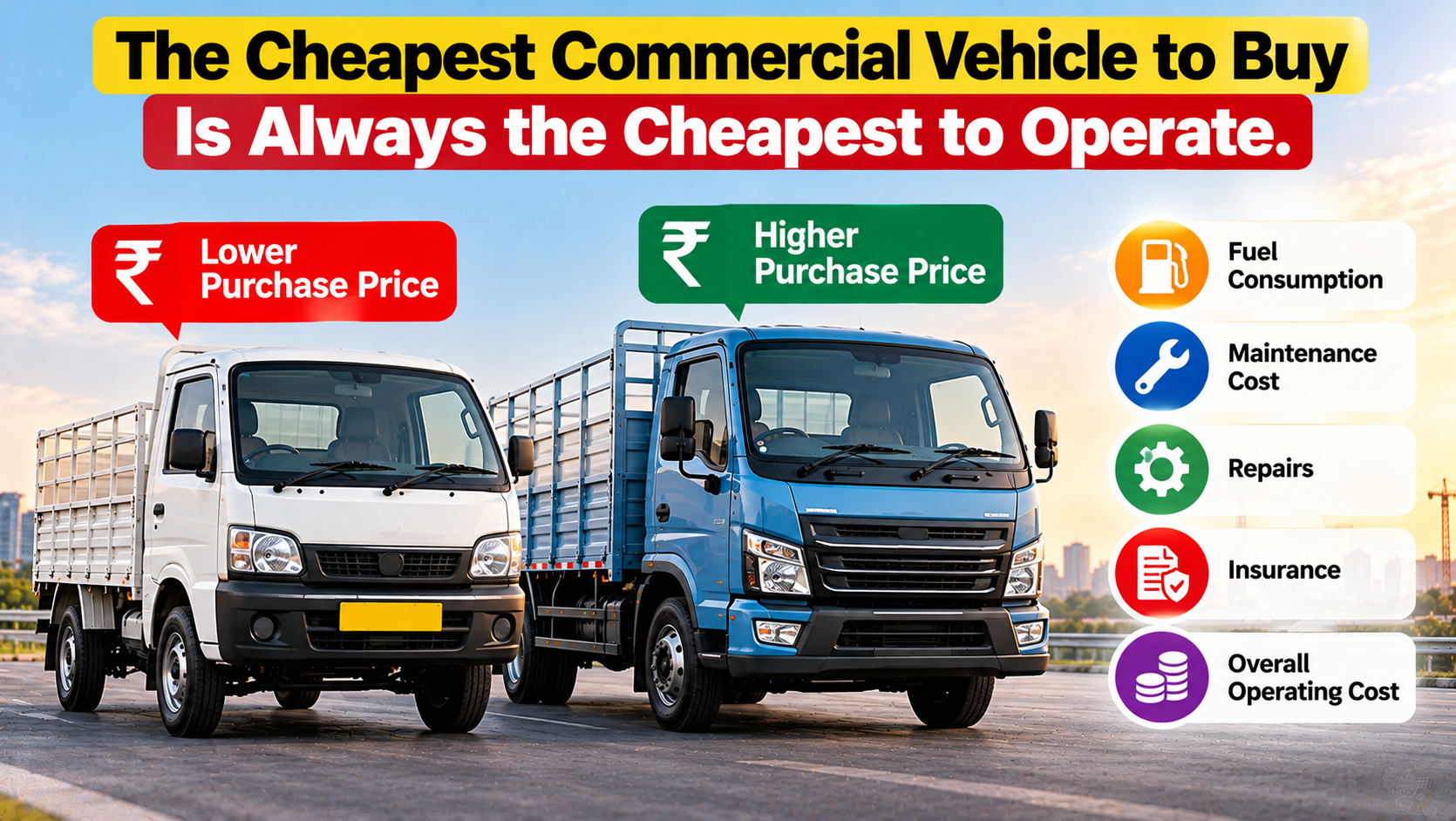
Buying a commercial vehicle at the lowest price does not necessarily mean spending less money over its entire working life. The initial purchase price is only one part of the total cost of ownership. Fuel consumption, maintenance, repairs, insurance, vehicle downtime, spare parts availability and resale value can have a much greater impact on long-term operating expenses.
For transport businesses, fleet operators and individual vehicle owners, choosing the right commercial vehicle is an important financial decision. A vehicle with a lower showroom price may appear attractive, particularly when the purchase budget is limited. However, if it consumes more fuel, requires frequent repairs or spends more time in the workshop, the initial savings can quickly disappear.
On the other hand, a slightly more expensive commercial vehicle may deliver better fuel efficiency, higher reliability and lower maintenance expenses. Over several years of regular operation, it could prove to be the more economical choice.
A Truck’s Gross Vehicle Weight Is the Weight of Goods It Can Carry: Myth or Fact?
The purchase price is the amount paid to acquire the commercial vehicle. It is usually one of the first factors buyers consider when comparing different models.
However, operating a commercial vehicle involves several additional expenses. Once the vehicle enters service, the owner must pay for fuel, servicing, tyres, insurance, permits, repairs and other operational requirements.
A low-cost vehicle may have an attractive initial price but could require more frequent maintenance or consume more fuel. These expenses can gradually increase the total amount spent on the vehicle.
For example, a delivery business operating vehicles every day may cover thousands of kilometres each month. Even a small difference in fuel consumption can create a significant expense over time.
Therefore, the cheapest vehicle at the dealership is not automatically the cheapest vehicle to own.

Fuel is one of the largest recurring expenses for many commercial vehicle operators.
A truck, pickup or delivery van that travels long distances regularly can consume a substantial amount of diesel, petrol or CNG. The vehicle's mileage directly affects the owner's monthly operating budget.
Consider two commercial vehicles with different purchase prices and fuel efficiency. The cheaper model may cost less initially but consume more fuel per kilometre.
If both vehicles cover the same distance every month, the less fuel-efficient model will require a larger fuel budget.
The difference becomes even more important for vehicles operating on highways, intercity routes or intensive delivery schedules.
Before purchasing a commercial vehicle, buyers should examine:
Manufacturer-claimed fuel efficiency.
Real-world mileage under similar operating conditions.
Expected monthly distance.
Typical payload carried.
Fuel type and local fuel prices.
Route conditions and traffic patterns.
Manufacturer-claimed mileage figures can provide a starting point, but actual fuel consumption depends on load, driving behaviour, road conditions, vehicle maintenance and operating speed.
Petrol vs Diesel vs CNG vs Electric Cars: How to Choose the Right Fuel Type
Every commercial vehicle requires regular maintenance to remain reliable and safe.
Engine oil, filters, brake components, transmission fluids, belts, suspension parts and other components need periodic inspection or replacement.
However, maintenance costs can vary considerably between vehicles.
Some models may have longer service intervals or relatively affordable replacement parts. Others may require more expensive components or specialised servicing.
A vehicle with a low purchase price may become expensive to maintain if its commonly replaced parts cost more or are difficult to source.
Buyers should compare the manufacturer's recommended service schedule, typical service expenses, warranty coverage and availability of authorised service centres.
For fleet operators, even a small difference in maintenance expenses per vehicle can become significant when multiplied across several vehicles.
Documents Required to Buy a New Car in India (Complete Checklist)
Regular servicing is predictable, but unexpected repairs can create additional financial pressure.
Commercial vehicles often operate under demanding conditions. They may carry heavy loads, travel on damaged roads, operate for extended hours or make frequent stops.
These conditions can increase wear and tear on the engine, clutch, brakes, suspension, tyres and transmission.
If a vehicle has expensive components or limited spare-parts availability, repairs may cost more than expected.
A vehicle with a strong service network and easily available replacement parts can be more convenient and economical over the long term.
Before buying, operators should check the availability and cost of commonly required parts, including:
Brake pads and brake components.
Clutch assemblies.
Filters and lubricants.
Suspension components.
Tyres and wheels.
Electrical and electronic parts.
Engine and transmission components.
A lower initial price should not be the only reason to select a commercial vehicle if its repair expenses are expected to be high.

Downtime is one of the most overlooked costs of operating a commercial vehicle.
When a vehicle is unavailable because of a breakdown, accident or extended repair, it cannot complete its assigned work.
For a transport company, this may mean delayed deliveries, missed schedules, customer complaints and reduced revenue.
For an owner-driver, every day spent waiting for repairs can mean lost earning opportunities.
A commercial vehicle that costs less to purchase but frequently requires workshop visits may create more financial problems than a slightly expensive but reliable alternative.
Reliability is therefore an important part of the total cost of ownership.
Buyers should consider the manufacturer's service network, warranty support, breakdown assistance and availability of replacement vehicles where applicable.
Tyres are another recurring expense for commercial vehicle operators.
The cost depends on vehicle category, tyre size, load rating, operating conditions and replacement frequency.
A vehicle that regularly carries heavy loads or travels on rough roads may experience faster tyre wear. Incorrect tyre pressure, wheel alignment problems and aggressive driving can also reduce tyre life.
Two commercial vehicles with similar purchase prices may have different tyre replacement costs because of differences in tyre specifications.
Before purchasing, operators should check:
Original tyre size and specifications.
Cost of replacement tyres.
Availability of suitable tyre brands.
Expected tyre life under comparable conditions.
Recommended tyre pressure.
Whether the vehicle uses common or specialised tyre sizes.
Good tyre maintenance can help improve safety, reduce rolling resistance and support better fuel efficiency.
Commercial vehicle ownership involves more than fuel and maintenance.
Owners must also consider insurance premiums, registration expenses, applicable taxes, permits and other legal requirements.
Insurance costs can differ depending on the vehicle's value, category, usage, location, coverage and claim history.
The applicable tax and permit requirements may also depend on the vehicle type and how it is operated.
A buyer should calculate these expenses before finalising the purchase. Choosing a cheaper vehicle without considering its overall compliance and insurance costs may lead to an inaccurate ownership budget.
Operators should also ensure that the vehicle meets the requirements applicable to its intended commercial use.
The resale value of a commercial vehicle plays an important role in determining its overall ownership cost.
Some vehicles retain their value better because of their reputation for reliability, fuel efficiency, durability and availability of spare parts.
Others may depreciate faster because of limited demand, higher repair costs or concerns about long-term reliability.
Consider two vehicles purchased at different prices. The more expensive vehicle may retain a higher resale value after several years, reducing the actual cost of ownership.
For example, if a vehicle is purchased for ₹12 lakh and later sold for ₹5 lakh, its depreciation is ₹7 lakh. Another vehicle purchased for ₹10 lakh but sold for ₹2.5 lakh has depreciated by ₹7.5 lakh.
In this simplified example, the more expensive vehicle has a lower depreciation cost.
However, resale value depends on vehicle condition, kilometres covered, service history, market demand, age and prevailing regulations.
Ashok Leyland DOST: What Should You Calculate Before Purchase?
A commercial vehicle should be selected according to the type and quantity of cargo it needs to transport.
A low-priced vehicle may have a lower payload capacity than a slightly more expensive alternative. If the business regularly needs to transport heavier loads, the smaller vehicle may not meet operational requirements.
This can lead to additional trips, higher fuel expenses and increased driver costs.
A vehicle with suitable payload capacity may complete more work in fewer trips, improving productivity.
However, choosing a vehicle with unnecessarily high capacity can also increase purchase and operating costs.
The ideal choice is a vehicle that matches the business's regular load requirements while remaining within the legally permitted gross vehicle weight and payload limits.
Overloading should never be used as a way to increase earning capacity because it can compromise safety, vehicle durability and legal compliance.
Many commercial vehicle buyers use loans or financing arrangements to purchase their vehicles.
In such cases, the purchase price alone does not represent the complete financial commitment.
The buyer should also consider the down payment, interest rate, loan tenure, processing charges and total amount payable.
A vehicle with a lower purchase price may not always offer the most attractive financing arrangement. Similarly, a more expensive model with favourable financing terms may have a different overall cost profile.
Buyers should compare the total repayment amount rather than looking only at the monthly EMI.
They should also consider whether the expected income generated by the vehicle can comfortably cover the instalments and operating expenses.
The following example shows why the cheapest commercial vehicle to purchase may not be the cheapest to operate.
These figures are illustrative assumptions for understanding the concept. They are not actual prices or specifications of any particular commercial vehicle.
|
Cost factor |
Vehicle A |
Vehicle B |
|
Purchase price |
₹10 lakh |
₹12 lakh |
|
Annual fuel expense |
₹3.60 lakh |
₹3.00 lakh |
|
Annual maintenance and repairs |
₹60,000 |
₹40,000 |
|
Annual insurance and other expenses |
₹50,000 |
₹55,000 |
|
Estimated resale value after 5 years |
₹2.50 lakh |
₹5 lakh |
In this example, Vehicle A costs ₹2 lakh less to purchase. However, Vehicle B has lower assumed annual fuel and maintenance expenses and a higher estimated resale value.
Over five years, the difference in fuel and maintenance expenses could help Vehicle B recover much of its higher initial purchase price.
This example does not include financing costs, downtime, taxes or changes in fuel prices. Actual ownership costs will depend on the vehicle, operating conditions and market circumstances.

Total cost of ownership, commonly called TCO, estimates the complete cost of using a vehicle over a particular period.
A basic calculation can include:
Total Cost of Ownership = Purchase Price + Fuel Costs + Maintenance + Repairs + Insurance + Taxes + Financing Costs + Other Operating Expenses − Resale Value
For a commercial vehicle, operators should also consider the financial impact of downtime and lost business opportunities.
The calculation should be based on the expected ownership period, annual kilometres, average payload and route conditions.
For example, a vehicle operating 200 kilometres every day may have a very different cost profile from one used only for occasional local deliveries.
Fleet operators can use actual fuel bills, service invoices, tyre replacement records and repair expenses to estimate realistic operating costs.
This makes it easier to compare vehicles based on business performance rather than showroom pricing alone.
All Automatic Gearboxes Work in the Same Way: Myth or Fact?
Before selecting a commercial vehicle, buyers should evaluate the following factors:
Fuel efficiency: Compare real-world mileage under similar operating conditions.
Service network: Check whether authorised service centres are available along the vehicle's operating routes.
Spare parts: Compare the cost and availability of commonly replaced components.
Payload capacity: Choose a vehicle suitable for the business's regular cargo requirements.
Reliability: Research the vehicle's service record and long-term operating performance.
Warranty: Understand the coverage period, kilometre limits and exclusions.
Resale value: Consider expected demand in the used commercial vehicle market.
Financing: Calculate the complete repayment amount, not just the EMI.
Business suitability: Make sure the vehicle is appropriate for the routes, distance and type of work involved.
A careful comparison can help avoid unexpected expenses and improve the profitability of commercial vehicle operations.
Myth – The cheapest commercial vehicle to buy is not always the cheapest to operate.
The initial purchase price is only one component of commercial vehicle ownership. Fuel efficiency, maintenance, repair expenses, tyre life, insurance, downtime, financing and resale value all influence the total cost of ownership.
A vehicle with a higher purchase price may prove more economical if it delivers better mileage, requires fewer repairs and retains its value over time. Similarly, a low-priced vehicle can be a sensible choice if it offers reliable performance and affordable operating expenses for the intended application.
For transport businesses and individual operators, the smartest buying decision is not necessarily choosing the vehicle with the lowest showroom price. It is choosing the vehicle that delivers the best balance of purchase cost, operating expenses, reliability and earning potential throughout its working life.











Kia Cars
₹7.33 - 14.09 Lakh