 Khyati Sharma 2026-09-26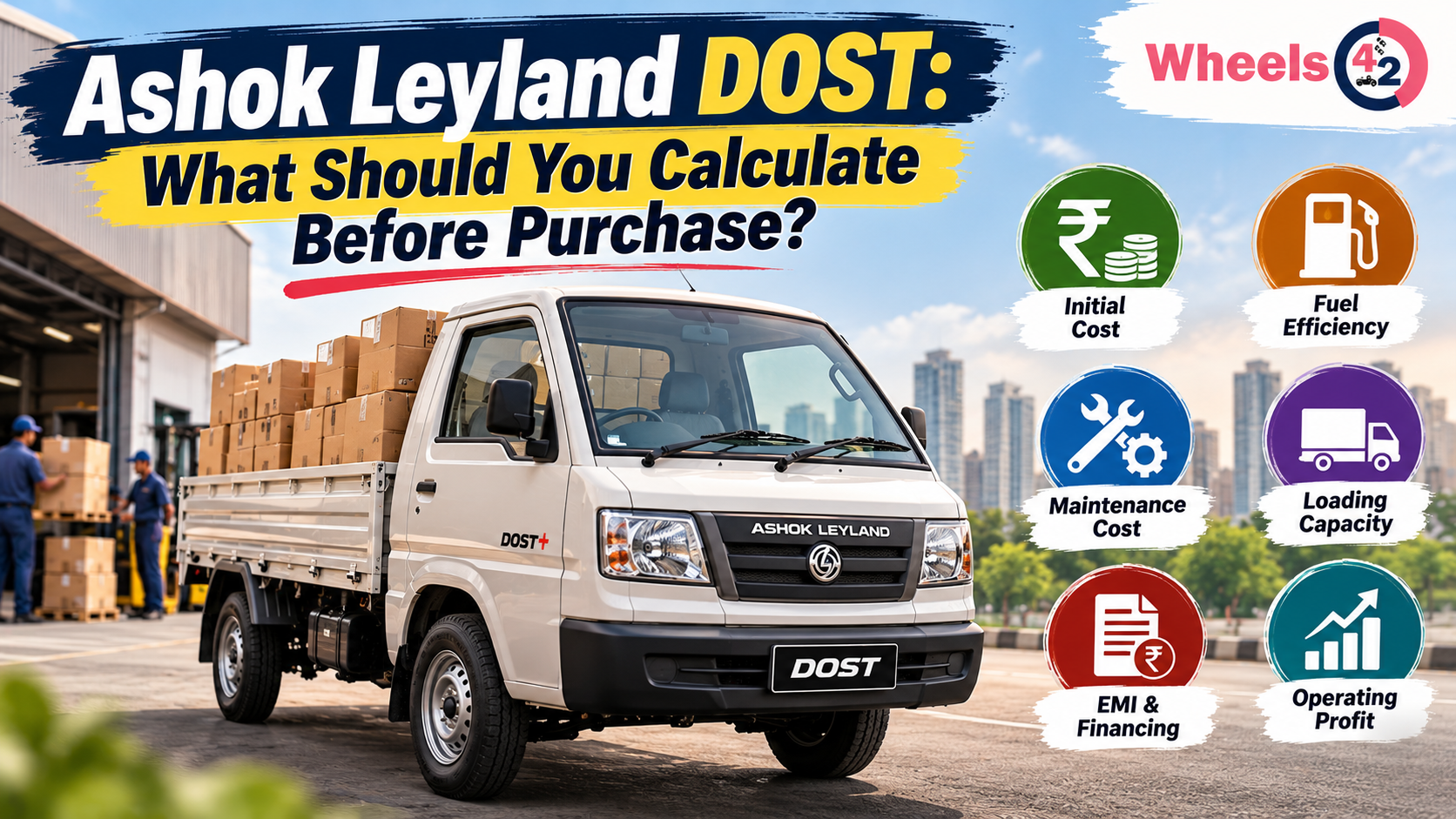
Buying a small commercial vehicle is not simply about finding a truck that fits your budget. For a business owner, the more important question is whether the vehicle can earn enough to cover its monthly costs and still leave a useful margin.
The Ashok Leyland DOST is designed for last-mile and small commercial transportation, making it relevant for businesses such as FMCG distribution, grocery delivery, agricultural transport and local goods movement.
Before signing the purchase papers, however, calculate the numbers based on your own business.
The first number to calculate is simple:
How many kilometres will the DOST actually travel every day?
Your monthly running could look very different depending on the business
|
Usage |
Typical Consideration |
|
Local delivery |
Lower daily kilometres |
|
FMCG distribution |
Frequent short trips |
|
Market-to-market transport |
Higher running |
|
Agricultural goods |
Seasonal and variable |
|
Inter-city delivery |
Higher monthly kilometres |
|
E-commerce logistics |
Frequent stop-and-go operation |
Fuel can become one of the biggest operating expenses.
Use this basic calculation:
Monthly Fuel Cost = Monthly Kilometres ÷ Actual Mileage × Fuel Price
For example, if your vehicle travels 100 km per day and operates for 26 days:
100 × 26 = 2,600 km/month
You can then divide 2,600 by your real-world mileage and multiply the result by your local fuel price.
The important word here is real-world.
Mileage can change significantly depending on:
Payload
Traffic
Road conditions
Driving style
Tyre pressure
Vehicle maintenance
A commercial vehicle earns money by moving goods, so payload is central to the purchase decision.
Before buying, calculate the average load your business carries.
Ask:
How much do I carry on a normal day?
Then ask:
How often do I carry my maximum expected load?
You should avoid choosing a vehicle purely because its maximum payload appears attractive. Your actual load pattern matters more.
Overloading can affect operating costs, tyre wear, braking and vehicle durability.
Now move from expenses to earnings.
If you charge customers based on each delivery, calculate:
Revenue Per Day = Number of Trips × Average Revenue Per Trip
For businesses charging by distance:
Revenue = Total Billable Kilometres × Rate Per Kilometre
This gives you a basic picture of how much the vehicle can generate.
|
Calculation |
Example |
|
Daily trips |
8 |
|
Average revenue/trip |
₹500 |
|
Daily revenue |
₹4,000 |
|
Working days |
26 |
|
Monthly gross revenue |
₹1,04,000 |
These are only sample figures. Replace them with your actual business numbers.
If you finance the DOST, the EMI becomes a fixed monthly expense.
Don't calculate affordability only from the showroom's down-payment figure.
Consider:
Down Payment + EMI + Insurance + Maintenance + Fuel + Permit/Taxes + Driver Cost
Your monthly vehicle cost should be compared with your expected monthly revenue.
A vehicle that generates high revenue but also has very high operating costs may not deliver the cash flow you expect.
If you will drive the DOST yourself, your cost structure will be different from a business that employs a driver.
With a hired driver, include:
Monthly salary
Overtime
Incentives
Food or travel allowances, if applicable
Replacement-driver costs
For a self-driven business, you should still assign a value to your own time.
Your time has an economic value even if there is no salary payment.
Commercial vehicles generally work harder than private cars.
Your calculation should include a monthly reserve for:
Scheduled servicing
Engine oil and filters
Tyres
Brake components
Battery
Unexpected repairs
Instead of waiting for a large repair bill, set aside a fixed amount every month.
This creates a more realistic picture of the DOST's operating cost.
This is an expense that many first-time commercial-vehicle buyers overlook.
If the DOST is unavailable for three days because of repairs, how much revenue could you lose?
Calculate:
Daily Net Contribution × Number of Downtime Days
You should also consider whether your business has a backup vehicle.
A commercial vehicle is an income-generating asset, so availability matters.
One of the most useful calculations is your monthly break-even point.
Break-Even Revenue = Fixed Monthly Costs + Variable Operating Costs
For example:
|
Cost |
Monthly Amount |
|
EMI |
₹25,000 |
|
Fuel |
₹25,000 |
|
Driver |
₹18,000 |
|
Maintenance reserve |
₹5,000 |
|
Insurance/other reserve |
₹3,000 |
|
Total |
₹76,000 |
Again, these are illustrative figures, not official DOST running costs.
If your expected monthly revenue is consistently below your total operating cost, the purchase needs to be reconsidered.
This is one of the best ways to compare commercial vehicles.
Use:
Total Monthly Running Cost ÷ Monthly Kilometres
If the vehicle costs ₹76,000 to operate and covers 2,600 km:
₹76,000 ÷ 2,600 = ₹29.23/km
You can then compare this figure with your actual revenue per kilometre.
|
Calculation |
What to Know |
|
Monthly kilometres |
Average real usage |
|
Payload |
Normal and peak load |
|
Fuel cost |
Based on actual mileage |
|
Revenue |
Per trip or per kilometre |
|
EMI |
Monthly financing cost |
|
Driver cost |
Salary and allowances |
|
Maintenance |
Service and repair reserve |
|
Tyres |
Replacement reserve |
|
Insurance |
Annual cost divided monthly |
|
Downtime |
Possible lost revenue |
|
Cost/km |
Total operating cost per kilometre |
|
Break-even |
Minimum revenue required |
The Ashok Leyland DOST should be treated as a business investment rather than simply a vehicle purchase.
Before buying, calculate your monthly kilometres, average payload, revenue per trip, fuel expense, EMI, driver cost, maintenance reserve and possible downtime.
The most important number is not the purchase price alone. It is the relationship between what the vehicle costs to operate and what it can realistically earn for your business.
If the numbers remain positive even after allowing for maintenance, fuel fluctuations and periods of lower demand, the DOST can fit into a commercial operation more comfortably.
The best time to do this calculation is before booking the vehicle, when you still have the flexibility to adjust the loan amount, down payment or even compare different vehicle configurations.




Land Rover
₹138.00 - 316.49 Lakh