 Khyati Sharma 2026-06-24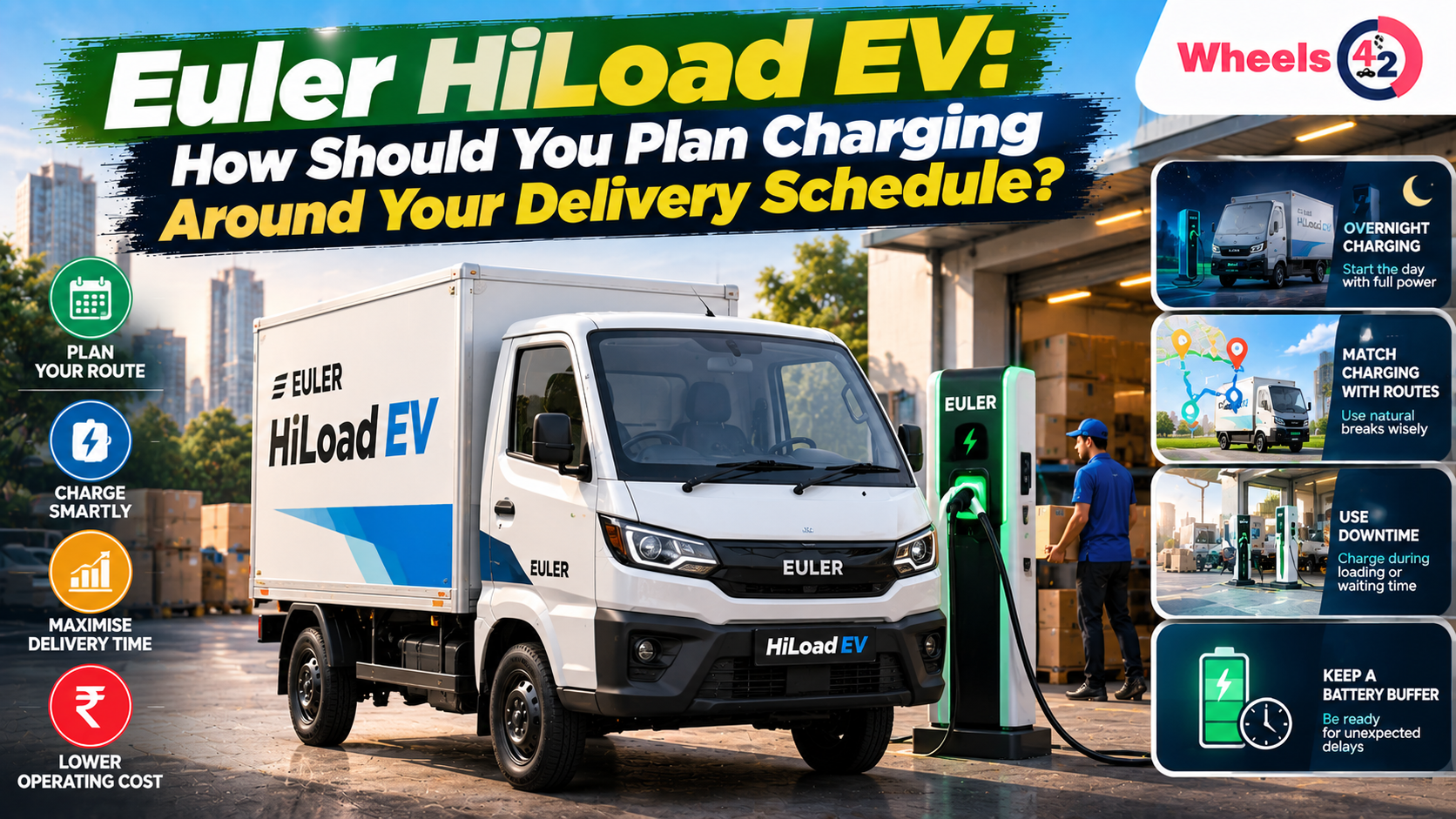
For an electric commercial vehicle, charging is not simply about plugging in whenever the battery is low. For a delivery business, when you charge can be just as important as how much you charge.
The Euler HiLoad EV is designed for urban and last-mile commercial operations, where vehicles can spend long hours moving between warehouses, markets, shops and customer locations. That makes charging strategy an important part of daily route planning.
A well-planned charging routine can help reduce downtime, maintain sufficient range throughout the working day and make better use of periods when the vehicle is naturally parked.
Here are the key things operators should consider when planning charging around a delivery schedule.
Before deciding when to charge, understand how the vehicle is actually used.
A delivery operator should first record:
For example, a vehicle completing multiple short urban deliveries may have several natural parking periods during the day. Those periods can potentially be used for charging.
On the other hand, a vehicle running continuously between different locations may need a different strategy.
The key is to build charging into the existing work schedule rather than treating it as an additional task.

For businesses operating from a fixed depot, overnight charging is generally the easiest routine to establish.
The vehicle can be connected after completing the day's deliveries and remain parked while the driver and staff are off duty.
This has several advantages:
For a business with predictable routes, this can become a simple routine:
Complete deliveries → return to depot → unload → plug in → charge overnight → start next day.
However, operators should still avoid assuming that every day will have identical energy consumption.
One of the biggest mistakes an EV operator can make is planning a route based entirely on the advertised maximum range.
Real-world range can vary depending on several factors.
A lightly loaded vehicle travelling on relatively open roads can consume energy differently from a fully loaded vehicle making dozens of urban deliveries.
Therefore, businesses should establish their own real-world energy consumption over several working days.
This gives a much better basis for route planning than relying only on a theoretical range figure.
Commercial operations should avoid running the battery extremely low before searching for a charger.
Instead, maintain a reserve.
For example, if a vehicle normally returns to the depot with around 20–30% battery remaining, the operator has a useful buffer for unexpected situations such as:
The exact reserve should depend on the route and local charging infrastructure.
A delivery business that operates close to its depot may be comfortable with a different reserve compared with a vehicle travelling long distances away from its base.
The important principle is simple:
Don't make the final delivery of the day dependent on having exactly enough battery.
One advantage of commercial EVs is that charging can potentially be combined with existing vehicle downtime.
Suppose a driver spends 45 minutes at a warehouse waiting for loading or unloading. If suitable charging infrastructure is available at that location, that downtime could potentially become an opportunity to add energy.
The same principle applies to:
However, charging should not be forced into every short stop.
A few minutes of charging may not justify the time or operational complexity involved in moving the vehicle to a charger.
The best opportunities are usually longer planned stops where the vehicle would be parked anyway.
|
Delivery Pattern |
Recommended Charging Approach |
|
Short daily urban route |
Primarily overnight charging |
|
Long daily route |
Overnight charging plus planned top-up |
|
Multiple shifts |
Charging between shifts where possible |
|
Fixed depot operation |
Depot-based scheduled charging |
|
Warehouse-based deliveries |
Charge during longer loading breaks |
|
Highly variable routes |
Maintain a larger battery reserve |
|
High daily utilisation |
Dedicated charging window and backup plan |
A commercial vehicle's workload directly affects its energy requirements.
A HiLoad EV carrying a heavier load for most of the day may consume more energy than the same vehicle operating with a lighter payload.
This makes payload planning important.
Businesses should track:
Payload + distance + traffic + energy consumption
over several days.
After enough data is collected, operators can identify patterns.
For example, if a particular route consistently consumes significantly more energy, the company can schedule a charging opportunity before the vehicle begins that route.
This is particularly useful for businesses with predictable delivery cycles.
Charging should not unnecessarily reduce the vehicle's productive working hours.
If the vehicle is sitting idle only because it needs to charge, the business is effectively losing operating time.
A better approach is to identify periods when the vehicle is already inactive.
Examples include:
The more charging can overlap with these periods, the less impact it has on business productivity.
Even with careful planning, unexpected situations can happen.
A commercial operator should therefore have a backup plan.
This could include identifying:
Drivers should also know what to do if the vehicle reaches a lower-than-planned battery level.
This is especially important for businesses operating outside their normal delivery area.
One of the best ways to improve charging planning is to keep a simple daily record.
Record:
After a few weeks, the business can establish its own operating pattern.
This information can then help answer practical questions such as:
How many kilometres can the vehicle realistically cover on our busiest route?
How much battery should we have before starting the afternoon delivery cycle?
Which routes require a top-up?
How long should the vehicle remain connected overnight?
This is much more useful than making decisions based only on the manufacturer's maximum-range figure.
|
Planning Area |
What to Do |
|
Daily route |
Calculate actual kilometres |
|
Overnight parking |
Make this the primary charging window where possible |
|
Payload |
Consider load when estimating energy consumption |
|
Midday stops |
Use longer idle periods for planned top-ups |
|
Battery reserve |
Keep a practical buffer for unexpected conditions |
|
Public charging |
Identify backup locations before they are needed |
|
Driver routine |
Make charging part of the daily workflow |
|
Monitoring |
Track battery, distance and charging patterns |
|
Multiple shifts |
Use shift-change downtime for charging |
|
Route changes |
Recalculate energy requirements when routes change |
There isn't one charging schedule that works for every Euler HiLoad EV operator.
A business with short urban routes and a fixed depot can potentially rely heavily on overnight charging.
A vehicle covering longer routes or completing multiple shifts may need additional planned charging during the day.
The most effective strategy is to combine charging with periods when the vehicle would already be stationary.
That means the vehicle spends more time delivering and less time waiting specifically for energy.