
 Khyati Sharma 2026-08-31
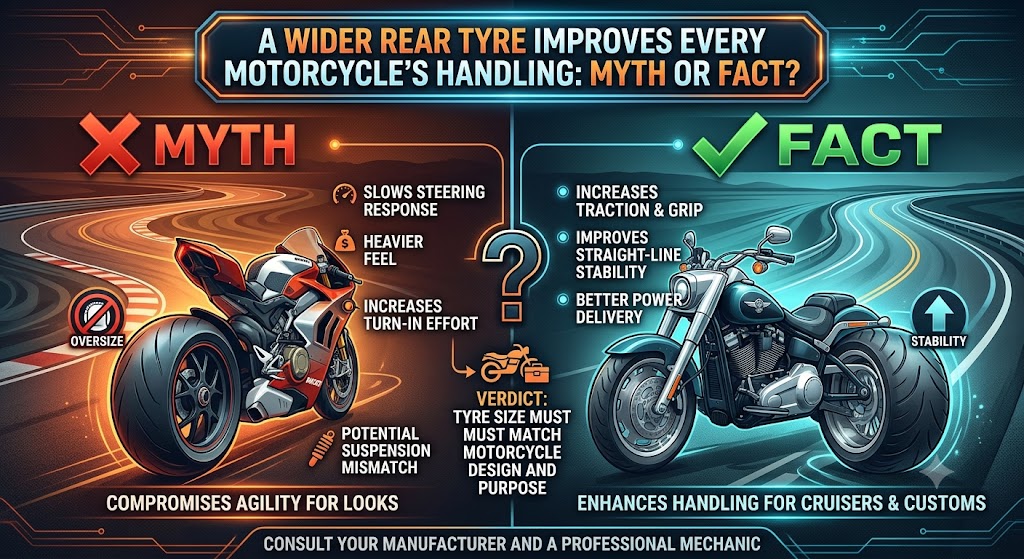
A wider rear tyre can improve traction and stability in certain conditions, but it does not automatically make every motorcycle handle better. Handling depends on tyre design, compound, profile, pressure, motorcycle geometry, suspension setup, weight distribution and riding conditions. Fitting a tyre that is wider than the manufacturer recommends can sometimes make a motorcycle less predictable rather than safer.
Motorcycle owners often believe that a wider rear tyre offers better grip, sharper cornering and improved road stability. This belief is especially common among riders who want their bikes to look sportier or more muscular. While a wider tyre can provide benefits in specific applications, width alone does not determine how well a motorcycle handles.
Before changing a motorcycle’s rear tyre, it is important to understand how tyre dimensions influence grip, steering response, cornering and braking. The right tyre is not necessarily the widest one available; it is the tyre that works correctly with the motorcycle’s design.
Company-Fitted vs Aftermarket Accessories: Which Is Better?
Wider rear tyres are often associated with performance motorcycles, powerful engines and premium styling. A wider tyre can create a more substantial appearance and, when properly engineered for the motorcycle, may provide a larger usable contact patch under suitable conditions.
Motorcycles that produce high torque may also require tyres designed to transmit substantial power to the road. In such cases, a suitable tyre width, construction and rubber compound help the rear wheel maintain traction during acceleration.
However, these benefits do not mean that increasing the tyre width on an ordinary commuter motorcycle will produce the same results. Manufacturers select tyre dimensions to balance grip, steering effort, comfort, fuel efficiency, suspension behaviour and overall stability.
A tyre that works well on a powerful sports bike may not be suitable for a lightweight commuter motorcycle with different wheel dimensions and chassis geometry.

Tyre width is only one part of the handling equation. The tyre’s profile, construction, rubber compound and relationship with the wheel rim also influence how the motorcycle responds to rider inputs.
1. Grip and Traction
A wider rear tyre may offer greater traction when its construction, compound and profile are appropriate for the motorcycle and riding conditions. This can be useful during acceleration, especially on motorcycles that deliver substantial power to the rear wheel.
However, grip does not increase automatically in direct proportion to tyre width. The amount of traction available depends on the tyre’s rubber compound, temperature, road surface, inflation pressure, load and the forces acting on the tyre.
A quality tyre of the correct size can outperform a wider tyre made from a less suitable compound. On wet roads, tyre tread design, water evacuation and rubber characteristics can be particularly important.
2. Cornering and Leaning
Cornering is often the main reason riders consider installing wider rear tyres. They may expect a wider tyre to provide more grip when leaning into a turn.
In reality, cornering performance depends heavily on the tyre’s profile. Motorcycle tyres are curved to support changes in lean angle. Their shape influences how smoothly the bike transitions from upright riding to cornering.
If a tyre is too wide for the rim, its intended profile can be distorted. This may make the motorcycle feel reluctant to turn, change the way it responds during lean transitions or reduce the predictability of its handling.
A wider tyre designed for a particular wheel and chassis may work exceptionally well. An oversized tyre fitted to a wheel that was not designed for it may not.
3. Steering Response
A motorcycle’s steering response is affected by the shape and dimensions of both tyres, as well as steering geometry, wheel alignment and suspension settings.
Changing the rear tyre size can alter the way the motorcycle transitions into corners. Depending on the tyre profile and fitment, the bike may feel slower to turn, less neutral or different from what the manufacturer intended.
This matters in everyday riding, where predictable steering helps riders negotiate traffic, make quick direction changes and maintain control on winding roads.
A wider rear tyre is therefore not a guaranteed route to sharper handling. In some cases, the original tyre size provides the best balance between agility and stability.
4. Straight-Line Stability
Some riders assume a wider rear tyre will always make a motorcycle more stable at high speeds. However, straight-line stability depends on several factors, including chassis geometry, wheelbase, suspension condition, tyre pressure, wheel alignment and the condition of the road.
An appropriately designed wider tyre can support stability on a motorcycle engineered for it. But an incorrectly sized tyre may introduce unwanted handling characteristics or interfere with the motorcycle’s intended setup.
Tyre width alone cannot correct worn suspension components, incorrect tyre pressure, damaged wheels or poor wheel alignment.
5. Comfort and Road Feedback
Tyre construction, sidewall stiffness, pressure and profile affect how a motorcycle responds to road imperfections. A wider tyre does not automatically provide a softer ride or better feedback.
If an oversized tyre is fitted incorrectly, it may change the contact profile and the way forces are transmitted through the wheel and suspension. The resulting ride could feel less comfortable or less predictable.
For daily commuting, a correctly sized tyre with suitable construction and pressure is usually a more sensible choice than an oversized tyre selected mainly for appearance.
|
Factor |
Potential benefit of a suitable wider tyre |
Possible drawback of an unsuitable wider tyre |
|
Traction |
Can support higher power delivery when properly engineered |
Width alone may not improve grip |
|
Cornering |
Can provide appropriate support on a compatible motorcycle |
Incorrect profile may reduce predictable turn-in |
|
Stability |
May suit motorcycles designed for wider tyres |
Can disturb the intended handling balance |
|
Steering |
Can work well with matched wheel and chassis geometry |
May make direction changes feel slower |
|
Appearance |
Can give the motorcycle a fuller, sportier look |
Cosmetic changes may compromise functionality |
|
Fuel efficiency |
No guaranteed improvement from extra width |
Additional rolling resistance may increase energy use |
|
Clearance |
Correct fitment preserves designed clearances |
May rub against the chain, swingarm, mudguard or other components |
Does a Wider Rear Tyre Improve Braking?
Not necessarily. Motorcycle braking performance depends on tyre grip, road conditions, brake design, weight transfer, tyre condition and rider technique.
During hard braking, a motorcycle’s weight shifts towards the front wheel. The front tyre consequently plays a major role in stopping performance, while the rear wheel may become less heavily loaded.
A wider rear tyre cannot compensate for poor front-tyre condition, worn brake pads, incorrect tyre pressure or inadequate braking technique. Nor does a wider tyre guarantee a shorter stopping distance on wet or slippery surfaces.
The best approach is to use tyres with appropriate specifications and maintain both the front and rear tyres according to the manufacturer’s recommendations.
Does a Higher Engine Capacity Mean a Faster Bike? Understanding CC, Power and Speed
It can, depending on the tyre’s construction, weight, compound and rolling resistance. A wider tyre may have a different contact profile and may increase aerodynamic drag or rolling resistance in some applications, although the actual effect varies.
If a replacement tyre is heavier, the additional rotating mass may also affect acceleration and energy consumption. The difference is not the same for every motorcycle or tyre model.
For riders who use their motorcycles primarily for daily commuting, fuel efficiency, predictable handling and tyre life may be more important than the visual appeal of a wider rear tyre.
Installing a tyre wider than the manufacturer-approved specification can create several issues:
Incorrect tyre profile: The tyre may not sit on the rim as intended, affecting its behaviour during cornering.
Reduced clearance: The tyre could contact the chain, swingarm, mudguard or other components.
Changed steering behaviour: The motorcycle may feel slower to turn or less predictable.
Potential rubbing: Movement of the suspension or wheel under load may cause interference.
Uncertain performance: Grip, braking and stability may not improve as expected.
Warranty or compliance concerns: Non-approved modifications may affect warranty coverage or compliance with applicable vehicle requirements.
The severity of these issues depends on the motorcycle and the exact tyre dimensions. A tyre should never be selected based solely on whether it can physically fit into the available space.

Choosing the right rear tyre starts with the motorcycle manufacturer’s specifications. Check the owner’s manual or the tyre information label for the recommended tyre size, load index, speed rating and pressure.
Consider the following factors before purchasing a replacement:
1. Follow the recommended size. Use the specified dimensions unless the manufacturer explicitly approves an alternative.
2. Choose the right tyre compound. A tyre designed for everyday commuting may prioritise durability, while a sport-oriented tyre may focus more on grip and performance.
3. Match the tyre to your riding conditions. Frequent rain, rough roads, highway travel and city commuting can require different performance characteristics.
4. Maintain correct inflation pressure. Follow the manufacturer’s recommended pressure for the intended load and riding conditions. Do not assume a wider tyre needs a different pressure without checking the approved specifications.
5. Inspect the wheel and tyre condition. Look for uneven wear, cracks, punctures, bulges and other damage. Replace a tyre when required.
6. Get professional fitment advice. A qualified tyre technician can verify rim compatibility, clearance, load rating and other relevant requirements before installation.
Some high-performance motorcycles use wider rear tyres because their engines, chassis, wheel dimensions and suspension systems are designed around those specifications. The tyre must be capable of transmitting power while maintaining predictable behaviour at the motorcycle’s intended operating speeds and lean angles.
Commuter motorcycles generally have different priorities, including affordability, manoeuvrability, comfort, durability and fuel efficiency. Their original tyre dimensions are selected to suit those requirements.
This does not mean wider tyres are inherently better for sports bikes or inherently unsuitable for commuters. It means tyre selection should follow the engineering requirements of the particular motorcycle rather than a general belief that more width always means more performance.
The Complete Guide to Buying a New Car in India: The Wheels42 7-Step Framework
No. The claim that a wider rear tyre improves every motorcycle’s handling is a myth. A wider tyre can be beneficial when it is properly designed and approved for the motorcycle, but tyre width alone does not determine grip, cornering ability, braking performance or stability.
An unsuitable wider tyre may distort the intended profile, change steering response, reduce clearance or increase rolling resistance. For many riders, the original manufacturer-recommended tyre size offers the most reliable balance of handling, comfort, safety and efficiency.
Before upgrading, check the motorcycle’s specifications and seek advice from a qualified tyre professional. Choose a tyre based on compatibility, construction, compound and riding requirements—not width or appearance alone.













Audi
₹73.57 - 92.75 Lakh