Some motorcycles become popular because they offer the most power. Others win buyers with technology, low weight or an aggressive price.
The Royal Enfield Classic 350 follows a different formula.
It has never been positioned as the fastest motorcycle in its segment, nor does it try to overwhelm riders with electronics. Instead, the Classic 350 combines a recognisable retro design, relaxed performance, substantial road presence and a riding experience that is deliberately unhurried.
That formula has kept the motorcycle relevant even as the Indian 350cc segment has become increasingly competitive.
The Classic 350 currently uses Royal Enfield's 349cc J-platform engine, producing 20.2 bhp and 27 Nm, paired with a five-speed gearbox. For 2026, Royal Enfield has added an assist-and-slipper clutch and USB-C charging to the dual-channel ABS variants, while the basic mechanical package remains unchanged.
But specifications alone don't explain its popularity.
So, what keeps bringing riders back to the Classic 350?
It Doesn't Try to Look Like Every Other Modern Motorcycle
The first answer is sitting right in front of you.
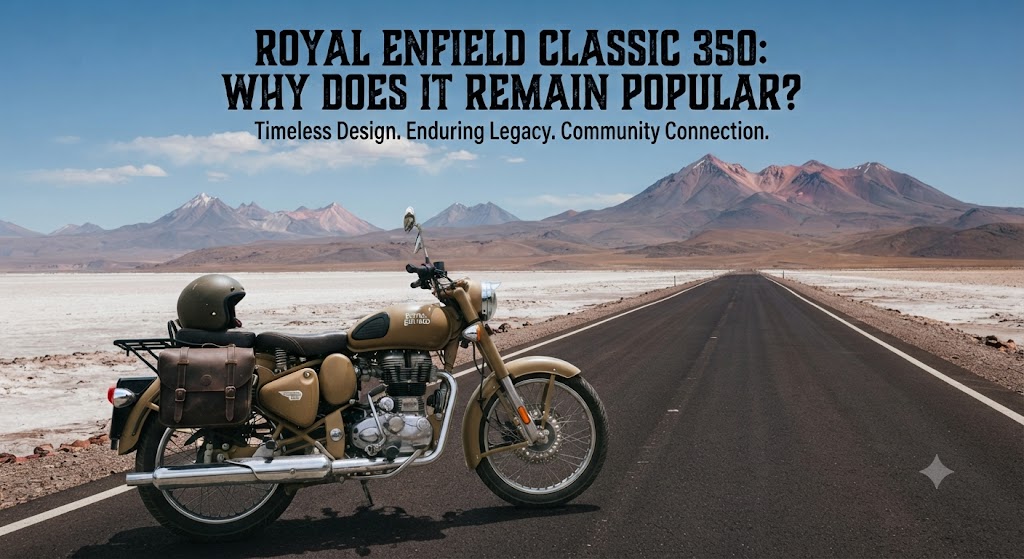
The Classic 350 has a design that immediately communicates what it is.
The round headlamp, curved mudguards, teardrop-shaped fuel tank, traditional side panels and spoke-wheel options give it a distinctly old-school appearance. Royal Enfield has deliberately retained these design cues while updating the mechanical and electrical components underneath.
That matters because motorcycle buyers don't always choose with a specification sheet.
A Classic 350 parked outside a café, office or house has a visual identity of its own. It doesn't need aggressive graphics or an oversized exhaust to establish its presence.
For many buyers, that timeless appearance is part of the reason they want the motorcycle in the first place.
The Classic 350 Is About the Experience, Not the Numbers
On paper, the Classic 350's engine figures don't look extraordinary.
The 349cc single-cylinder, air-oil-cooled motor makes 20.2 bhp at 6,100rpm and 27 Nm at 4,000rpm. It uses electronic fuel injection and a five-speed constant-mesh gearbox.
But the motorcycle isn't designed around chasing maximum acceleration.
The engine's character is more important than its headline output.
It delivers its torque relatively low in the rev range, which suits relaxed city riding and steady cruising. Instead of constantly encouraging the rider to chase higher revs, the Classic encourages a calmer approach.
That character is a major part of its identity.
Autocar India's long-term experience with the Classic 350 similarly highlights the sense of occasion the motorcycle brings to ordinary rides, rather than presenting it as a machine built primarily around outright performance.
It Has the Right Kind of Weight for Its Character
At 195kg with 90 percent fuel and oil, the Classic 350 is not a lightweight motorcycle.
That can sound like a disadvantage in a world where manufacturers increasingly promote lighter motorcycles.
But weight also contributes to the Classic's substantial feel.
Once moving, the motorcycle feels planted rather than nervous. The longer 1,390mm wheelbase also contributes to its stable character.
This is particularly noticeable when riding at a relaxed pace.
The Classic doesn't constantly feel as if it wants to change direction or accelerate aggressively. It encourages the rider to settle into the motorcycle.
That's an important distinction.
Some motorcycles make you feel energetic.
The Classic 350 often makes the ride itself feel like the destination.
The Riding Position Is One of Its Biggest Strengths
The Classic 350 uses a relatively upright and relaxed riding position.
For riders who don't want to lean forward over the handlebar, this can make everyday riding more comfortable.
The motorcycle also has an 805mm seat height and a 170mm ground clearance, according to Royal Enfield's current specifications.
The combination gives it a familiar roadster-like stance without making it feel excessively tall.
This helps explain why the Classic appeals to riders who want one motorcycle for a mixture of city riding, weekend outings and occasional highway journeys.
It isn't an extreme machine in either direction.
The 349cc Engine Is Now a Familiar Formula
One reason the Classic feels mature is that its engine and platform have been around long enough to become familiar within Royal Enfield's lineup.
The 349cc J-platform also powers other Royal Enfield motorcycles, including the Hunter 350, Meteor 350, Bullet 350 and Goan Classic 350. All five use the same basic 349cc engine output of 20.2hp and 27Nm.
That means Royal Enfield has built a substantial 350cc family around the platform.
And the Classic remains the model that most clearly represents the traditional interpretation of that formula.
It is essentially the motorcycle that defines what many riders imagine when they hear "Royal Enfield 350."
The Sound and Feel Still Matter
Modern motorcycles have become increasingly quiet and refined.
The Classic 350 takes a slightly different approach.
Its single-cylinder engine retains a distinctive mechanical character, while the exhaust note and engine pulses contribute to the overall experience.
This isn't about saying one sound is objectively better than another.
It's about character.
The Classic 350 feels like a motorcycle with personality rather than simply a machine designed to transport the rider from one location to another.
That emotional element is difficult to measure in a specification table, but it is important when explaining the model's continued popularity.
It Has Become More Modern Without Losing Its Identity
This may be the most important change over the years.
The Classic 350 is no longer a purely old-school motorcycle.
The current model gets features such as an LED headlamp, LED indicators, USB-C charging on applicable variants, gear-position information and optional Tripper navigation functionality.
The 2026 update also introduced an assist-and-slipper clutch on the dual-channel ABS variants.
Royal Enfield says this reduces clutch effort and helps smooth downshifts.
That is a useful example of how the Classic has evolved.
The company hasn't dramatically changed the motorcycle's personality. Instead, it has gradually removed some of the inconveniences associated with older-generation Royal Enfields.
The Classic 350 Isn't Trying to Win the Technology Race
This is where the motorcycle differs from many newer rivals.
The Classic 350 does not attempt to turn the handlebar area into a smartphone screen.
Its instrumentation remains relatively simple, combining an analogue-style speedometer with a digital information display on applicable versions. Royal Enfield also offers a Tripper navigation display on selected versions.
For some riders, that's exactly the point.
There is less visual clutter.
The motorcycle remains recognisable as a motorcycle rather than becoming another screen-heavy consumer device.
That simplicity is part of its appeal.
The 2026 Update Shows What Royal Enfield Is Prioritising
The latest update is interesting because Royal Enfield did not radically change the engine.
Instead, the 2026 Classic 350 received practical improvements.
The assist-and-slipper clutch is intended to make gear changes easier, while the USB-C port addresses a straightforward modern requirement: charging a smartphone while riding.
The basic Redditch variant continues without these additions, while the higher dual-channel ABS versions receive the newer equipment.
This approach tells us something about the Classic.
Royal Enfield appears to understand that many buyers aren't asking for a completely different motorcycle.
They want the same Classic experience with fewer everyday compromises.
It Has the Right Size for Its Audience
The Classic 350 measures:
- 2,145mm in length
- 785mm in width without mirrors
- 1,090mm in height without mirrors
- 1,390mm wheelbase
- 170mm ground clearance
- 805mm seat height
- 195kg kerb weight
- 13-litre fuel tank
These are official Royal Enfield figures.
The dimensions give it a substantial stance without turning it into an oversized touring motorcycle.
Its 13-litre tank is also useful for riders who regularly undertake longer journeys.
Autocar India's testing has recorded fuel economy figures of 32.7kpl in the city and 36.8kpl on the highway, although real-world economy naturally varies with riding style, traffic and conditions.
Why Does the Classic 350 Still Feel Special?
The answer is partly because it occupies a very specific space.
It isn't trying to be:
- The fastest 350cc motorcycle
- The lightest motorcycle
- The most technologically advanced motorcycle
- The most aggressive-looking motorcycle
Instead, it tries to be a recognisable, relaxed and characterful motorcycle.
That makes its appeal easier to understand.
A rider who wants sharp acceleration and sporty handling has plenty of alternatives.
A rider who wants maximum electronic equipment can find that too.
But someone who wants a motorcycle that looks traditional, feels substantial and encourages relaxed riding still finds the Classic 350 difficult to replace.
The Royal Enfield Image Is Part of the Product
There is also a brand element that cannot be ignored.
Royal Enfield has spent years building an identity around classic motorcycles, riding culture and customisation.
The Classic 350 fits naturally into that ecosystem.
Owners can personalise their motorcycles with accessories, luggage, seats and other equipment, while Royal Enfield also has a large network of dealerships and service infrastructure in India.
The result is that buying a Classic is not simply about choosing an engine size.
For many customers, it is also about becoming part of a recognisable motorcycle culture.
That emotional connection helps explain why the model remains relevant even when newer products arrive.
The 350cc Family Is Extremely Important to Royal Enfield
The Classic's popularity becomes even more interesting when viewed alongside Royal Enfield's wider 350cc portfolio.
Autocar India reported that Royal Enfield sold more than one million motorcycles between April 2025 and February 2026, with 9.31 lakh of the 10.07 lakh units coming from its 350cc range.
That figure covers the entire 350cc family, not the Classic 350 alone.
However, it demonstrates how important this engine platform has become to Royal Enfield's business in India.
The Classic 350 is one of the most recognisable members of that family.

 Khyati Sharma 2026-09-30