


 Khyati Sharma 2026-09-29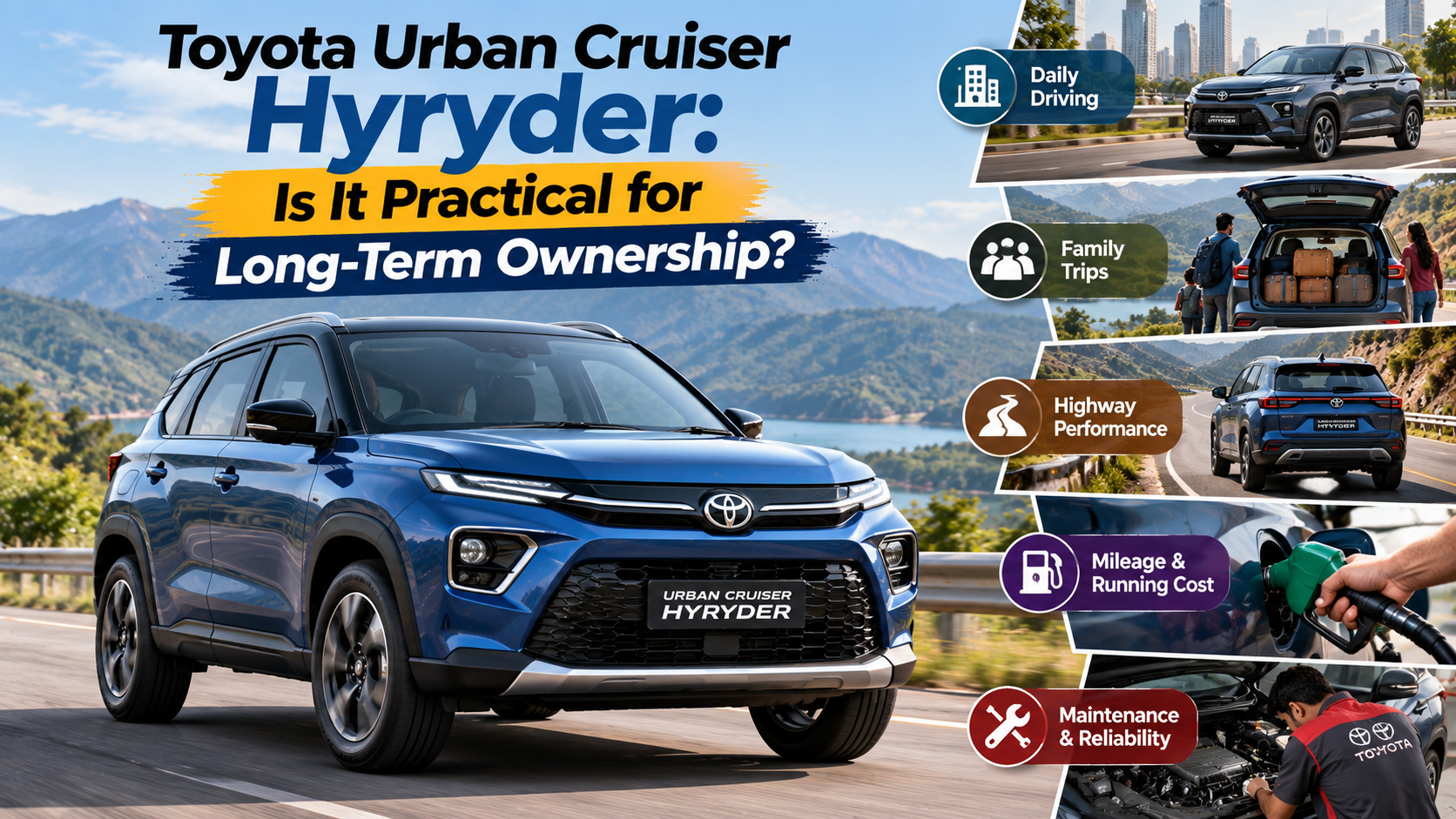
The Toyota Urban Cruiser Hyryder is aimed at buyers who want an SUV that can handle everyday commuting while also being suitable for family trips and longer journeys. Its biggest talking point is the availability of multiple powertrain options, including a strong-hybrid setup, petrol mild-hybrid/NeoDrive versions and a factory-fitted CNG option.
But long-term ownership is about more than fuel economy. Running costs, practicality, comfort, powertrain choice, maintenance requirements and everyday usability all matter. So, how does the Hyryder fit into that equation?
Toyota offers the Hyryder with three broad powertrain choices:
The strong-hybrid version combines a 1.5-litre petrol engine with an electric motor and lithium-ion battery. Toyota quotes a certified 27.97km/l for the hybrid. The NeoDrive petrol versions are rated at up to 21.11km/l with the 5-speed manual, while the 6-speed automatic is rated at 20.58km/l in 2WD form. The CNG version is rated at 26.6km/kg in Toyota's current specification information.
That variety is important because buyers with very different driving patterns can approach the Hyryder in different ways.
|
Powertrain |
Key Output |
Transmission |
Certified Efficiency* |
|
Strong Hybrid |
115.56 PS system power |
e-Drive |
27.97 km/l |
|
NeoDrive Petrol |
103.06 PS |
5MT/6AT |
Up to 21.11 km/l |
|
E-CNG |
100.6 PS petrol / 87.8 PS CNG |
5MT |
26.6 km/kg |
For someone covering high annual mileage, the strong hybrid is particularly relevant because its efficiency advantage can have a meaningful effect on fuel consumption over several years.
The CNG version, meanwhile, can make sense for buyers who have convenient access to CNG refuelling and primarily drive in areas where the fuel is readily available.
The Hyryder measures 4,365mm long, 1,795mm wide and 1,645mm high, with a 2,600mm wheelbase. It is a five-seater SUV.
Toyota specifically highlights the cabin's legroom and headroom, along with a 60:40 split rear seat.
This makes the Hyryder suitable for the typical five-member family, while the split-folding rear seat adds flexibility when carrying luggage.
For long-term ownership, this everyday flexibility can be more useful than simply having a large exterior footprint.
The Hyryder's dimensions are relatively manageable for an SUV, while Toyota lists a 5.4-metre turning radius.
The automatic transmission option is available with the petrol powertrain, while the strong hybrid uses an e-Drive transmission.
For predominantly urban users, the hybrid powertrain is particularly interesting because the electric motor can contribute to the driving experience at lower speeds, while the system is designed to recharge its battery without requiring an external charging connection.
The Hyryder is also designed for family road trips.
The petrol NeoDrive version can be specified with a 6-speed automatic, while an AWD 6AT configuration is also available in the current specification range. Toyota lists a certified efficiency figure of 19.20km/l for the AWD 6AT.
The AWD option gives the Hyryder an additional capability for buyers who regularly travel on rougher roads or in areas where extra traction can be useful.
However, buyers should distinguish between an AWD compact SUV and a dedicated off-road vehicle. The Hyryder's primary role remains family-oriented road use.
This is probably the most interesting question surrounding the Hyryder.
The strong-hybrid system uses a 1.5-litre petrol engine, electric motor and lithium-ion battery, with a total system output of 85kW (115.56 PS). Toyota quotes 27.97km/l under the applicable certification cycle.
The key benefit is that the owner gets an electrified driving system without needing to install a home charger.
For a buyer who drives frequently in traffic and covers substantial kilometres every year, the efficiency advantage could be useful over a longer ownership period. For someone who drives only a few thousand kilometres annually, the financial calculation can be different because the purchase price and usage pattern also matter.
In other words, the hybrid should be considered based on annual running and driving conditions, not simply its headline mileage figure.
1. Multiple Fuel Choices
Petrol, hybrid and CNG options allow buyers to select a powertrain around their usage pattern.
2. Five-Seat Family Layout
The five-seat configuration and 60:40 split rear seat make it suitable for regular family use.
3. Strong Hybrid Efficiency
The certified 27.97km/l figure gives the hybrid version a clear efficiency focus.
4. Automatic Option
The petrol range includes a 6-speed automatic, while the strong hybrid uses an e-Drive transmission.
5. AWD Availability
Certain NeoDrive variants can be equipped with AWD and a 6-speed automatic, adding another option for buyers who regularly encounter challenging road conditions.
No single Hyryder variant suits every owner.
A buyer choosing the CNG model should consider whether CNG stations are convenient along regular routes. The CNG system also means the vehicle's configuration differs from the petrol-only versions.
The strong hybrid makes more sense to investigate when annual running is relatively high and city driving forms a significant part of the usage.
The NeoDrive petrol remains the simpler choice for someone who wants conventional petrol power and does not want to make the hybrid or CNG decision.
Another point is that features and equipment vary by grade. Toyota's current specification information includes features such as six airbags, TPMS, ventilated seats, rear sunshades, electronic parking brake and other equipment depending on the variant.
|
Factor |
Hyryder |
|
Seating |
5 |
|
Length |
4,365 mm |
|
Width |
1,795 mm |
|
Height |
1,645 mm |
|
Wheelbase |
2,600 mm |
|
Strong Hybrid Efficiency |
27.97 km/l |
|
CNG Efficiency |
26.6 km/kg |
|
Petrol Efficiency |
Up to 21.11 km/l |
|
Automatic |
Yes |
|
AWD |
Available on selected petrol variant |
|
Rear Seat |
60:40 split |
|
Turning Radius |
5.4 m |
The Toyota Urban Cruiser Hyryder is built around flexibility rather than a single ownership formula. A buyer can choose between conventional petrol, strong hybrid and CNG powertrains, while selected versions also offer an automatic transmission and AWD.
For long-term ownership, the most important decision is therefore choosing the right powertrain for your annual running and typical routes. The hybrid can appeal to high-mileage urban users, CNG can suit buyers with easy access to CNG stations, and the petrol version provides a more conventional ownership proposition.
Its five-seat cabin, 2,600mm wheelbase, family-friendly layout and multiple powertrain choices make the Hyryder a vehicle that can be considered for everyday use as well as regular road trips.




Audi
₹46.02 - 63.71 Lakh