



 Khyati Sharma 2026-09-30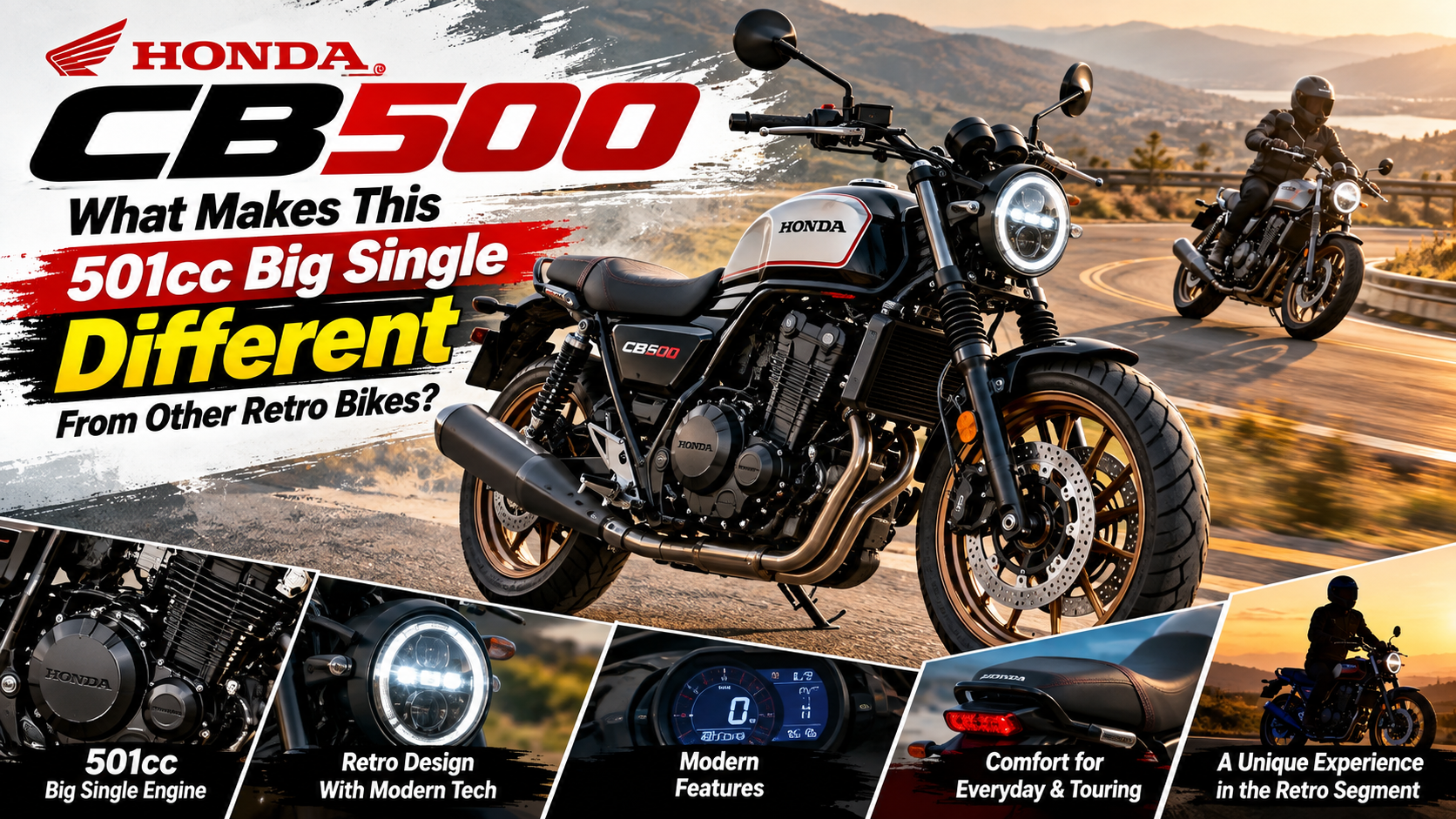
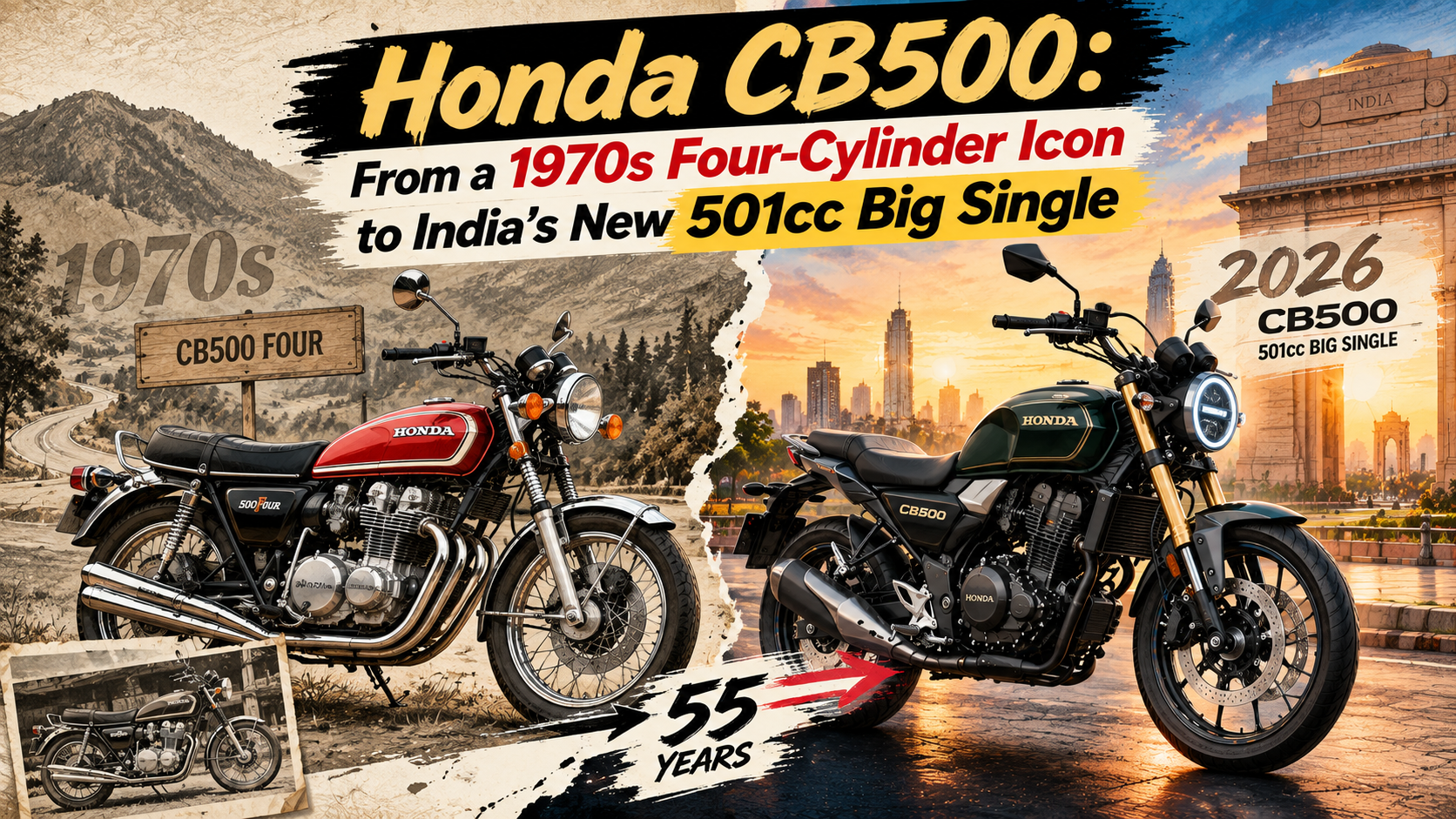
Honda bike has introduced the CB500 in India with a 501cc single-cylinder engine, giving the retro-roadster segment a very different alternative to the twin-cylinder motorcycles that dominate this price and displacement range.
The new Honda CB500 is one of the more unusual motorcycles to enter the Indian market in 2026. While the CB500 name is familiar internationally, the India-spec motorcycle is fundamentally different from Honda's current global CB500 models.
Instead of using a parallel-twin engine, the Indian CB500 gets a 501cc air- and oil-cooled single-cylinder engine producing 27.6 bhp and 43.3 Nm. It is paired with a five-speed gearbox and is manufactured in India.
That large single-cylinder engine is the biggest reason the CB500 stands apart.
|
Specification |
Honda CB500 |
|
Engine |
501cc single-cylinder |
|
Cooling |
Air + oil cooled |
|
Maximum Power |
27.6 bhp |
|
Maximum Torque |
43.3 Nm |
|
Gearbox |
5-speed |
|
Clutch |
Assist and slipper clutch |
|
Traction Control |
Honda Selectable Torque Control |
|
ABS |
Dual-channel |
|
Connectivity |
Honda RoadSync |
|
Headlamp |
LED |
|
Manufacturing |
India |
|
Starting Price |
₹2.75 lakh |
The defining feature of the Honda CB500 is its engine.
Rather than using a twin-cylinder configuration, Honda has developed a 501cc single-cylinder air/oil-cooled motor for the Indian motorcycle.
The engine produces 27.6 bhp and 43.3 Nm of torque. Those numbers reveal what Honda is trying to achieve with the CB500: the motorcycle is not primarily about chasing high horsepower figures. Instead, the large single focuses on torque, tractability and a distinctive riding character.
A large single-cylinder engine also has a different mechanical character from a parallel-twin. Riders can expect a more pronounced single-cylinder feel, with the engine's torque delivery becoming an important part of the riding experience.
This is what makes the CB500 particularly interesting in India's current motorcycle market.
For several years, Indian riders looking for a retro motorcycle with a large single-cylinder engine had limited choices.
Royal Enfield's 500cc single-cylinder UCE-powered motorcycles were discontinued in 2020. Honda's new CB500 therefore enters a part of the market that has remained relatively quiet since then.
Honda has now taken that basic formula and combined it with modern electronics and contemporary manufacturing.
The result is a motorcycle that combines:
This is an important point for potential buyers.
The India-spec CB500 should not be confused with Honda's international CB500F/CB500 family.
Honda's modern global CB500 family has traditionally used a 471cc liquid-cooled parallel-twin engine. The Indian motorcycle instead uses a newly developed 501cc single-cylinder air/oil-cooled engine.
So, despite sharing the CB500 name, the Indian motorcycle has a substantially different mechanical identity.
That difference is actually one of the most interesting aspects of the new model.
The CB500 produces 43.3 Nm of torque but only 27.6 bhp.
This means Honda has clearly focused on the motorcycle's torque characteristics rather than maximum performance.
For everyday riding, strong torque can be useful when accelerating from lower speeds, overtaking and riding through traffic. The motorcycle's five-speed gearbox is also designed around this engine's characteristics.
The CB500 therefore shouldn't be judged only by its engine displacement.
A 500cc motorcycle producing less than 30 bhp might appear unusual on paper, but its purpose is different from that of a high-revving performance motorcycle.
The CB500 follows Honda's heritage-roadster design direction.
Its styling features a round LED headlamp, sculpted fuel tank, exposed mechanical components and a traditional roadster profile. The design takes inspiration from Honda's historic motorcycles while incorporating modern lighting and equipment.
The result is a motorcycle that aims to look classic without using an entirely old-fashioned mechanical package.
The styling also helps differentiate the CB500 from Honda's more contemporary street motorcycles.
Although the CB500 uses a relatively traditional air/oil-cooled single-cylinder engine, Honda hasn't kept the electronics equally basic.
The motorcycle gets Honda Selectable Torque Control (HSTC), Honda's traction-control system.
It also comes with a slipper clutch, which can help manage rear-wheel behaviour during aggressive downshifts.
Other equipment includes:
These features give the CB500 a more contemporary equipment package than its old-school engine layout might suggest.
Honda offers the CB500 in three variants.
|
Variant |
Price |
Main Difference |
|
CB500 Alloy |
₹2.75 lakh |
Alloy wheels |
|
CB500 Spoke Tubeless |
₹2.99 lakh |
Cross-spoke tubeless wheels |
|
CB500 Spoke Tubeless With Stripe |
₹3.02 lakh |
Spoke wheels + exclusive graphics |
The mechanical package remains broadly the same across the variants. The major differences are related to wheel type, colours and graphics.
This means buyers are primarily choosing the appearance and wheel configuration rather than a different engine or performance specification.
One interesting feature of the CB500 range is the availability of cross-spoke tubeless wheels.
This gives the motorcycle a more traditional appearance while retaining the convenience of tubeless tyres.
The top-spec version adds exclusive graphics, giving buyers another option for a more distinctive appearance.
For a motorcycle positioned as a heritage roadster, this combination of classic-looking wheels and modern tubeless-tyre technology fits the overall concept.
Honda has equipped the CB500 with several important safety technologies.
The motorcycle gets:
The inclusion of traction control is particularly notable because the motorcycle is built around a large single-cylinder engine with strong torque output.
Honda Selectable Torque Control can help manage rear-wheel slip in appropriate conditions, although it does not replace careful riding or proper tyre grip.
The CB500 sits above Honda's CB350 family.
That makes it an interesting option for riders who like the design philosophy of a 350cc retro roadster but want a larger engine.
The CB500 does not simply try to compete by offering maximum power. Instead, its appeal comes from the combination of:
larger displacement + single-cylinder character + retro styling + modern electronics.
This gives Honda a product with a noticeably different identity within its own range.
The CB500 also sits below the larger 650cc motorcycles in terms of engine output and price.
Honda has therefore created a middle position between the traditional 350cc retro category and larger 650cc motorcycles.
The motorcycle's starting price of ₹2.75 lakh puts it below several 650cc alternatives, although direct comparisons should also consider performance, equipment, weight, engine configuration and intended riding style.
The CB500 is therefore less about being the fastest motorcycle in its price bracket and more about offering a different engine experience.
Another important aspect is that the CB500 is manufactured in India.
Local production helps Honda position the motorcycle competitively in the Indian market. The company is also using the motorcycle to fill a gap between its existing 350cc motorcycles and larger offerings.
The Indian market has historically had strong demand for motorcycles that combine retro styling with practical everyday usability.
The CB500's design appears to target precisely that audience.
Not exactly.
The CB500 has a 501cc engine, but its output of 27.6 bhp means it isn't designed primarily as a performance-focused middleweight.
Its character is more closely tied to:
The engine's large single-cylinder configuration is the centrepiece of the experience.
There are several factors that separate the CB500 from many other motorcycles.
1. 501cc Single-Cylinder Engine
The engine layout is the biggest differentiator. A 501cc single-cylinder engine is unusual in the current Indian market.
2. Torque-Focused Character
With 43.3 Nm of torque and 27.6 bhp, the motorcycle prioritises torque rather than outright horsepower.
3. Modern Electronics
HSTC, dual-channel ABS and RoadSync connectivity bring modern features to an otherwise traditional motorcycle concept.
4. Retro Roadster Design
The round headlamp, classic tank shape and exposed mechanical design give the motorcycle a traditional roadster appearance.
5. Indian Manufacturing
The CB500 is manufactured in India, helping Honda position it within the local market.
The CB500 isn't simply a bigger version of Honda's CB350.
It uses a completely different engine architecture and offers substantially different mechanical character.
At the same time, it isn't a direct equivalent of Honda's global 500cc parallel-twin motorcycles either.
The Indian CB500 is essentially its own product: a 501cc big-single retro roadster designed around torque, simplicity and modern safety technology.