 Khyati Sharma 2026-09-08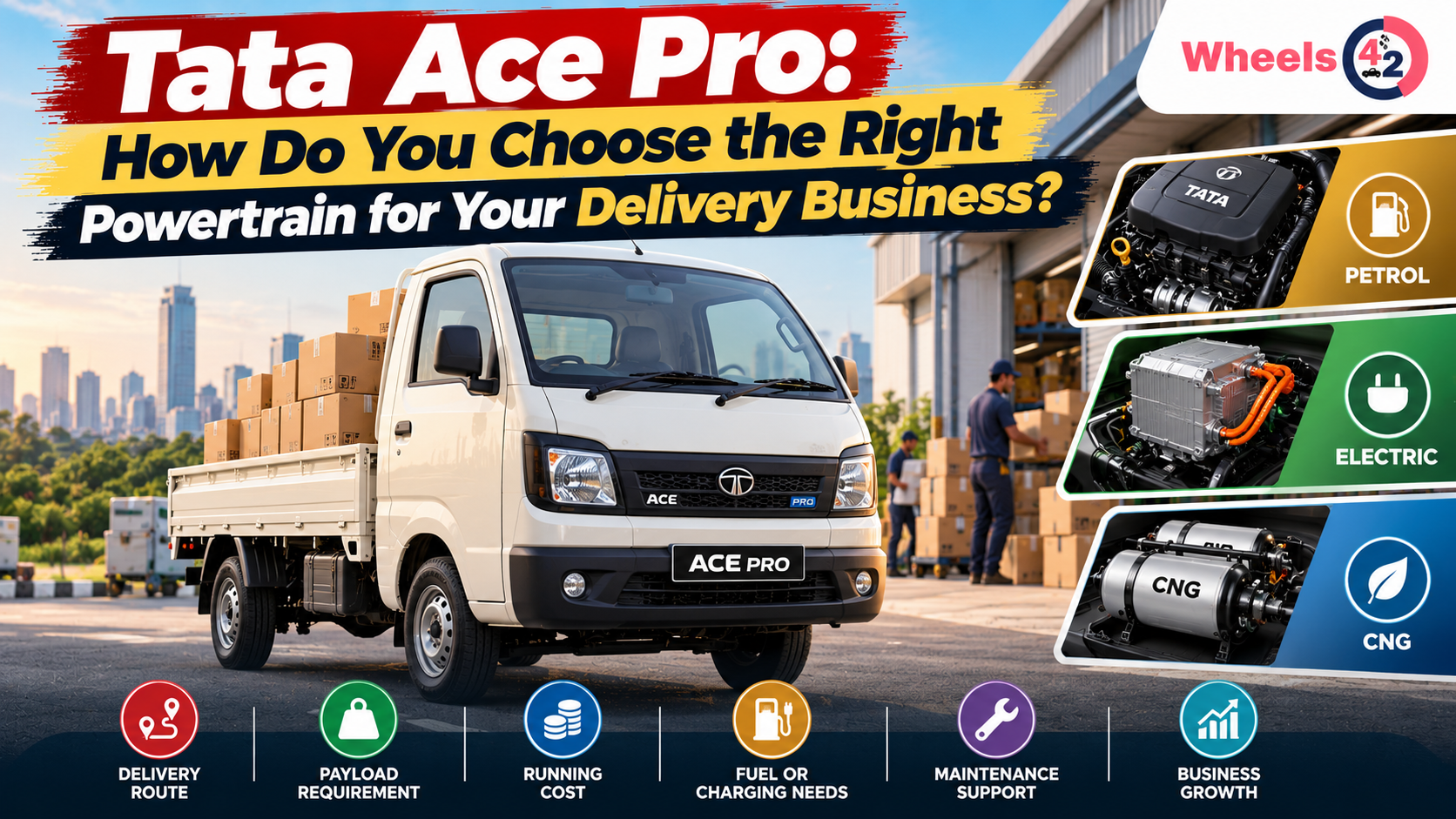
Choosing a small commercial vehicle for a delivery business is not simply about finding the lowest purchase price. The powertrain can have a major impact on fuel or energy costs, daily running, payload requirements, maintenance and overall profitability.
The Tata Ace Pro is designed for last-mile and small-load transportation, making it relevant for businesses such as grocery delivery, e-commerce, FMCG distribution, agricultural transport and local logistics. But before choosing a particular powertrain, buyers should understand how their vehicle will actually be used.
The first question should be: Where will the Tata Ace Pro operate most of the time?
A vehicle working inside a crowded city has very different requirements from one covering longer distances between towns.
For primarily urban operations, consider:
For longer routes, consider:
Your operating environment should be the starting point for selecting the appropriate powertrain.
The number of kilometres covered each day can change which powertrain makes the most financial sense.
A vehicle travelling only a few kilometres each day may not justify paying significantly more for a powertrain with a higher upfront cost. On the other hand, a delivery vehicle covering substantial distances every day can benefit more from lower running costs.
Before buying, calculate your approximate:
Daily kilometres × Working days per month × 12 months
This gives you a rough annual running figure.
For example, a business operating a vehicle for 26 days every month should consider annual usage rather than simply comparing showroom prices.
Payload is another critical consideration.
A delivery vehicle may operate with different loads depending on the business. A grocery distributor, for example, could carry relatively consistent loads, while an e-commerce operator may have varying loads throughout the day.
Before choosing, consider:
The right powertrain should be selected according to your actual business requirements, rather than simply choosing the most powerful option.
For a commercial vehicle, powertrain selection should be based on the total operating cycle.
A conventional internal-combustion powertrain can be convenient for businesses that operate across locations where fuel stations are readily available. It can also make sense for operators who need flexibility for longer routes.
An alternative powertrain may become more attractive when the vehicle has a predictable daily route and the required energy infrastructure is readily available.
The important point is to compare total operating cost, not just the initial purchase price.
Petrol vs Diesel vs CNG vs Electric Cars: How to Choose the Right Fuel Type
Running costs can have a significant effect on a delivery business's profit margin.
Instead of asking only, "Which vehicle is cheaper?", calculate:
A powertrain with a higher initial price can potentially make sense if its operating cost is substantially lower over the period you intend to keep the vehicle.
Infrastructure should be considered before making the final decision.
If your business depends on a conventional fuel-powered vehicle, check whether fuel stations are easily accessible along your routes.
For an electrified vehicle, charging becomes a much more important part of the business plan.
Ask:
A lower running cost is useful only if the vehicle can complete your daily delivery cycle reliably.
One of the best ways to select a commercial-vehicle powertrain is to calculate its cost per delivery.
Suppose a vehicle completes 40 deliveries per day. Even a small difference in operating cost per kilometre can become significant over several months.
Track:
Daily operating cost ÷ number of deliveries = approximate operating cost per delivery
You can then compare different powertrain options based on actual business usage.
This is more useful than comparing showroom prices alone.
Last-mile delivery often involves repeated acceleration, braking and idling.
tata motors cv If the Tata Ace Pro is being used primarily for urban deliveries, pay particular attention to how the selected powertrain behaves during:
A delivery vehicle spends much of its working day in conditions that may be very different from a private car's usage.
Downtime can be just as costly as fuel.
If your Tata Ace Pro is unavailable for a day, deliveries may have to be postponed or another vehicle may need to be hired.
Before purchasing, ask about:
A powertrain that fits your business but is difficult to maintain locally may not be the best long-term choice.
Your delivery business may grow after you buy the vehicle.
If your current operation covers 50 km per day but could increase to 100–150 km as the business expands, consider that before selecting the powertrain.
Similarly, if you expect to add more vehicles, standardising your fleet around a powertrain that suits your routes can simplify:
|
Factor |
What You Should Check |
|
Daily running |
How many kilometres will the vehicle cover? |
|
Route |
Mostly city, highway or mixed? |
|
Payload |
What is the typical load? |
|
Traffic |
Heavy stop-and-go or open roads? |
|
Running cost |
Fuel/energy cost per kilometre |
|
Infrastructure |
Refuelling or charging availability |
|
Maintenance |
Service network and routine costs |
|
Downtime |
How quickly can the vehicle be repaired? |
|
Business growth |
Could daily running increase later? |
|
Total cost |
Purchase + financing + running + maintenance |
Choosing the right Tata Ace Pro powertrain should begin with your delivery pattern rather than the showroom price. A business covering short urban routes with frequent stops may have different priorities from an operator running longer intercity routes.
The most important factors are daily kilometres, payload, route conditions, energy or fuel availability, maintenance support and total operating cost.
Before making the purchase, calculate your expected annual running and cost per delivery. Then compare the powertrain options according to how the vehicle will actually be used.
For a delivery business, the best powertrain is ultimately the one that keeps the vehicle productive, economical and available for work throughout its ownership period.