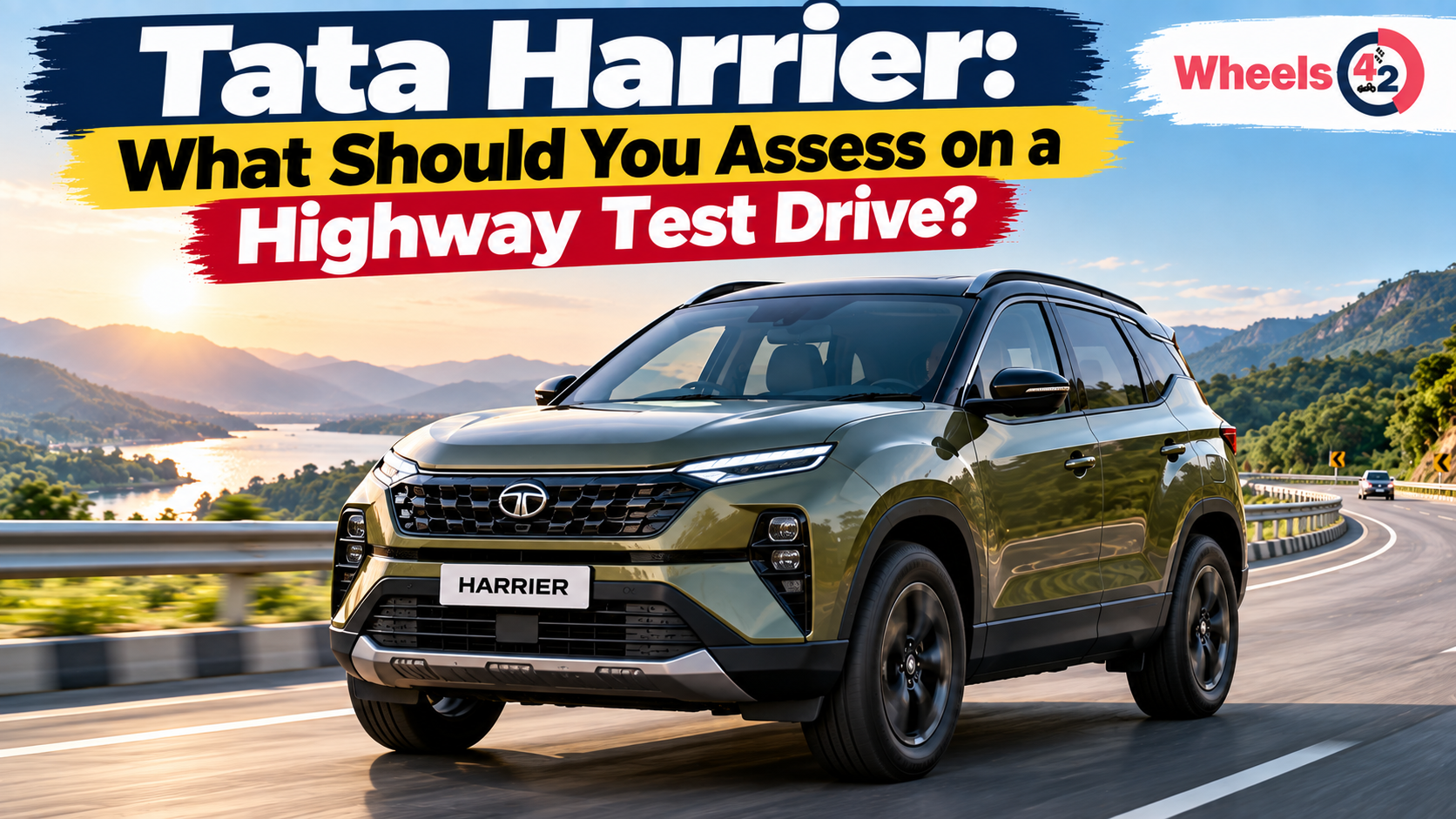
A city test drive can tell you whether a car is easy to drive, but a highway test drive reveals much more about an SUV. With the Tata Harrier, buyers should pay attention to high-speed stability, overtaking performance, braking, ride comfort, visibility, cabin noise and the way the automatic or manual gearbox behaves.
The Harrier is a five-seat SUV powered by a 2.0-litre Kryotec diesel engine producing 170 PS and 350 Nm. It is available with a 6-speed manual and 6-speed automatic transmission, depending on the variant.
So, instead of simply checking how the Harrier feels around a dealership, here is what you should assess during a proper highway test drive.
1. Check High-Speed Stability
The first thing to observe is how confidently the Harrier maintains its line at highway speeds.
The Harrier measures 4,605 mm in length and 1,922 mm in width, with a 2,741 mm wheelbase. These dimensions give the SUV a substantial footprint.
During the test drive, notice:
- Does the SUV remain stable when cruising?
- Does it require frequent steering corrections?
- How does it behave when changing lanes?
- Does the steering feel predictable at higher speeds?
Don't deliberately drive at unsafe speeds just to test stability. The objective is to understand the SUV's behaviour at legal and comfortable highway speeds.
2. Evaluate Overtaking Performance
A highway test drive is an opportunity to understand how the engine responds when you need additional acceleration.
The Harrier's 2.0-litre diesel produces 350 Nm of torque between 1,750 and 2,500 rpm, which is particularly relevant when accelerating from cruising speeds.
During a safe overtaking situation, assess:
- Initial acceleration
- Throttle response
- Mid-range performance
- Gearbox response
- How quickly the vehicle builds speed
- Performance with multiple occupants
Avoid judging the engine only by its maximum power figure. For highway driving, the way torque is delivered in the mid-range can be more relevant.
3. Test the Automatic Gearbox Properly
If you are considering the automatic Harrier, don't restrict the test drive to slow-moving traffic.
The Harrier uses a 6-speed automatic transmission on applicable variants.
Pay attention to how quickly the gearbox responds when:
- Accelerating onto a highway
- Overtaking another vehicle
- Climbing an incline
- Slowing down behind traffic
- Accelerating again after braking
A good test drive should include different traffic conditions so you can understand whether the transmission suits your driving style.
4. Check Braking Confidence
Braking performance is especially important on highways because vehicles generally travel at higher speeds and may need to slow down quickly.
The Harrier's braking configuration varies by variant. Tata's published specifications list front disc brakes across the range, while rear disc brakes are fitted from specified higher variants.
During your test drive, pay attention to:
- Brake pedal feel
- Initial braking response
- Straight-line stability while braking
- Ease of controlling braking pressure
- Whether the brakes feel predictable
Never perform emergency-braking tests on public roads unless the dealership provides a controlled area specifically for that purpose.
5. Assess Ride Quality on Different Surfaces
A highway isn't always perfectly smooth. Expansion joints, repaired sections, rough patches and uneven surfaces can reveal how well the suspension controls the vehicle.
The Harrier uses independent front suspension with McPherson struts and a semi-independent rear setup with coil springs.
During the drive, look for:
- How the suspension handles expansion joints
- Body movement over undulations
- Comfort on rough sections
- Whether passengers feel repeated bouncing
- How the SUV settles after a bump
Try to drive over different surfaces rather than judging the suspension from a perfectly smooth road.
6. Listen for Cabin Noise
Highway comfort isn't just about suspension. Noise levels can make a major difference during long journeys.
With the Harrier's diesel engine, listen carefully to:
- Engine noise during acceleration
- Tyre noise
- Wind noise around the mirrors and windows
- Suspension noise over rough surfaces
- Noise during higher-speed cruising
Have the audio system switched off for part of the test drive so you can properly assess the cabin environment.
7. Check the Driving Position
A highway journey can last several hours, so the driver's seating position matters.
Spend enough time adjusting:
- Driver's seat
- Steering reach and height
- Seatback angle
- Lumbar support, where available
- ORVMs
- Rear-view mirror
Then drive for at least enough time to determine whether your legs, back and shoulders remain comfortable.
A vehicle can feel comfortable during a five-minute dealership drive but feel very different after an extended journey.
8. Test Visibility and Lane Changes
The Harrier is a relatively large SUV, so visibility should be assessed carefully.
Check:
- Forward visibility
- Side visibility
- ORVM coverage
- Rear visibility
- Blind spots
- Parking-camera visibility, where equipped
Try a few normal lane changes at safe speeds and see whether the mirrors give you enough information.
9. Try the Cruise Control and Driver Assistance Features
Higher Harrier variants offer advanced driver-assistance features. Tata's published material notes features including Adaptive Cruise Control with Stop and Go and lane-centering assistance on applicable versions.
If your chosen variant has these systems, ask the dealership to demonstrate them properly.
However, ADAS should be treated as a driver-assistance system rather than a substitute for attentive driving. Tata itself states that the driver remains responsible for safe and vigilant operation.
During the demonstration, understand:
- How the system detects vehicles
- How adaptive cruise control maintains distance
- How lane assistance behaves
- What warnings appear
- When the system disengages
10. Check Highway Fuel-Use Expectations
Don't judge fuel economy from a short test drive.
Your actual consumption can vary depending on:
- Average speed
- Traffic
- Number of passengers
- Luggage
- Road gradient
- Tyre pressure
- Driving style
- Use of air conditioning
Instead of expecting the test-drive vehicle to deliver a particular figure, use the drive to understand how the engine and gearbox behave at your normal cruising speeds.
11. Test the Harrier With Your Family
If the Harrier is being considered as a family SUV, take family members along for the test drive if the dealership permits it.
Ask rear passengers about:
- Seat comfort
- Legroom
- Headroom
- Seat cushioning
- Rear AC performance
- Visibility
- Ride comfort over uneven roads
The Harrier is a five-seater, and Tata's published specifications list 445 litres of boot space, increasing to 815 litres with the rear seats folded according to the cited brochure.
This also gives you an opportunity to check whether your family's luggage fits comfortably.
Highway Test Drive Checklist
|
What to Check
|
What to Observe
|
|
High-speed stability
|
Straight-line confidence and steering corrections
|
|
Overtaking
|
Mid-range response and acceleration
|
|
Automatic gearbox
|
Shift response and downshifts
|
|
Brakes
|
Pedal feel and stability
|
|
Suspension
|
Bumps, joints and undulations
|
|
Steering
|
Weight and response
|
|
Cabin noise
|
Engine, tyre and wind noise
|
|
Driving position
|
Seat and steering comfort
|
|
Visibility
|
Mirrors and blind spots
|
|
ADAS
|
Operation and warnings on equipped variants
|
|
Rear-seat comfort
|
Space and ride quality
|
|
Boot
|
Luggage capacity
|
|
Fuel consumption
|
Real-world usage rather than short-trip figures
|
Manual vs Automatic: What Should You Test?
If you're undecided between the manual and automatic Harrier, ideally test both.
The manual version uses a 6-speed transmission, while the automatic version uses a 6-speed automatic on applicable variants.
For the manual, focus on:
- Clutch weight
- Gear-shift quality
- Ease of maintaining cruising speed
- Downshifts during overtaking
For the automatic, focus on:
- Smoothness
- Downshift response
- Highway overtaking
- Behaviour on inclines
- Ease of controlling speed
What Should You Record After the Test Drive?
Don't rely entirely on your first impression. Immediately after the drive, write down a few observations.
Score it for yourself on:
- Highway stability
- Engine response
- Gearbox behaviour
- Braking
- Ride comfort
- Steering
- Cabin noise
- Driver comfort
- Rear-seat comfort
- Visibility
This makes it easier to compare the Harrier with other SUVs without relying only on memory.
A proper highway test drive should go beyond checking whether the Tata Harrier feels powerful. The more useful assessment is how the SUV behaves as a complete package during cruising, overtaking, braking, lane changes and long-distance driving.
The Harrier's 170 PS/350 Nm diesel engine, 6-speed manual or automatic transmission, substantial dimensions and five-seat cabin provide the basic ingredients for highway use.
Before booking one, spend enough time assessing stability, braking, ride quality, gearbox response, cabin noise and passenger comfort. These are the areas that are difficult to judge properly from a short city test drive.

 Khyati Sharma 2026-09-29