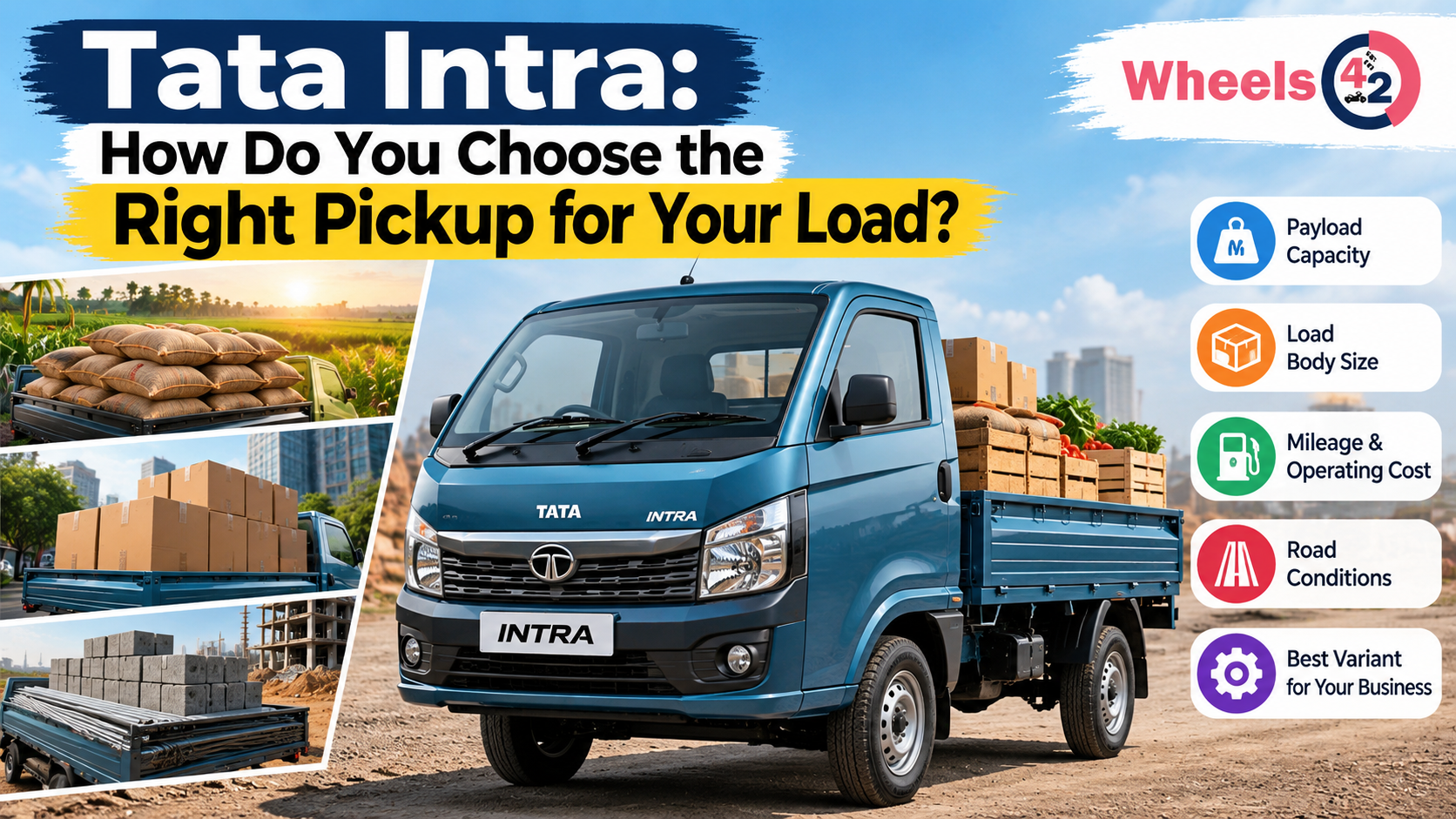
Choosing a commercial pickup is not simply about finding the vehicle with the biggest payload figure. For small businesses, farmers, delivery operators and local transporters, the right pickup needs to match the type of cargo, daily distance, road conditions, loading frequency and operating budget.
The Tata Intra range is designed to cover different small-commercial-vehicle requirements, with multiple variants offering different combinations of payload capacity, dimensions, engine performance and load-body configurations.
So, how should you decide which Tata Intra is suitable for your work?
Start With Your Actual Load
The first question should be: What do you carry every day?
A vehicle used for vegetables, groceries or parcels may have completely different requirements from one carrying construction materials, agricultural produce or heavy industrial goods.
If your normal load is well below the vehicle's maximum payload, choosing a higher-capacity model may not always make financial sense. On the other hand, regularly operating close to the maximum payload can make a lower-capacity pickup less suitable.
The safest approach is to calculate your average and maximum daily load before selecting a variant.
Payload Is Only One Part of the Decision
Payload capacity is important, but it should be considered alongside the vehicle's overall size and operating environment.
A larger payload rating can be useful for heavy cargo, while a compact pickup may be easier to operate in narrow city lanes and crowded markets.
For example:
- Urban deliveries: Compact dimensions and manoeuvrability can be important.
- Agricultural transport: Ground clearance and load capacity can matter more.
- Construction work: Payload, suspension and durability become key considerations.
- Longer routes: Engine performance, fuel efficiency and driving comfort become more relevant.
Tata Intra Range: What Should You Compare?
The Tata Intra family includes different models aimed at different commercial applications. Specifications vary by model and variant, so buyers should check the exact version available in their market.
|
Factor
|
What to Check
|
Why It Matters
|
|
Payload
|
Maximum permitted load
|
Determines how much cargo you can legally carry
|
|
Load body
|
Length and width
|
Important for bulky goods
|
|
Engine
|
Power and torque
|
Affects performance under load
|
|
Ground clearance
|
Clearance from road
|
Useful on rough and uneven routes
|
|
Turning radius
|
Manoeuvrability
|
Important in narrow roads and markets
|
|
Fuel efficiency
|
Real-world operating cost
|
Directly affects running expenses
|
|
Cabin
|
Space and comfort
|
Important for frequent or long trips
|
|
Service network
|
Availability near your route
|
Helps reduce downtime
|
|
Financing
|
EMI and down payment
|
Determines monthly business expense
|
Match the Pickup to Your Route
Your daily route can be just as important as your cargo.
If the pickup spends most of its time inside a city, a vehicle that is easy to manoeuvre and park may be more useful than one designed primarily for heavier loads.
For semi-urban or rural operations, the requirements can change. Poor roads, steep sections and unpaved routes may make ground clearance, torque and vehicle durability more important.
For highway-oriented operations, buyers may put greater emphasis on cruising ability, cabin comfort, stability and fuel consumption.
Consider the Load Body Carefully
The physical shape of your cargo should influence the vehicle choice.
A pickup carrying sacks or boxes may work efficiently with a conventional load body, while long or bulky goods may require a different cargo arrangement.
Before purchasing, measure the typical cargo rather than relying only on its weight.
Ask:
- How long is the cargo?
- How wide is it?
- How high can it be stacked?
- Does it need protection from weather?
- How frequently is loading and unloading required?
A vehicle with enough payload capacity may still be inconvenient if the load body cannot accommodate the cargo properly.
Don't Ignore Operating Costs
For a commercial vehicle, purchase price is only one part of the total cost.
Fuel, maintenance, tyres, insurance, financing and downtime can all affect profitability.
For example, if two pickups have similar payload capabilities, the one with lower operating expenses may make more sense for an operator covering thousands of kilometres every month.
This is why buyers should calculate an estimated cost per kilometre and compare it with their expected revenue per trip.
Think About Your Daily Usage
The right Tata Intra variant can also depend on how frequently the vehicle is used.
A business making several short trips every day may prioritise easy loading, manoeuvrability and fuel efficiency.
An operator travelling longer distances may place more emphasis on:
- Cabin comfort
- Engine performance
- Seating
- Stability
- Service availability
- Highway drivability
If the pickup is used for only occasional transport, financing and fixed ownership costs may become more important than maximum performance.
Calculate Your Business Requirement
A simple calculation can help before visiting a dealership.
Suppose a transporter carries 800 kg on average, but occasionally needs to move 1,000 kg. Instead of selecting a vehicle solely around the average figure, the operator should examine how often the heavier load occurs and whether the vehicle's rated payload legally accommodates it.
The same principle applies to volume. A lightweight but bulky cargo may require more load-body space even though it does not approach the maximum payload.
Tata Intra: Which Buyer Should Look at What?
|
Business Requirement
|
Important Priority
|
|
Grocery and parcel delivery
|
Compact size, manoeuvrability, operating cost
|
|
Vegetable and fruit transport
|
Load body, payload, easy loading
|
|
Agricultural goods
|
Payload, ground clearance, durability
|
|
Construction materials
|
Payload, torque, suspension and durability
|
|
Local distribution
|
Fuel efficiency, cargo space, service
|
|
Rural transportation
|
Ground clearance, durability and torque
|
|
Mixed city/highway work
|
Balance of payload, comfort and efficiency
|
After-Sales Support Matters
A commercial vehicle earns money only when it is working.
Before buying, check the availability of Tata commercial-vehicle service facilities along your regular routes. Spare-parts availability and turnaround time can be particularly important for businesses that cannot afford several days of downtime.
Also check the warranty and scheduled-maintenance requirements for the exact variant you are considering.
Don't Choose Only on the Highest Payload
One of the most common mistakes is choosing a commercial pickup simply because it offers a higher payload.
A higher payload can be useful, but if your work involves narrow roads, frequent loading and unloading, short-distance deliveries and relatively light cargo, a smaller and more efficient pickup may be more appropriate.
Similarly, choosing a vehicle below your actual requirement can lead to overloading, higher mechanical stress and operational difficulties.
The goal should therefore be to find the closest match to your real business requirement, rather than simply choosing the biggest model.
Final Checklist Before Buying a Tata Intra
Before making a purchase decision, consider these questions:
- What is my average cargo weight?
- What is the maximum load I regularly carry?
- Is my cargo heavy, bulky or both?
- How many kilometres will the vehicle cover each day?
- Will it operate mainly in cities, villages or highways?
- Do I need higher ground clearance?
- How much load-body space do I need?
- What fuel and maintenance cost can my business handle?
- Is a service centre easily accessible?
- Will the vehicle's EMI fit comfortably into my monthly cash flow?
The right Tata Intra is the one that matches the job, not necessarily the one with the highest payload or the lowest starting price.
For city deliveries, manoeuvrability and running costs may take priority. For agriculture and construction applications, payload, ground clearance and durability can become more important. Operators covering longer routes should also consider comfort, performance and service support.
Before booking, compare the exact Tata Intra variants available in your area and match their payload, load-body dimensions, performance and operating costs with your actual business requirements.
That approach can help ensure the pickup remains productive without paying for capacity or features that your business may rarely use

 Khyati Sharma 2026-09-29