 Khyati Sharma 2026-09-29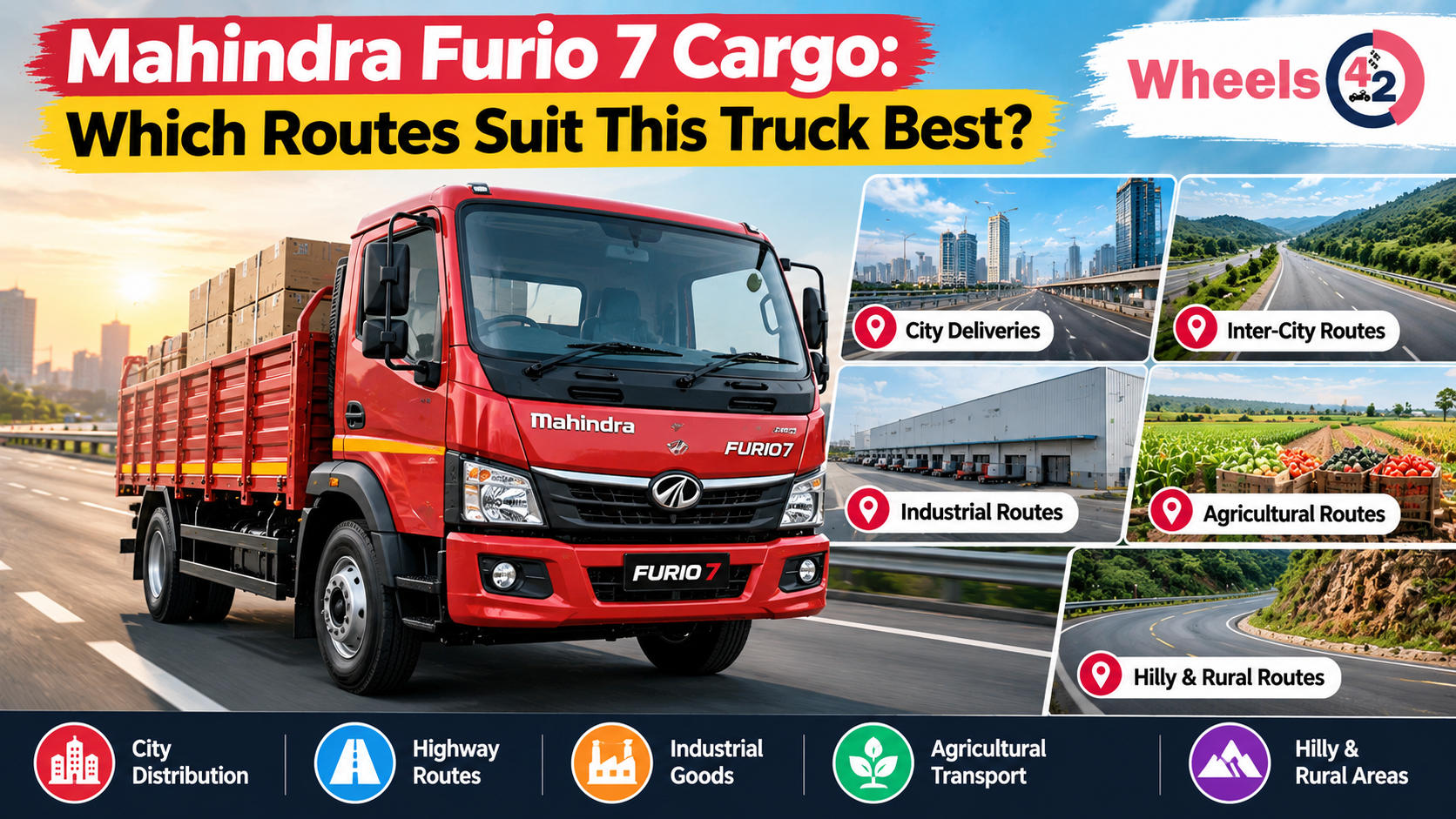
For a commercial vehicle operator, choosing the right truck is not only about payload or engine output. The route itself can determine whether a truck delivers good productivity and operating economics. Traffic density, road quality, trip length, cargo type, loading frequency and the availability of service support all matter.
The Mahindra Furio 7 Cargo is a light commercial vehicle designed for goods transportation and is offered in different cargo-body configurations. Mahindra lists the 4-tyre Furio 7 Cargo with a 2.5-litre four-cylinder mDi engine, 60.5kW of power, 220Nm of torque, a 6,950kg GVW and 10.5ft/14ft cargo-body options, depending on the configuration.
So, which routes make the most sense for this truck?
The Furio 7 Cargo can make sense for operators moving goods between nearby cities, industrial areas and distribution centres.
These routes often involve a combination of highways, state roads and urban traffic. Mahindra has positioned the Furio platform for both inter-city and intra-city traffic conditions, with the engine designed to provide useful torque at lower engine speeds.
Typical applications could include:
Mahindra's own Furio 7 material lists these types of applications for the Cargo range.
For operators running regular highway distribution, the Furio 7 Cargo's cargo capacity and 4x2 configuration make it relevant for moving goods between distribution hubs.
A route such as:
Warehouse → City Distribution Centre → Retail Market
can be more productive when the truck is carrying a consistent load rather than making multiple short trips.
The truck's available 10.5ft and 14ft cargo-body options allow operators to select a configuration according to the volume and type of goods they normally carry.
However, operators should choose the body length according to their actual cargo requirement rather than simply selecting the longest available body.
The Furio 7 Cargo can also be considered for industrial goods movement.
For example, businesses may use such a truck to move:
between factories, warehouses and distributors.
These routes often involve repeated trips, making uptime, fuel consumption, service availability and loading efficiency important factors.
The truck can also suit agricultural supply chains where goods need to move from production areas towards larger markets.
Possible applications include:
Farm → Collection Centre → Wholesale Market or Agricultural Hub → City Market → Retail Distribution
Fruits, vegetables and other market loads can require frequent loading and unloading, so the cargo-body configuration becomes particularly important.
Operators should also consider the road surface and seasonal conditions of their regular routes before choosing a truck.
Not every commercial truck needs to spend its entire working life on long highway trips.
A vehicle working within a state or around a cluster of nearby cities may make several trips every day. In this situation, the operator should look at:
The Furio 7 platform was developed for a wide range of LCV applications, rather than being limited to one specific type of route.
Road quality should be one of the first considerations before putting any cargo truck on a particular route.
The Furio 7 Cargo specification lists 229mm ground clearance and 26% gradeability for the 4-tyre AC version.
These characteristics can be useful when routes include uneven surfaces or gradients, but buyers should still evaluate the actual road conditions.
A route with:
may place different demands on a truck compared with a well-maintained highway route.
The Furio 7 Cargo is available with different wheelbase and cargo-body configurations, including 10.5ft and 14ft options.
|
Requirement |
More Suitable Consideration |
|
Frequent city deliveries |
Shorter body may be easier to manoeuvre |
|
High-volume parcel distribution |
Longer cargo body can be useful |
|
FMCG distribution |
Choose based on load volume and weight |
|
Agricultural produce |
Consider cargo volume and loading method |
|
Industrial goods |
Match body dimensions to cargo |
|
Regular highway movement |
Body size should match average shipment volume |
|
Narrow-market routes |
Manoeuvrability becomes more important |
The key point is that cargo volume and cargo weight are not the same thing. A load may be relatively light but occupy considerable space.
The best route for a Furio 7 Cargo is ultimately determined by how the truck earns money.
|
Route Type |
What Matters Most |
|
City distribution |
Manoeuvrability and loading efficiency |
|
Inter-city distribution |
Fuel economy, payload and uptime |
|
Highway logistics |
Consistent loads and route utilisation |
|
Agricultural routes |
Ground clearance, cargo space and durability |
|
Industrial routes |
Payload, reliability and service support |
|
Wholesale-market trips |
Quick loading/unloading and cargo capacity |
|
E-commerce distribution |
Cargo volume and frequent stop efficiency |
For a commercial operator, choosing a route should also involve checking where the truck can be serviced.
A breakdown far away from a service facility can affect delivery schedules and increase operating costs.
Mahindra has highlighted its extensive service and spares network for the Furio range, including authorised service centres, dealerships and parts outlets.
Before purchasing, operators should check the current authorised service locations along their regular routes, rather than relying only on the overall network size.
Payload is important, but it should not be the only deciding factor.
A truck that regularly operates underloaded may not provide the best economics for a particular business. Conversely, consistently carrying loads close to or beyond the permitted limit can increase mechanical stress and create legal and safety issues.
The better approach is to calculate:
Average load + maximum load + daily kilometres + number of trips + road conditions
before selecting the configuration.
Consider a distributor who moves packaged goods from a regional warehouse to three nearby cities every day.
The ideal operating cycle might look like:
Warehouse → City A → City B → City C → Warehouse
For this type of work, the operator should focus on cargo volume, loading time, fuel consumption and the distance between each stop.
Another operator moving construction materials over rough rural roads may have very different priorities.
That is why the same truck can perform differently from one business to another even when both operators cover similar distances.
The Mahindra Furio 7 Cargo is best considered as a versatile goods carrier for city, inter-city and distribution applications rather than a truck designed around one particular route.
Its available cargo-body configurations, 6,950kg GVW and 2.5-litre diesel powertrain give operators several factors to consider when matching the vehicle to their business.
For FMCG, parcels, e-commerce, agricultural goods, industrial products and market loads, the most important step is to match the truck's body size and operating capability with the actual route.
Ultimately, the right route is one where the truck can carry a productive load, complete trips efficiently, minimise downtime and generate enough revenue to justify its operating costs.








Ferrari
₹540.00 Lakh