


 Khyati Sharma 2026-09-29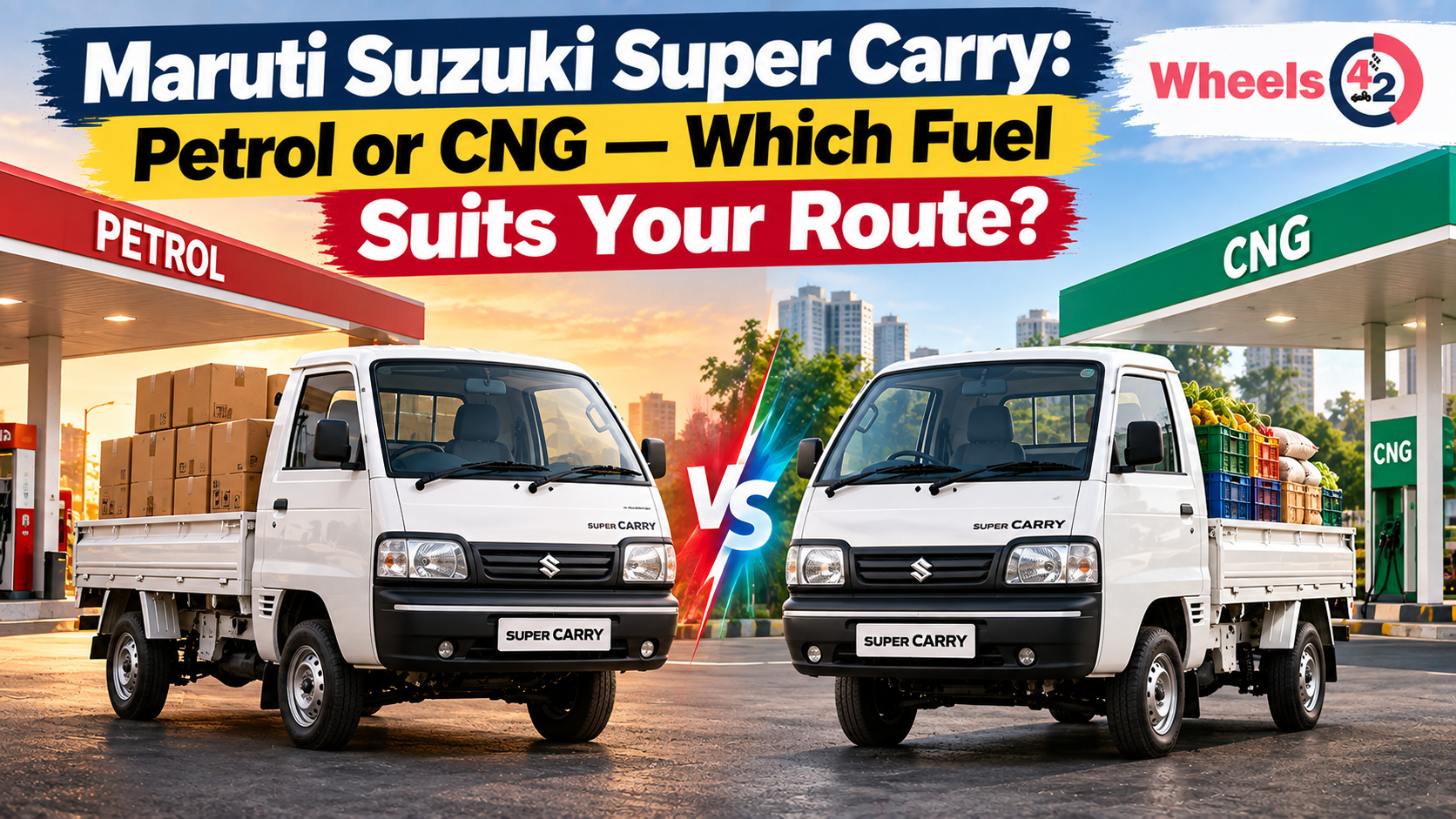
For a small commercial vehicle, choosing between petrol and CNG is not simply about the purchase price. The right fuel depends on how many kilometres the vehicle covers, the type of roads it operates on, the availability of fuel stations and how frequently it carries a load.
The Maruti Suzuki Super Carry is offered with both petrol and CNG powertrains and is designed for applications such as e-commerce, courier operations, FMCG distribution and general goods transportation. Maruti Suzuki says the Super Carry is sold through more than 370 commercial outlets across 270 cities.
So, which version makes more sense for your business route? Let's break it down.
The Super Carry's petrol version uses a 1.2-litre K-Series Dual Jet, Dual VVT four-cylinder engine producing 80.7 PS and 104.4 Nm. It is paired with a 5-speed manual transmission.
The CNG version uses the factory-fitted S-CNG system and also retains a 5-litre emergency petrol tank, giving operators an additional fuel option when required.
The choice therefore depends largely on your operating pattern.
|
Factor |
Super Carry Petrol |
Super Carry CNG |
|
Fuel type |
Petrol |
CNG + emergency petrol |
|
Transmission |
5-speed manual |
5-speed manual |
|
Engine |
1.2-litre K-Series |
1.2-litre K-Series |
|
Best suited to |
Mixed/short routes |
High-running routes |
|
Refuelling flexibility |
Wider petrol availability |
Depends on CNG network |
|
Running-cost focus |
Simpler for occasional use |
Designed for fuel-cost efficiency |
|
Initial purchase price |
Lower |
Higher |
|
Ideal applications |
Local deliveries, mixed routes |
Regular goods distribution, high-mileage work |
Petrol can be a practical choice when your Super Carry operates on short or unpredictable routes.
For example, consider a business that covers relatively low daily kilometres and frequently travels through areas where CNG stations are limited. In such a case, the convenience of petrol availability can be more important than choosing a CNG vehicle.
Petrol can also be useful for businesses that occasionally use the vehicle rather than running it continuously throughout the day.
The petrol Super Carry produces 80.7 PS and 104.4 Nm, according to Maruti Suzuki's published specifications.
Petrol Could Suit:
Short-distance city deliveries
CNG becomes more relevant when the vehicle covers high daily kilometres on predictable routes.
A delivery operator running the Super Carry every day between the same city, industrial area or distribution points may be able to plan refuelling around the available CNG network.
Maruti Suzuki has previously reported a 21.55 km/kg fuel-efficiency figure for the Super Carry S-CNG. However, actual efficiency can vary depending on load, traffic, driving style, road conditions and vehicle maintenance.
The factory-fitted S-CNG system also comes with a 5-litre emergency petrol tank, which can provide additional flexibility if CNG is temporarily unavailable.
CNG Could Suit:
High-mileage delivery routes
A common mistake is to choose CNG simply because its advertised fuel-efficiency figure looks attractive.
The more important question is:
How many kilometres will your Super Carry actually travel every day?
For example, a vehicle covering 30–40 km per day has a very different fuel-use pattern from one covering 150–200 km every day.
If the truck runs extensively throughout the week, even a relatively small difference in running cost per kilometre can become significant over thousands of kilometres.
On the other hand, if the vehicle is used only occasionally, the higher upfront cost of a CNG variant may take longer to justify.
The Super Carry is a commercial mini-truck designed for different types of goods movement. Maruti Suzuki specifically highlights applications including e-commerce, courier, FMCG and goods distribution.
Your load pattern can influence the fuel decision.
A delivery vehicle making frequent stops and starts in a city may have a different operating cost from one carrying goods over longer intercity routes.
Therefore, businesses should consider:
The CNG version costs more upfront than the petrol version.
In Maruti Suzuki's March 2025 published pricing, the Gasoline Deck was ₹5.64 lakh, while the CNG Deck was ₹6.64 lakh ex-showroom. The Gasoline Cab Chassis was ₹5.49 lakh and the CNG Cab Chassis ₹6.49 lakh. Prices and schemes can change, so buyers should confirm the applicable price before purchase.
Fuel choice should not be considered separately from the vehicle's commercial purpose.
The Super Carry has a deck measuring 2,183 mm long and 1,488 mm wide, with Maruti Suzuki previously quoting a payload capacity of up to 740 kg, depending on the configuration.
For businesses, the payload and route should therefore be considered alongside fuel costs.
A vehicle carrying heavy loads over steep roads, for example, may experience different real-world consumption compared with a lightly loaded vehicle operating on flat urban roads.
The latest Super Carry also received additional safety equipment. In March 2025, Maruti Suzuki announced Electronic Stability Program (ESP) along with features including front disc brakes, reverse parking sensors and seat-belt reminders.
The company also highlights a lighter steering system and improved ride comfort for daily commercial use.
These features matter because commercial vehicles can spend several hours on the road every day.
There is no single answer for every Super Carry operator.
Your route is short, irregular or has limited CNG availability.
If your business covers relatively few kilometres or frequently changes routes, petrol's refuelling convenience can be useful.
Your Super Carry covers high kilometres every day and has easy access to CNG stations.
For a vehicle working continuously on delivery or distribution routes, lower fuel expenditure can become increasingly important.
|
Your Operating Pattern |
Fuel to Consider |
|
Short city trips |
Petrol |
|
Low monthly running |
Petrol |
|
Irregular routes |
Petrol |
|
CNG stations difficult to access |
Petrol |
|
High daily kilometres |
CNG |
|
Fixed delivery routes |
CNG |
|
E-commerce distribution |
CNG |
|
Courier operations |
CNG |
|
FMCG distribution |
CNG |
|
Long-term high utilisation |
CNG |
This is a use-case guide rather than a universal recommendation; actual fuel prices, mileage, route conditions and CNG availability should be included in your business calculation.





Land Rover
₹93.55 - 320.74 Lakh