 Khyati Sharma 2026-09-29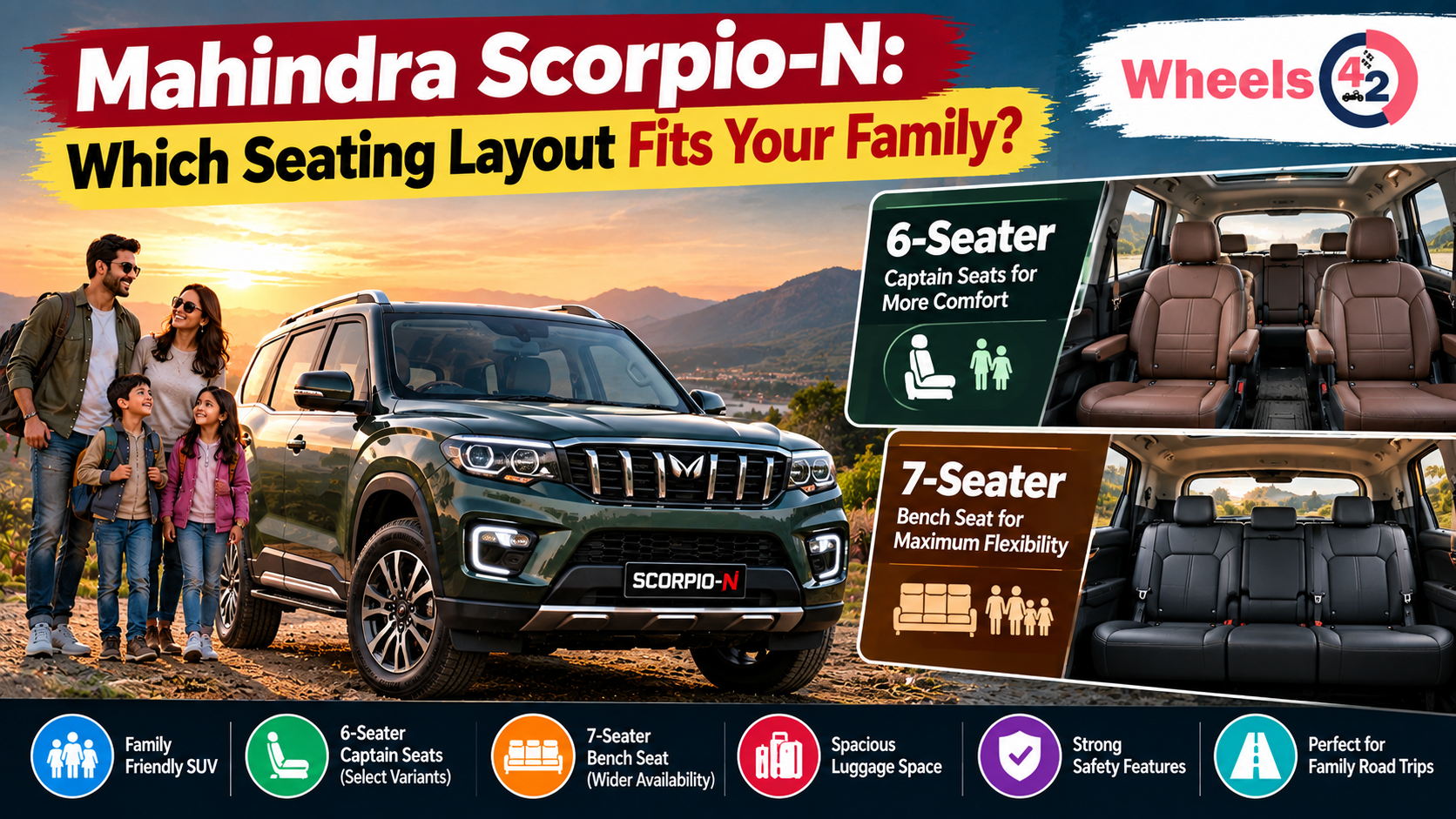
Choosing a seven-seat SUV is not only about how many people it can carry. For families, the second-row layout, third-row access, child-seat requirements and luggage needs can make a significant difference to everyday comfort.
The Mahindra Scorpio-N is offered in both 6-seat and 7-seat configurations, but the 6-seat layout is limited to select Z8L variants. The key difference is in the second row: the 6-seater gets captain seats, while the 7-seater uses a conventional three-person second-row bench.
The choice is essentially between second-row comfort and maximum passenger flexibility.
|
Feature |
Scorpio-N 6-Seater |
Scorpio-N 7-Seater |
|
Total seating |
6 |
7 |
|
Second row |
Captain seats |
Bench seat |
|
Second-row passengers |
2 |
3 |
|
Third row |
2 seats |
2 seats |
|
Best suited for |
Families prioritising comfort |
Families needing maximum seating |
|
Second-row movement |
Easier movement between seats |
More conventional layout |
|
Maximum occupants |
6 |
7 |
|
|
|
|
Mahindra's current model information confirms that the 6-seat configuration is available on select Z8L variants, while the 7-seat layout is offered across a much broader range of variants.
The 6-seater Scorpio-N makes sense for a family that normally travels with five or six people but wants a more premium second-row experience.
The captain seats separate the two second-row passengers, giving each occupant more individual seating space. This can be useful for families that frequently undertake long highway journeys.
It can also make movement inside the cabin easier because there is space between the second-row seats. For parents travelling with children, this layout can provide a different level of cabin flexibility compared with a conventional bench.
However, there is an important trade-off: you lose the ability to seat three people in the second row.
For families that regularly carry grandparents, children, relatives or friends, the 7-seater layout provides greater passenger flexibility.
The second-row bench can accommodate three people, while two additional passengers can use the third row. This makes it the more conventional choice for a family that occasionally needs to use all seven seats.
It is also available across more Scorpio-N variants, including several petrol and diesel combinations and both manual and automatic options.
For example, if your family normally has four or five occupants but sometimes needs to carry two additional people, the 7-seater gives you that extra capacity without changing the seating arrangement.
The third row is important when deciding between the two layouts.
Mahindra's owner's manual explains that the Scorpio-N's third-row seats can be folded and tumbled to create additional luggage-carrying flexibility when required.
This means buyers should think about how often they will actually use the third row.
If the third row is used only occasionally, you may prefer to keep it folded when travelling with fewer passengers and use the additional space for luggage.
Families with young children should pay particular attention to child-seat compatibility rather than simply counting seats.
Mahindra's owner's manual provides specific child-restraint installation information for different seating positions. It identifies suitable positions for different child-seat categories, so buyers should check the exact restraint requirements before installing a child seat.
For a family with small children, the practicality of accessing the second and third rows should also be considered during a dealership test drive.
The seating decision is separate from the engine choice, but both powertrains are relevant for family buyers.
The Scorpio-N is offered with a 2.0-litre turbo-petrol engine and a 2.2-litre diesel engine. Depending on the variant, buyers can choose manual or automatic transmissions, while selected diesel variants also offer 4WD.
For buyers who mainly drive around the city and cover moderate kilometres, the petrol version can be considered. Families covering significant highway distances or carrying passengers regularly may also want to evaluate the diesel option based on their driving pattern.
The Scorpio-N measures 4,662 mm in length, 1,917 mm in width and 1,857 mm in height, with a 2,750 mm wheelbase.
That gives it a substantial road presence, but its size should be considered if your regular driving involves narrow streets, crowded markets or tight parking spaces.
The answer depends on how your family actually uses the SUV.
Choose the 6-seater if:
Choose the 7-seater if:
The Mahindra Scorpio-N's 6-seat and 7-seat layouts serve different family requirements rather than simply offering two versions of the same cabin. The 6-seater focuses on a more individualised second-row experience, while the 7-seater prioritises passenger capacity and flexibility.
For a family that usually has four to six occupants, the captain-seat layout can be considered for its second-row experience. For households that frequently need to accommodate seven people, the conventional 7-seat arrangement provides the additional passenger capacity.
The best way to decide is to take both layouts for a physical test: sit in the second and third rows, check child-seat placement if applicable, and see how much luggage remains when all seats are occupied.