
 Khyati Sharma 2026-09-22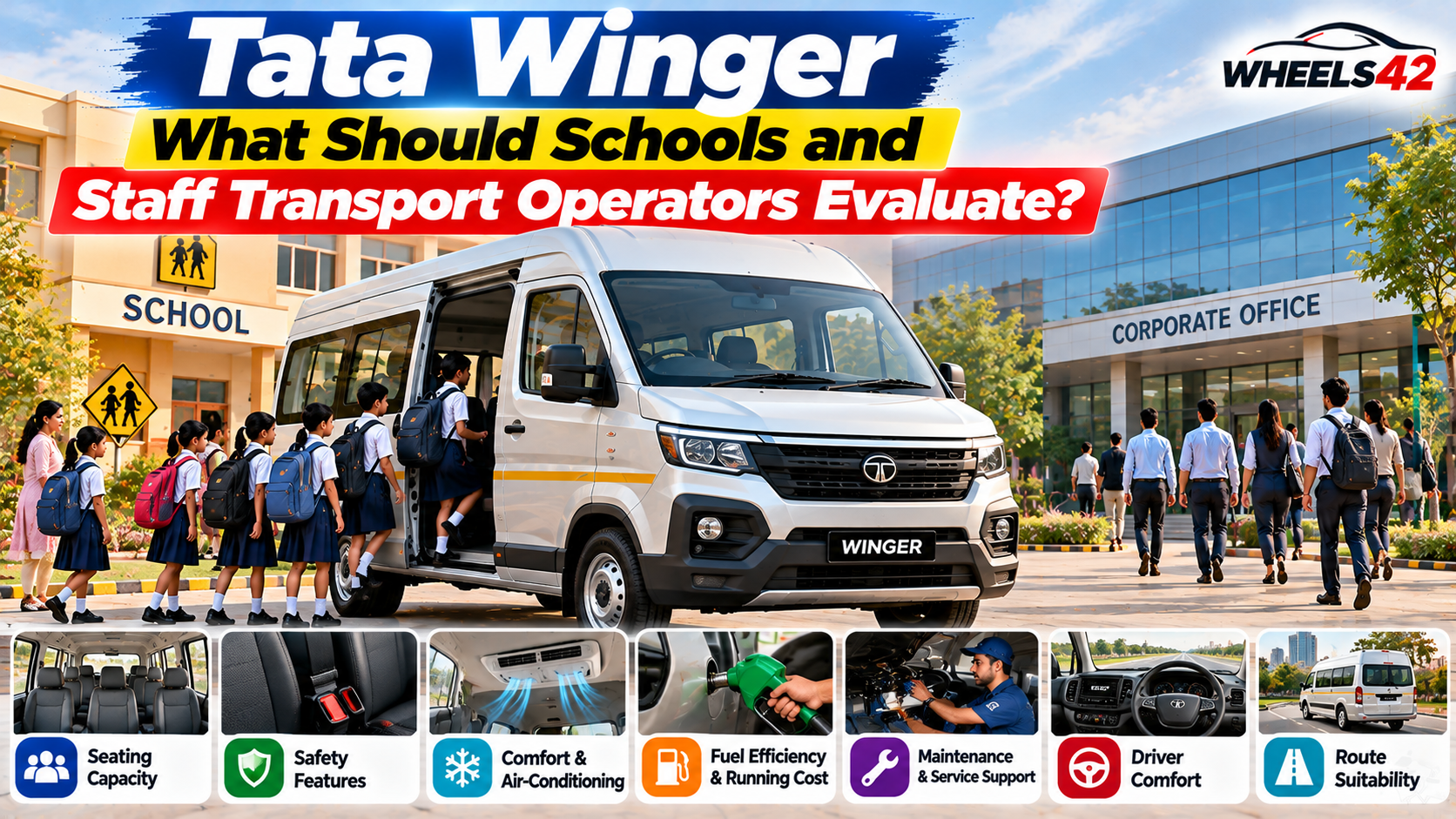
Choosing a vehicle for school transportation or employee staff movement is very different from buying a personal car. Operators have to think about passenger safety, seating capacity, comfort, running costs, reliability and ease of maintenance at the same time.
The Tata Winger is a familiar name in India's van and people-mover segment, with configurations designed for different passenger and commercial vehicle applications. For schools, institutions and staff transport operators, however, the right variant and configuration matter as much as the vehicle itself.
So, what should an operator evaluate before choosing the Tata Winger?
The first step is to understand how the vehicle will be used every day.
A school operator may have a completely different requirement from a company transporting employees.
Consider:
Number of passengers per trip
Average daily kilometres
City or highway usage
Number of trips per day
Route length
Road conditions
Peak-hour traffic
Luggage requirements
School-bag or equipment requirements
A vehicle that works well for a short urban staff route may not necessarily be the best option for longer intercity journeys.
Passenger capacity is one of the most important factors.
The Winger is available in different configurations depending on the application, so operators should choose a version that matches their actual passenger requirement rather than simply selecting the highest-capacity option.
For school transportation, adequate space between passengers is particularly important. Overcrowding can reduce comfort and make passenger movement more difficult.
For staff transportation, a slightly more comfortable seating layout may be preferable if employees spend significant time travelling every day.
For school transportation, safety should be the first consideration.
Before purchasing, operators should check the vehicle's available safety equipment and the specific configuration being offered.
Important areas to evaluate include:
Seat belts
ABS
Electronic Stability Control, where available
Airbags
Reverse parking assistance
Strong body construction
Emergency exits or safety provisions as applicable
Fire extinguisher provisions
First-aid arrangements
Safety equipment can vary by variant and model year, so buyers should verify the exact specification of the vehicle they are purchasing.
The Complete Guide to Buying a New Car in India: The Wheels42 7-Step Framework
A commercial passenger vehicle can make many stops every day.
This makes entry and exit design extremely important.
School children, teachers and employees should be able to enter and leave the vehicle without unnecessary difficulty.
Operators should look at:
Door opening size
Step height
Grab handles
Interior aisle space
Ease of accessing the rear seats
Driver visibility around the passenger door area
For school routes in particular, faster and more organised boarding can help reduce the time spent at each stop.
A vehicle used several times a day can accumulate significant passenger hours over a month.
Therefore, comfort should not be treated as a luxury.
Check the quality and positioning of the seats, available headroom, legroom and ventilation. Air-conditioning performance is particularly important for vehicles operating in hot Indian conditions.
Staff transport operators should also consider whether employees are likely to use the vehicle for 30 minutes, one hour or several hours every day.
A comfortable cabin can make a noticeable difference to passenger satisfaction.
For school and staff transportation in India, air-conditioning can be one of the most important features.
Operators should evaluate whether the AC can cool the entire passenger compartment effectively rather than focusing only on the front cabin.
During a test drive, check:
Cooling speed
Rear-cabin airflow
Vent placement
Performance with a full passenger load
Cooling during slow-moving traffic
This is especially important for vehicles operating in cities with high temperatures and heavy congestion.
A fully loaded passenger vehicle behaves differently from an empty one.
The operator should therefore evaluate how the Winger performs with its expected passenger load.
Pay attention to:
Initial acceleration
Hill-climbing ability
Overtaking performance
Gear-shift frequency
Performance with AC running
Highway cruising ability
For routes involving hills or frequent flyovers, sufficient low-speed pulling ability becomes more important.
For a commercial operator, fuel efficiency directly affects profitability.
The Winger's fuel consumption will vary depending on passenger load, route conditions, traffic, driving style and AC usage.
Instead of relying only on a claimed mileage figure, operators should calculate their expected operating cost using their actual route.
For example:
Monthly fuel cost = Monthly kilometres ÷ Real-world fuel efficiency × Fuel price
This provides a more realistic picture of operating expenses.
A school or staff transport vehicle cannot remain off the road for long periods.
Every day the vehicle is unavailable can affect the operator's schedule and potentially require a replacement vehicle.
Before purchasing, check:
Service centre availability
Scheduled maintenance requirements
Spare-part availability
Typical service costs
Warranty coverage
Roadside assistance
Local technician support
Operators working in smaller cities should pay particular attention to the availability of authorised service support nearby.
The driver spends almost every working day inside the vehicle, so driver ergonomics should not be ignored.
Check the:
Driving position
Seat adjustment
Steering position
Visibility
Mirror coverage
Gear-shifter placement
Instrument visibility
AC controls
Ease of parking
A comfortable driver is more likely to remain alert during long working hours.
The Winger is substantially larger than a conventional passenger car.
Operators should therefore test it on the actual type of roads where it will operate.
A school vehicle may need to enter narrow residential streets, while a staff transport vehicle may spend most of its time on major city roads.
Check its behaviour during:
U-turns
Tight corners
Parking
Reverse manoeuvres
Narrow lanes
Heavy traffic
If multiple drivers will use the vehicle, all of them should ideally participate in the evaluation.
Purchase price is only one part of the financial calculation.
A commercial operator should calculate the total cost over several years.
|
Cost Area |
What to Evaluate |
|
Purchase Price |
On-road cost and financing |
|
Fuel |
Expected monthly consumption |
|
Maintenance |
Scheduled and unexpected expenses |
|
Insurance |
Annual premium |
|
Tyres |
Replacement frequency |
|
Driver Cost |
Salary and allowances |
|
Permit/Taxes |
Applicable commercial requirements |
|
Downtime |
Cost of vehicle being unavailable |
|
Resale |
Expected value after usage period |
A vehicle with a slightly higher purchase price could still make more financial sense if it delivers better reliability and lower operating costs.
There is no single perfect configuration for every operator.
A school running short urban routes may prioritise easy entry, AC performance and safety.
A corporate staff operator covering longer distances may place greater emphasis on seating comfort, highway performance and fuel economy.
An operator working on mixed rural and urban routes may prioritise ground clearance, durability and service accessibility.
The route should therefore determine the vehicle configuration rather than the other way around.
Schools have additional responsibilities because children are being transported.
Operators should create a comprehensive safety checklist covering the vehicle, driver and daily operation.
This can include:
Regular vehicle inspections
Seat-belt checks
Emergency contact information
First-aid kit
Fire extinguisher
Driver background and training requirements
Safe boarding and drop-off procedures
Child supervision arrangements
Regular maintenance records
The exact requirements can vary according to local regulations, school policies and the type of service being operated.
For employee transportation, the vehicle is also part of the company's daily workforce system.
If employees spend significant time travelling, poor comfort can affect their overall experience.
Operators should therefore consider:
Route duration
Pick-up frequency
Seating comfort
AC performance
Noise levels
Ride quality
Reliability
Punctuality
Ease of cleaning
A dependable vehicle can help reduce disruptions to employee transportation schedules.
|
Area |
Priority |
|
Passenger Safety |
Very High |
|
Seating Configuration |
Very High |
|
AC Performance |
High |
|
Passenger Comfort |
High |
|
Fuel Efficiency |
High |
|
Maintenance Cost |
High |
|
Service Network |
Very High |
|
Driver Comfort |
High |
|
Manoeuvrability |
High |
|
Reliability |
Very High |
|
Purchase Cost |
High |
|
Total Cost of Ownership |
Very High |
Final Verdict
The Tata Winger can be considered by schools and staff transport operators looking for a dedicated passenger vehicle, but the right choice should be based on the actual route and operating conditions rather than passenger capacity alone.
Safety, seating layout, air-conditioning, passenger comfort and reliability should be at the top of the evaluation list. Operators should also calculate fuel, maintenance, insurance and downtime costs before making the final decision.
For schools, additional attention should be given to child safety, boarding procedures and driver standards. For corporate staff transportation, comfort, punctuality and operating efficiency can become equally important.
Ultimately, the best Winger configuration is the one that matches the passenger requirement, route, daily running pattern and long-term operating budget.