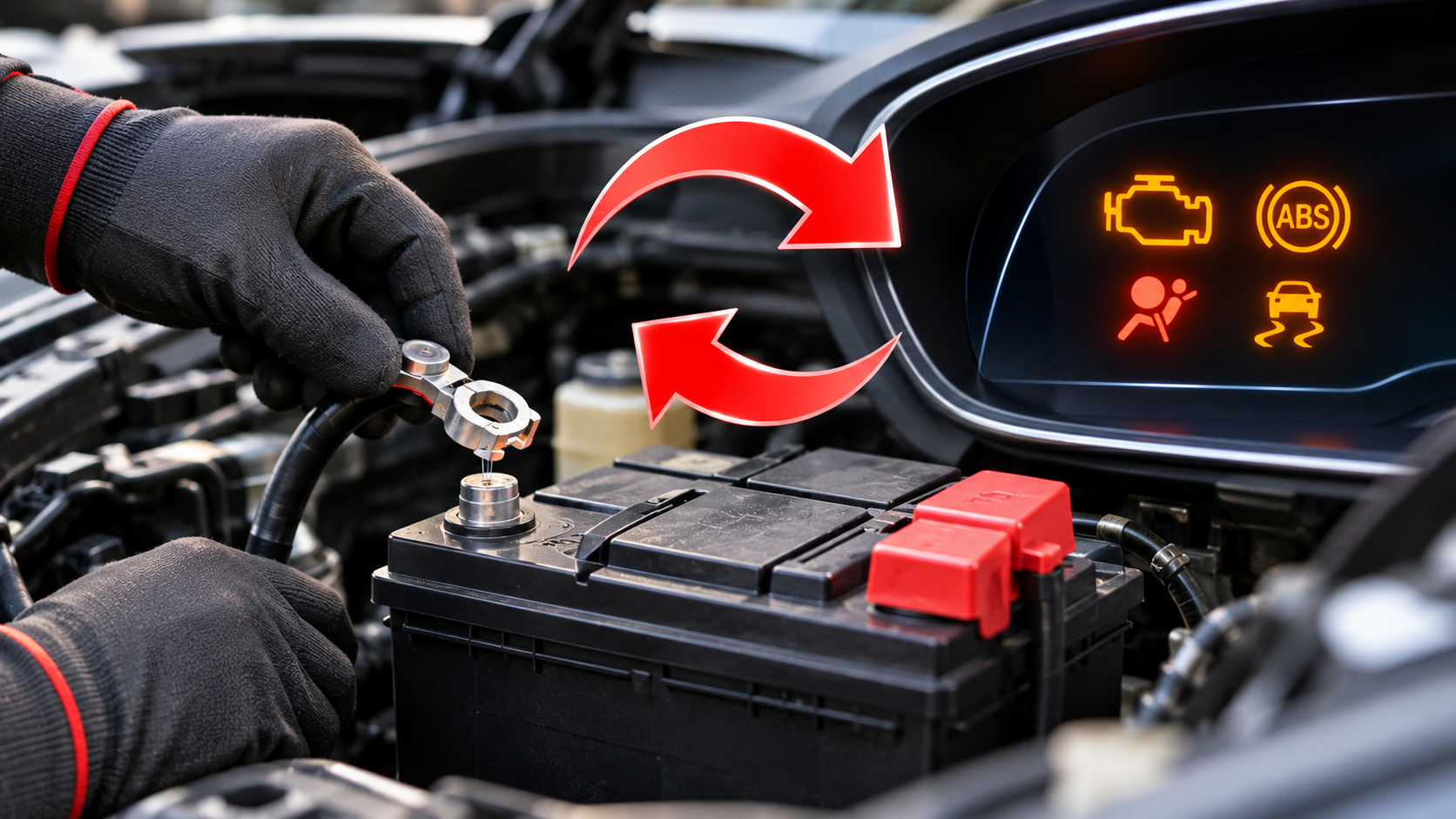
Modern cars depend on electronic systems for almost everything, from engine management and automatic transmission control to infotainment, power windows, safety features and driver assistance technologies. When an electronic warning appears on the dashboard or a system stops working, some drivers try a simple solution: disconnecting the car battery and reconnecting it after a few minutes.
This method is commonly described as a battery reset. In certain situations, it can help clear temporary electronic glitches or restart a control module. However, the belief that disconnecting the battery fixes every electronic fault is a myth.
A battery reset cannot repair damaged wiring, defective sensors, blown fuses, faulty control modules or mechanical problems. It may temporarily remove a warning or restore a system, but the underlying issue can remain.
Understanding what a battery reset actually does, when it is useful and when professional diagnosis is necessary can help drivers avoid unnecessary repairs and prevent further electrical damage.
New Car Dealer Negotiation Tips That Actually Work
Why Do Cars Develop Electronic Faults?
Today's vehicles contain multiple electronic control units (ECUs). These units communicate with different sensors, switches and components to manage vehicle functions.
For example, the engine control module monitors engine temperature, fuel delivery, ignition timing and emissions-related systems. Other modules may control the transmission, airbags, anti-lock braking system, climate control, infotainment and body electronics.
These systems constantly exchange information through the vehicle's communication network.
An electronic fault can develop for several reasons:
-
A temporary software or communication glitch
-
A weak or unstable battery voltage
-
A loose electrical connection
-
Damaged wiring or corroded terminals
-
A faulty sensor or actuator
-
A blown fuse
-
A defective electronic control module
-
Water entering electrical connectors
-
Software incompatibility or a module programming issue
Some faults are temporary, while others indicate a component failure. Disconnecting the battery may help with certain temporary issues, but it cannot physically repair a damaged component.

What Happens When You Disconnect a Car Battery?
Disconnecting the battery interrupts the vehicle's main electrical supply. As a result, many electronic modules lose their operating power and may restart when the battery is connected again.
This process is sometimes called a power reset.
Depending on the vehicle's design, a reset may clear temporary operating conditions or allow an electronic module to initialise again. It can sometimes restore a feature that stopped responding because of a temporary software issue.
However, not every vehicle stores its fault information in the same way. Some diagnostic trouble codes remain stored in non-volatile memory even after the battery is disconnected. Other systems may retain settings or require specific reset and calibration procedures.
Therefore, disconnecting the battery does not guarantee that all warning lights, fault codes or electronic problems will disappear.
Can a Battery Reset Fix Electronic Problems?
Yes, but only in limited circumstances.
If an electronic system has temporarily stopped responding because of a software glitch or unstable voltage, a controlled power reset may help restore normal operation.
For example, an infotainment screen may freeze, a touchscreen may stop responding or a body electronics module may behave unexpectedly. In some vehicles, restarting the relevant system can resolve such temporary problems.
However, a battery reset is not a universal repair method.
If a warning light is caused by a faulty sensor, damaged wiring, a defective ABS component or a malfunctioning ECU, disconnecting the battery will not solve the underlying problem.
In some cases, the warning may disappear temporarily and return as soon as the vehicle detects the fault again.

Electronic Faults That a Battery Reset May Not Fix
There are several common electronic problems that require proper diagnosis rather than repeated battery disconnection.
1. Faulty Sensors
Modern cars use sensors to monitor engine performance, wheel speed, temperature, pressure and other operating conditions.
A faulty oxygen sensor, crankshaft position sensor, mass airflow sensor or wheel-speed sensor can send incorrect information to the vehicle's control module.
A battery reset cannot repair a defective sensor. The system may detect the same problem again once the engine is running or the vehicle is driven.
2. Damaged Wiring and Loose Connections
Electrical connections can become loose or corroded due to vibration, moisture, heat and ageing.
Damaged wiring may interrupt communication between electronic modules or prevent a component from receiving power.
Disconnecting the battery does not restore a broken wire or repair a corroded connector. The affected circuit needs inspection and repair.
3. Blown Fuses and Faulty Relays
Fuses protect electrical circuits against excessive current. If a fuse blows, the connected component may stop working.
A battery reset will not restore a blown fuse. The reason for the fuse failure should also be investigated before replacing it, because a short circuit or overloaded component may cause it to blow again.
4. ABS and Airbag Warning Lights
Warning lights related to the anti-lock braking system or airbags should never be ignored.
These systems are safety-critical. Their faults may be caused by damaged wiring, wheel-speed sensors, control modules, connectors or other components.
Disconnecting the battery may not clear these faults, and it should not be used as a substitute for diagnosis. A qualified technician should inspect the system using appropriate diagnostic equipment.
5. Defective Electronic Control Modules
An ECU or another control module can develop internal faults due to electrical damage, moisture, overheating or component failure.
A power reset may restart a module if the problem is temporary. However, it cannot repair damaged electronic circuits or failed internal components.
Such problems may require specialist testing, software updates, module repair or replacement.
Battery Reset vs Proper Electronic Diagnosis
|
Situation
|
Can Battery Reset Help?
|
Recommended Action
|
|
Infotainment screen temporarily frozen
|
Sometimes
|
Follow the manufacturer's reset procedure
|
|
Temporary electronic glitch
|
Sometimes
|
Restart the affected system safely
|
|
Weak or unstable battery voltage
|
Not a complete fix
|
Test battery and charging system
|
|
Faulty engine sensor
|
No
|
Read fault codes and inspect the sensor
|
|
Blown fuse
|
No
|
Inspect the circuit and replace the correct fuse after diagnosis
|
|
Damaged wiring
|
No
|
Repair the affected wiring or connector
|
|
ABS warning light
|
Usually not
|
Perform an ABS diagnostic scan
|
|
Airbag warning light
|
No reliable fix
|
Get the restraint system inspected
|
|
Defective ECU
|
No
|
Perform module-level diagnosis
|
|
Software issue requiring an update
|
Not necessarily
|
Check for an approved software update
|
Why Disconnecting the Battery Can Create New Problems
Although a battery reset may appear simple, disconnecting the battery without following the manufacturer's instructions can create additional complications.
Modern vehicles may store important settings and learned operating values in their electronic modules. Interrupting the power supply can affect some of these settings.
Car Waiting Period: How to Get Your New Car Faster
Possible consequences include:
-
Loss of clock and infotainment settings
-
Radio security code requirements on certain older vehicles
-
Reset of trip or convenience settings
-
Power-window or sunroof initialisation requirements
-
Loss of certain learned engine or transmission adaptations
-
Steering-angle or other system calibration requirements on some vehicles
Some vehicles may also display warning messages after the battery is reconnected until certain systems complete their initialisation procedures.
The exact effects depend on the vehicle's make, model, year and electronic architecture.

Can Disconnecting the Battery Damage Modern Cars?
Disconnecting a battery does not automatically damage a vehicle. However, doing it incorrectly or without checking the manufacturer's procedure can create risks.
Some modern cars use battery monitoring systems, intelligent charging systems and complex electronic modules. They may require a specific battery replacement or disconnection procedure.
Before disconnecting a battery, drivers should check the owner's manual or seek advice from an authorised service centre.
Important precautions include:
-
Switch off the ignition and all electrical accessories.
-
Remove the key or keep the key fob away from the vehicle if instructed.
-
Follow the manufacturer's recommended waiting period before disconnecting the battery.
-
Use the correct tools and avoid shorting the terminals.
-
Never disconnect the battery while the engine is running.
-
Avoid touching both battery terminals with a metal tool.
-
Follow the correct reconnection procedure.
For conventional negative-ground vehicles, the negative terminal is generally disconnected first and reconnected last. However, manufacturer-specific instructions should always take priority.
Never attempt to disconnect a high-voltage traction battery in an electric or hybrid vehicle. These systems require specialist safety procedures and trained technicians.
What Should You Do Before Disconnecting the Battery?
If your car displays an electronic warning or a feature stops working, it is better to identify the problem before attempting a reset.
Start by checking the warning message and noting when it appears. If the vehicle behaves abnormally, loses power or displays a safety-related warning, avoid unnecessary driving.
A diagnostic scanner can retrieve fault codes from the relevant control modules. These codes help technicians identify the system or circuit reporting a problem.
It is also useful to check the battery's condition. Low voltage can cause multiple electronic systems to behave unexpectedly, particularly during engine starting.
If the battery is weak, the alternator is not charging correctly or a connection is loose, the underlying electrical issue should be addressed.
Do not erase fault codes before recording them. Stored diagnostic information can help a technician identify intermittent problems and understand what happened before the warning appeared.
When Should You Visit a Service Centre?
Professional inspection is recommended when:
-
An engine warning light remains illuminated.
-
ABS, airbag or brake-related warnings appear.
-
The same electronic fault returns after a reset.
-
Multiple dashboard warnings appear together.
-
The vehicle experiences unexpected power loss or poor performance.
-
Electrical accessories repeatedly stop working.
-
There are signs of burning smells, overheating wires or damaged connectors.
-
The vehicle needs module programming or calibration.
For safety-related faults, arrange an inspection promptly. A reset should never be used to hide a warning that indicates a possible problem with braking, steering or airbag systems.
How to Prevent Electronic Problems in Your Car
Preventive maintenance can reduce the chances of electrical and electronic failures.
Maintain the battery: Check battery condition periodically and replace it when testing indicates that it can no longer perform reliably.
Inspect electrical connections: Battery terminals, grounding points and accessible connectors should be checked for corrosion or looseness.
Protect wiring from moisture: Water entering connectors can cause corrosion, short circuits and communication problems. Investigate signs of water leakage inside the cabin or engine bay.
Use the correct replacement components: Always use fuses, batteries and electrical components that match the manufacturer's specifications.
Keep software updated: If the manufacturer releases an approved software update or technical service procedure for a known issue, have it checked by an authorised workshop.
Avoid unnecessary modifications: Poorly installed accessories, aftermarket lighting and incorrect wiring can overload circuits or interfere with electronic systems.
Final Verdict: Myth or Fact?
The statement "Disconnecting the battery fixes every electronic fault" is a myth.
Disconnecting the battery can sometimes restart an electronic module or resolve a temporary software glitch. However, it cannot repair faulty sensors, damaged wiring, blown fuses, defective ECUs or other hardware failures.
It can also reset certain vehicle settings and trigger additional calibration requirements, depending on the model.
The correct approach is to identify the cause of the fault before attempting a reset. Use diagnostic equipment when necessary, follow the manufacturer's battery-disconnection procedure and seek professional help for persistent or safety-related warnings.
A battery reset may be a useful troubleshooting step in specific situations, but it is not a substitute for proper vehicle diagnosis and repair.

 Khyati Sharma 2026-11-02