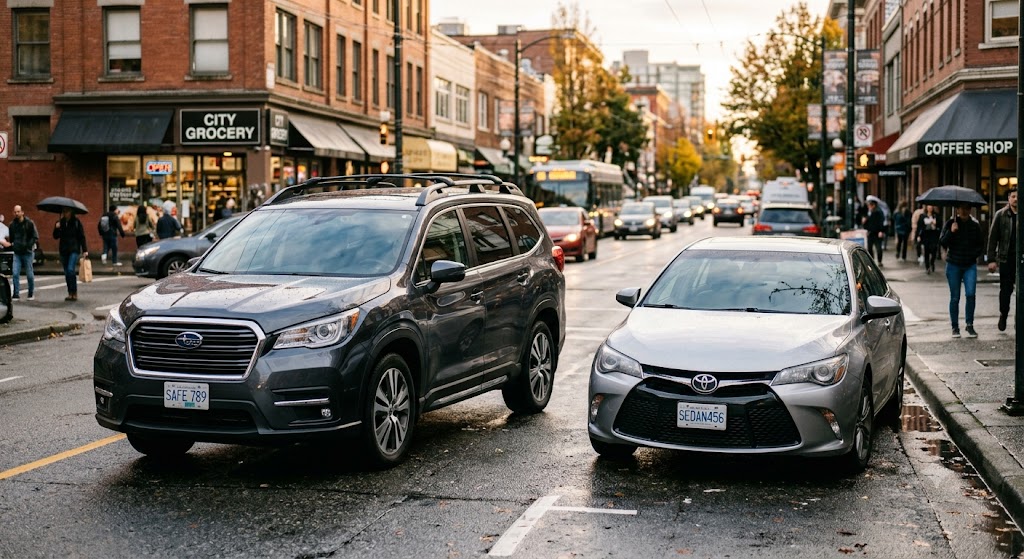
When buying a new car, safety is one of the most important factors to consider. Many people believe that an SUV is always safer than a sedan because it is larger, heavier and sits higher off the ground. This perception has made SUVs increasingly popular among families and people who frequently travel on highways.
However, is an SUV cars really safer than a sedan in every situation? The answer is no. Although SUVs can offer certain advantages, a sedan with strong crash-test performance, effective safety technology and good handling can be safer than an SUV with a weaker safety structure or fewer safety features.
Vehicle safety depends on several factors, including crash protection, braking performance, stability, tyres, visibility, driver assistance systems and the way a vehicle is driven. The vehicle's size alone cannot determine how well it protects its occupants during an accident.
In this article, we explain the differences between SUVs and sedans, compare their safety features and help you understand which type of car may be the better choice for your family.
Documents Required to Buy a New Car in India (Complete Checklist)
1. Why Do People Think SUVs Are Safer?

The belief that SUVs are safer comes mainly from their larger size, heavier construction and higher seating position. These characteristics can provide real advantages in certain situations, but they do not guarantee better protection in every crash.
SUVs often have a higher front end and more mass than smaller sedans. In a collision between vehicles of different sizes, the heavier vehicle can have a physical advantage. Its larger structure may also provide more space for energy-absorbing components.
The higher seating position gives SUV drivers a commanding view of traffic ahead. This can help them anticipate road conditions and spot obstacles in some situations.
However, a higher driving position does not eliminate blind spots. Large SUVs can have substantial areas immediately around the vehicle that are difficult to see, especially near the front and rear. Pedestrians, cyclists and small children can be particularly difficult to detect if the driver relies only on mirrors and direct vision.
A sedan may have a lower centre of gravity, which can help it remain stable during sudden steering manoeuvres. Depending on the model, it may also offer better braking and handling characteristics.
Therefore, an SUV's size is only one part of the safety equation.
Hatchback vs Sedan vs SUV: Which Car Type Suits You Best?
2. SUV vs Sedan: Which Is Safer?
|
Safety factor
|
SUV
|
Sedan
|
|
Occupant protection
|
Can benefit from greater mass and a larger structure
|
Can provide excellent protection with a strong safety cell
|
|
Driving position
|
Higher seating position
|
Lower seating position
|
|
Rollover risk
|
Generally higher due to a higher centre of gravity
|
Generally lower due to a lower centre of gravity
|
|
Emergency handling
|
Depends on suspension, tyres and vehicle design
|
Often benefits from a lower centre of gravity
|
|
Braking
|
Depends on weight, tyres and braking system
|
May benefit from lower weight
|
|
Blind spots
|
Can be larger on some models
|
Often easier to judge around the vehicle, but varies
|
|
Crash-test performance
|
Varies by model and test
|
Varies by model and test
|
|
Family practicality
|
Often offers more ground clearance and flexible space
|
Often offers comfortable road manners and a lower step-in height
|
3. Crash Protection: Does a Bigger Car Protect You Better?

One of the strongest arguments in favour of SUVs is their size and mass. In a collision between a heavier SUV and a lighter sedan, the occupants of the heavier vehicle may have an advantage because the lighter vehicle generally experiences a greater change in velocity.
However, this does not mean that every SUV is safer than every sedan.
Modern vehicles use carefully engineered structures designed to manage crash energy. These include crumple zones, reinforced passenger compartments, airbags, seat-belt pretensioners and load limiters.
A good crumple zone absorbs energy by deforming in a controlled manner, while the passenger safety cell is designed to preserve survival space. Seat belts and airbags work together to reduce the forces experienced by occupants.
A sedan with a rigid passenger compartment, well-designed crumple zones and effective restraint systems can offer excellent protection in a collision. An SUV with weaker crash performance may not provide the same level of protection.
It is also important to consider compatibility between vehicles. Differences in bumper height and structural design can affect how crash forces are transferred when two vehicles collide.
When comparing cars, look for credible crash-test results for the exact model and variant where available. A recognised rating is generally more useful than simply choosing the larger vehicle.
Petrol vs Diesel vs CNG vs Electric Cars: How to Choose the Right Fuel Type
4. SUVs Have a Higher Rollover Risk

One potential disadvantage of SUVs is their higher centre of gravity. Because much of the vehicle sits higher above the road, certain SUVs are more susceptible to rolling over during extreme manoeuvres than comparable lower vehicles.
A rollover may occur when a driver makes a sudden steering input, loses control on a slippery surface or leaves the road and encounters an obstacle that causes the vehicle to tip.
This risk is not identical across all SUVs. Modern electronic stability control, suspension engineering and rollover mitigation systems can reduce the likelihood of losing control.
Sedans generally have a lower centre of gravity, which can improve stability during rapid changes of direction. Their lower body profile may make them less prone to rollover in comparable circumstances.
Nevertheless, no vehicle is immune to rollover. Excessive speed, abrupt manoeuvres, poor tyres and unsafe driving can make any vehicle dangerous.
For SUV buyers, electronic stability control, good tyres and responsible driving are particularly important. Never assume that a large vehicle can safely negotiate a corner at a higher speed simply because it feels substantial.
5. Braking Performance: Weight Makes a Difference
Braking is another important factor in vehicle safety.
SUVs are often heavier than sedans of similar market positioning. All else being equal, a heavier vehicle has more kinetic energy to manage at the same speed. Its braking system and tyres must handle the demands created by that mass.
However, vehicle weight alone does not determine stopping distance. Tyre grip, brake design, road conditions, suspension behaviour, vehicle speed and the condition of the braking system all matter.
A well-equipped SUV can have powerful brakes and excellent stopping performance. Similarly, a lighter sedan with good tyres and a well-calibrated braking system can perform very well during emergency braking.
Anti-lock braking systems (ABS) help prevent the wheels from locking during hard braking, allowing the driver to retain more steering control. Electronic brake-force distribution can help distribute braking force appropriately, while electronic stability control can assist when the vehicle begins to skid.
Automatic emergency braking can provide another layer of protection by detecting certain potential collisions and applying the brakes when necessary.
When comparing vehicles, look for independent braking test results where available. Do not judge braking safety by the size of the wheels or the apparent size of the brakes alone.
6. Safety Features Matter More Than Body Style

Safety technology can make a significant difference regardless of whether you choose an SUV or a sedan.
Here are some of the most useful features to check before purchasing a car:
-
Electronic Stability Control (ESC): Helps the driver maintain control when the vehicle begins to skid or deviate from the intended direction.
-
Anti-lock Braking System (ABS): Helps prevent wheel lock-up during hard braking.
-
Airbags: Provide additional protection in certain types of crashes. The number, placement and effectiveness of airbags vary by model.
-
Three-point seat belts and pretensioners: Help restrain occupants and manage forces during a collision.
-
ISOFIX child-seat mounts: Make it easier to install compatible child restraints correctly.
-
Automatic Emergency Braking (AEB): Can help avoid or reduce the severity of certain forward collisions.
-
Blind-spot monitoring: Warns drivers about vehicles in adjacent areas that may not be visible in mirrors.
-
Rear parking sensors and cameras: Help drivers detect obstacles while reversing.
-
Tyre-pressure monitoring: Alerts drivers to certain tyre-pressure problems, where fitted.
Feature availability differs by model and variant. Some systems are standard on entry-level versions, while others are restricted to higher trims.
For Indian buyers, it is worth checking the exact safety equipment offered in the variant being considered rather than relying on a model's overall marketing claims.
7. Which Is Safer for Indian Roads?
Indian driving conditions vary considerably. Busy city streets, highways, potholes, uneven rural roads, heavy rain and mixed traffic can all affect vehicle safety.
An SUV may be a practical choice for drivers who regularly encounter uneven roads, steep approaches or rough surfaces. Greater ground clearance can reduce the likelihood of scraping the underside of the vehicle on certain obstacles.
However, ground clearance is not the same as crash protection. A vehicle that clears a pothole more easily is not automatically safer in a collision.
A sedan may be suitable for urban commuting and highway driving, particularly if the driver values stable handling, predictable road manners and comfortable long-distance travel.
For either body style, the most important considerations include:
-
Strong and independently assessed crash protection.
-
Effective braking and stability systems.
-
Good-quality tyres in the correct condition.
-
Adequate head restraints and properly fitted seat belts.
-
Clear visibility and suitable driver-assistance technology.
-
Appropriate speed and careful driving for the road conditions.
Drivers should also consider whether the vehicle's dimensions are suitable for the roads and parking spaces they regularly use. A large SUV can be more difficult to manoeuvre through narrow streets or crowded parking areas.
8. Family Safety: SUV or Sedan?

For families, the best choice depends on the occupants' needs and the vehicle's safety performance.
SUVs often offer more flexible luggage space, a higher seating position and convenient access to the cabin. These qualities can be useful for families travelling with children, grandparents or substantial luggage.
Sedans can provide excellent rear-seat comfort, a spacious boot and stable highway driving. Some models also have excellent crash-test results and comprehensive safety equipment.
If you regularly travel with young children, check whether the rear seats accommodate your child restraint correctly. Look for suitable ISOFIX anchorages where provided, accessible seat-belt buckles and enough space to install the seat according to its manufacturer's instructions.
For older family members, consider how easy it is to get in and out of the vehicle. A high SUV seat can make entry easier for some people, but a very tall vehicle may be difficult for others. A sedan's lower seat height may be more convenient in certain cases.
Regardless of the body style, everyone should use a seat belt on every journey. Children should use age- and size-appropriate restraints, and they should never be carried unrestrained simply because the vehicle is large.
How Many Airbags Do You Really Need? A Safety Primer
9. How to Choose a Safer Car
Instead of deciding based on the SUV or sedan label, use a consistent checklist when comparing two vehicles.
Step 1: Check crash-test ratings. Look for results from recognised assessment programmes and confirm that the tested model is comparable to the version sold in your market.
Step 2: Compare standard safety equipment. Check airbags, ESC, ABS, seat-belt systems and any available collision-avoidance technology.
Step 3: Consider visibility. Sit in the driver's seat and check the mirrors, rear visibility, pillars and blind spots. Test parking assistance features if available.
Step 4: Evaluate braking and handling. Review independent test results and take a responsible test drive where possible.
Step 5: Inspect tyres and maintenance requirements. Tyres are the only parts of the vehicle that make direct contact with the road. Their condition, pressure and suitability matter greatly.
Step 6: Consider your typical journeys. A car used mainly in crowded cities may have different practical requirements from one regularly driven on highways or rough rural roads.
Step 7: Check the exact variant. Safety features and equipment can differ significantly between variants of the same model.
10. Common Myths About SUV Safety
|
Myth
|
Reality
|
|
Every SUV is safer than every sedan.
|
Safety depends on the individual vehicle's engineering and equipment.
|
|
A higher driving position eliminates blind spots.
|
SUVs can have significant blind spots around the vehicle.
|
|
Heavy cars always stop faster.
|
Stopping performance depends on tyres, brakes, speed and road conditions.
|
|
Ground clearance makes a car safer in every situation.
|
It helps with certain obstacles but does not guarantee better crash protection.
|
|
More airbags automatically mean a safer car.
|
Airbag placement, restraint design and overall crash performance matter too.
|
|
Sedans are unsafe for families.
|
Many sedans provide excellent occupant protection and family practicality.
|
Conclusion: Is an SUV Always Safer Than a Sedan?
No, an SUV is not always safer than a sedan. SUVs can offer advantages such as a higher driving position, greater ground clearance and, in some cases, a mass advantage in collisions with smaller vehicles. However, their higher centre of gravity can increase rollover susceptibility, and their size can create visibility challenges.
Sedans can benefit from a lower centre of gravity, predictable handling and strong crash protection. A well-engineered sedan with effective safety systems may be a better choice than an SUV with weaker crash performance or less comprehensive equipment.
For Indian car buyers, the smartest approach is to compare specific models, examine independent crash-test results, check the safety features offered in the chosen variant and consider the driving conditions the vehicle will face.
Ultimately, the safest car is not necessarily the biggest car. It is the vehicle that offers strong crash protection, effective safety technology, good handling and the right fit for your needs. Safe driving, correctly fitted seat belts, suitable child restraints and properly maintained tyres remain essential whichever body style you choose.

 Khyati Sharma 2026-10-21