Car loan interest is charged on what you still owe, not on the full amount you borrowed. Each EMI pays that month’s interest first, and whatever’s left reduces the loan. That’s why early EMIs barely dent the balance, and why the last few are almost all principal. Get that one idea, and most loan traps become easy to spot.
| Question |
Short answer |
| How is car loan interest charged? |
On the balance still outstanding, every month. |
| Why are early EMIs mostly interest? |
The balance is highest at the start, so the interest is too. |
| Is a flat rate cheaper? |
Usually no. It can work out to almost twice the quoted rate. |
| Does prepaying save interest? |
Yes, and paying extra early saves the most. |
How is car loan interest calculated?
Most lenders quote car loans on a reducing balance basis, and that’s the method you should ask for. Interest for each month is worked out on the amount you still owe, so the charge shrinks as you repay.
What is reducing balance interest?
Each month, the lender takes your annual rate, divides it by 12, and applies it to the outstanding principal. On an ₹8 lakh loan at 9.5%, the monthly rate is about 0.79%, so the first month’s interest comes to roughly ₹6,333.
Why does this matter to you? Every rupee you repay stops attracting interest from the next month. So a small extra payment early on quietly cuts the bill for years.
Is a flat interest rate cheaper?
No, and that’s the trap. A flat rate charges interest on the original loan amount for the whole tenure, even though you repay part of it every month. An 8.5% flat rate on ₹8 lakh for five years adds up to ₹3,40,000 in interest, and the true yearly cost lands close to 15%.
Dealers often open with the monthly number, which is exactly where a flat rate hides. If the talk keeps circling back to EMI, our breakdown of new car dealer negotiation tips helps you steer it back to the full price.
How do I check whether my loan uses flat or reducing interest?
Ask the lender in writing, and don’t settle for a vague answer. Then look at the APR and the Key Facts Statement (KFS), which shows the overall cost. Finally, ask for an amortization schedule. In a reducing-balance loan, the interest figure drops each month. A flat-rate loan shows the same interest amount every month.
How is the EMI worked out?
The EMI is the fixed monthly payment that repays the loan and its interest by the end of the tenure. Three numbers drive it: the loan amount, the monthly rate, and the number of months. If you want the wider picture, the complete guide to car loans in India puts this formula next to current rate ranges and fees.
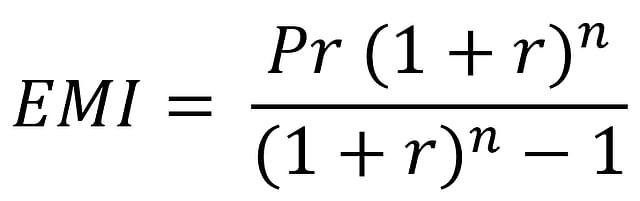
Here, P is the loan amount, r is the monthly rate (the annual rate divided by 12, then by 100), and n is the number of monthly instalments. Put in ₹8 lakh at 9% over five years, and you get about ₹16,607 a month. Use the same steps on any offer, and you can check every quote yourself.
What is the effective interest rate?
It’s the true yearly cost once monthly compounding is counted. You work it out as (1 + monthly rate) to the power of 12, minus 1. A 9% reducing-balance loan works out to about 9.38% effective, so that’s the number to compare when two lenders quote in different ways.
How much total interest will I pay on a car loan?
Multiply the EMI by the number of months, then subtract the loan amount. Riya’s Offer B, which you’ll meet below, gives ₹16,800 × 60 = ₹10,08,000, minus ₹8,00,000, which leaves ₹2,08,000 in interest. That two-line check tells you more than the rate printed on a brochure.
Why does the EMI stay the same while the interest falls?
On a fixed-rate loan, the EMI doesn’t change. What changes is the split inside it. As the balance drops, the interest slice shrinks and the principal slice grows. The total stays the same, but the mix keeps shifting.
Why are early EMIs mostly interest?
Interest is a percentage of what you owe, and you owe the most in month one. So the first EMIs carry the biggest interest bill, and the last few carry almost none. Once you see that pattern, the early years of any loan make a lot more sense.
How much of my first EMI goes to interest?
Take Riya’s first EMI on her ₹8 lakh loan at 9.5% over five years. It’s ₹16,800, and roughly ₹6,333 of that is interest. The remaining ₹10,467 reduces the loan. You can check your own first EMI the same way: multiply the loan by the monthly rate, and whatever’s left of the EMI goes to principal.
What is an amortization schedule?
It’s a table that splits every EMI into interest and principal, and shows the balance left after each payment. Lenders can usually share one before you sign. It takes about five minutes to read, and it shows you how fast the loan actually shrinks.
Case study: Riya’s ₹8 lakh loan, two offers
Riya is a hypothetical buyer, not a real customer. She needs ₹8 lakh for five years and has two offers on the table. Offer A is a dealer-linked loan at 8.5% flat. Offer B is a bank loan at 9.5% reducing balance. Offer A’s rate looks lower, which is exactly why people get caught.
| |
Offer A: 8.5% flat |
Offer B: 9.5% reducing |
| Monthly EMI |
₹19,000 |
₹16,800 |
| Total repayment |
₹11,40,000 |
₹10,08,000 |
| Total interest |
₹3,40,000 |
₹2,08,000 |
Offer B costs ₹1,32,000 less, even though its rate is higher on paper. The flat rate charges interest on the full ₹8 lakh every year, even though Riya repays part of it each month. Here’s how she checked. She multiplied each EMI by 60, subtracted the loan, and compared the two totals.
So Riya picks Offer B. Here’s how its interest falls over five years.
| Year |
EMIs paid |
Interest |
Principal repaid |
Balance at year end |
| 1 |
₹2,01,600 |
₹70,400 |
₹1,31,200 |
₹6,68,800 |
| 2 |
₹2,01,600 |
₹57,300 |
₹1,44,300 |
₹5,24,500 |
| 3 |
₹2,01,600 |
₹43,000 |
₹1,58,600 |
₹3,65,900 |
| 4 |
₹2,01,600 |
₹27,300 |
₹1,74,300 |
₹1,91,600 |
| 5 |
₹2,01,600 |
₹10,000 |
₹1,91,600 |
₹0 |
Notice the pattern. In year one, about 35% of what Riya pays goes to interest. By year five, it’s about 5%. The first two years alone carry roughly 60% of the total interest, so the early years do most of the damage.
Riya’s EMI isn’t her only monthly cost, though. Fuel, parking and insurance come on top, and small habits like keeping tyre pressure right can move the fuel bill. Our piece on how tyre pressure affects mileage looks at whether that effort actually pays off.
Now suppose Riya gets a ₹1 lakh bonus and puts it into the loan at the end of month 12. If she keeps the EMI the same, the loan closes about eight months early, and she saves roughly ₹42,000 in interest. Make the same ₹1 lakh payment at month 48 instead, and the saving drops to about ₹7,500.
These figures are rounded. They assume the rate stays the same and that no prepayment charge applies.
What happens when I prepay?
Does prepaying a car loan save interest?
Yes, because every rupee you repay early stops attracting interest for the rest of the loan. Timing matters a lot, though. Riya’s ₹1 lakh works far harder in month 12 than in month 48, so the early years are where extra payments earn their keep.
Should I shorten the tenure or lower the EMI after prepaying?
If you want the biggest interest saving, keep the EMI and let the loan end sooner. If you need room in your monthly budget, lower the EMI instead. That eases cash flow, but you’ll pay more interest in total. Think about which problem you’re solving first.
Are there charges for prepaying?
It depends on the rate type and the sanction date, so check before you pay. Under the RBI’s Pre-payment Charges on Loans Directions, 2025, many floating-rate loans given to individuals for non-business purposes carry no prepayment charge if they were sanctioned or renewed on or after 1 January 2026. Fixed-rate loans don’t get that same automatic exemption, so read your sanction letter and loan agreement.
Other questions about car loan interest
Is interest charged daily or monthly?
Usually monthly, on the outstanding balance. Some lenders calculate on the daily balance, though, so read the loan agreement to confirm. Either way, paying on or before the due date keeps late charges off your statement.
What happens if I pay an EMI late?
You’ll usually face a late charge, and some lenders add penal interest on the overdue amount. A missed EMI can also show up on your credit report and make future borrowing harder. Your loan agreement sets the exact charges, so read those clauses carefully. And if money gets tight, call the lender before the due date, not after.
Does a floating rate change my EMI?
It can. A floating rate moves with a benchmark or the lender’s reset terms. Depending on the lender, the EMI or the tenure can change when the rate resets. A fixed rate keeps the interest steady for the agreed period, so check which one your sanction letter shows.
Is APR the same as the interest rate?
No. The interest rate is the price of borrowing the money. APR (annual percentage rate) folds certain upfront charges into one yearly figure, so two offers become easier to compare. But the interest rate still matters, because it drives the monthly cost you actually feel.
Can I claim tax relief on car loan interest?
For a personal car, usually no. Tax relief on borrowing is mostly tied to home loans. If the car is for business use, ask a chartered accountant, since tax rules change from time to time.
Before you sign: a five-step check
Before you sign, test the EMI against your real monthly budget. Our guide to setting a realistic car buying budget shows how to size it against take-home pay.
- Ask whether the rate is flat or reducing, and get the answer in writing.
- Compare the APR and total interest, not just the EMI.
- Ask for an amortization schedule, and check the first year and the last year.
- Multiply the EMI by the number of months, subtract the loan, and compare totals across offers.
- Add fuel and running costs to the monthly picture. Summer AC use is one reason the fuel bill climbs, and our piece on whether switching off the AC saves much fuel covers the numbers.
If a bonus lands, put it toward the loan early, when it does the most good.
This article gives general information, not personal financial advice. Your rate, tax position and goals decide what’s right for you. For a loan this size, speak with a chartered accountant or a qualified financial planner before you commit.
Sources: RBI, Key Facts Statement guidance for covered retail loans; RBI, Pre-payment Charges on Loans Directions, 2025; SBI official car loan rates page, updated 15 October 2026.