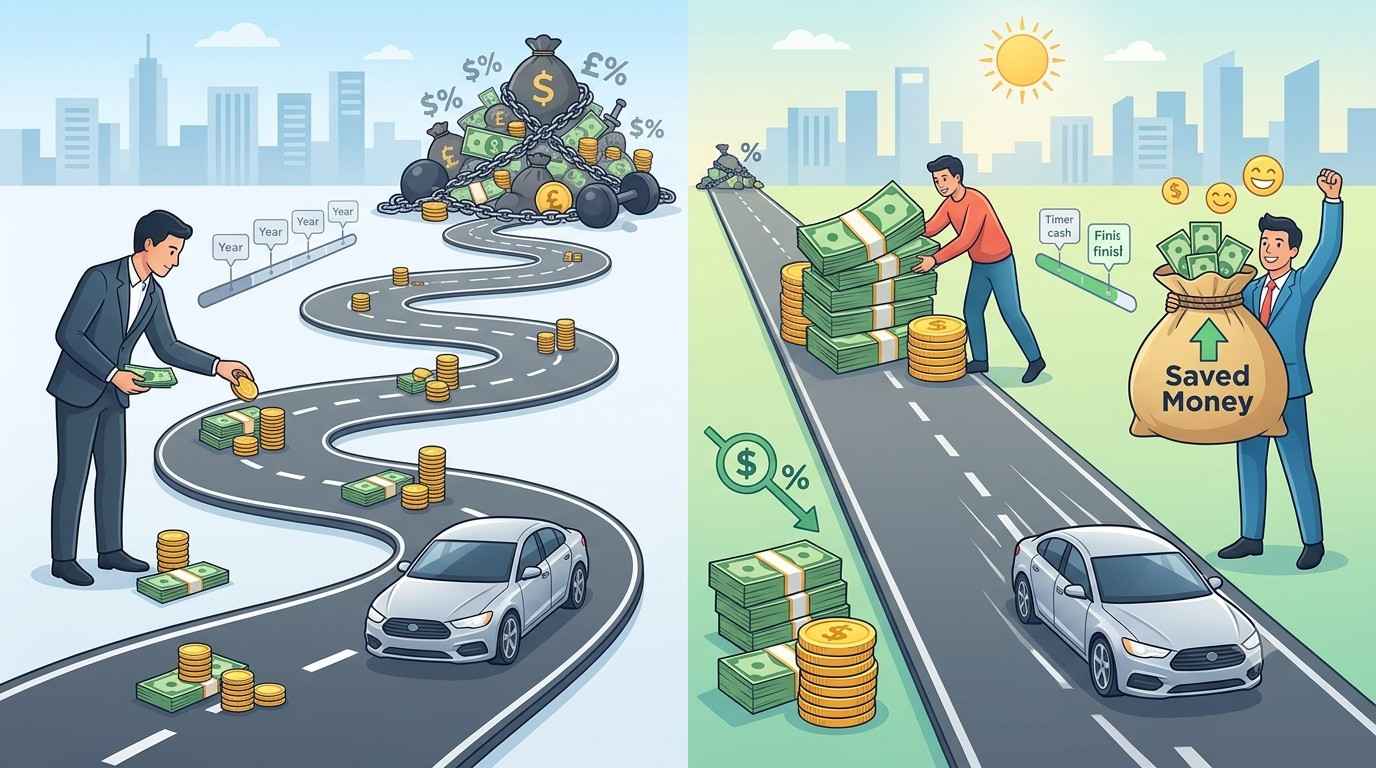
You get a lower car loan rate by changing what the lender sees and what it has to beat. Fix your credit report, collect three written quotes, put more down, match the lender to your profile, and ask for a match on a rival offer. Each 0.5 point is worth about ₹12,000 on an ₹8 lakh, five-year loan. So an afternoon of calls can pay for itself many times over.
| Lever |
Effort |
Works best when |
| Fix your credit report |
Medium |
Your report has errors or high card balances |
| Get three written quotes |
Low |
You haven’t compared yet |
| Match lender to profile |
Low |
Your income or score doesn’t fit one lender type |
| Put more down |
Medium |
You can spare cash and keep a cushion |
| Choose rate type and check the spread |
Low |
You’re comparing floating and fixed offers |
| Add a strong co-applicant |
Medium |
Your own file is thin |
| Negotiate with a rival offer |
Low |
You hold at least one written quote |
| Refinance later |
Medium |
The rate gap is large and years remain |
How much is a lower rate worth?
More than it sounds. On ₹8 lakh over five years, every half point adds roughly ₹12,000 in interest. The table shows how fast that builds.
| Rate |
EMI |
Total interest |
Extra vs 9% |
| 9.00% |
₹16,607 |
₹1,96,400 |
none |
| 9.50% |
₹16,805 |
₹2,08,300 |
₹11,900 |
| 10.00% |
₹16,998 |
₹2,19,900 |
₹23,500 |
| 10.50% |
₹17,195 |
₹2,31,700 |
₹35,300 |
| 11.00% |
₹17,394 |
₹2,43,600 |
₹47,200 |
| 12.00% |
₹17,795 |
₹2,67,700 |
₹71,300 |
The monthly difference looks small. Between 9% and 12%, the EMI moves by about ₹1,200. But the total moves by about ₹71,000, and that’s the number that matters. These are illustrative figures from standard reducing-balance math, and they ignore fees.
What counts as a good car loan rate?
There’s no single good rate. A good offer sits near the bottom of that lender’s published range for your profile, with low fees. As one dated example, SBI’s official rate page, updated on 15 October 2026, lists new-car loan rates from 8.55% to 9.50% and certified pre-owned car loans from 10.60% to 15.75%.
That’s one bank’s range. It isn’t a market average, and it isn’t your rate. But it shows that even inside one lender, the price swings with the buyer and the car.
Why do two buyers get different rates?
Lenders price risk. The rate you see advertised is the best case. Your offer moves with:
- your credit score and report
- your income and existing EMIs
- how much of the car’s value the loan covers
- the car, new or used, and its age
- the tenure
- the lender’s own policy
Every lever below works on one of those inputs.
1. Fix your credit report before you apply
Start here, because your report sets your price band. Pull your full report, correct errors, and pay card balances down before the statement date. Then stop applying anywhere until you’re ready.
Why bother? Look at the table above. A score problem that pushes you from 9.5% to 12% costs about ₹59,000 on this loan. Our guide on how your CIBIL score shapes the rate you’re offered walks through the report checks and a worked example of a fix.
2. Get three written quotes on the same loan
Quotes only compare when the inputs match. Ask each lender for a written offer on the same loan amount and tenure. Request indicative rates first, so you don’t add a stack of enquiries to your report.
Then do the sum. Multiply the EMI by the number of months, add the fees, and subtract the loan. Ask for the Key Facts Statement (KFS), which shows the annual percentage rate (APR). A lower headline rate with a 1.5% fee can cost more than a slightly higher rate with none.
3. Match the lender to your profile
The cheapest lender is the one whose policy fits you, not the one with the best ad.
- A bank where your salary lands already knows your history. It may offer a pre-approved rate, though that’s conditional.
- An NBFC may fit if your income is variable or your file is thin. You’ll often pay more for that, so read how banks and NBFCs price car loans differently to see what the extra cost buys.
- A carmaker’s finance scheme can look sharp. Check whether the low rate comes with a smaller discount on the car, and compare the final price with and without finance.
4. Borrow less against the car
A smaller loan relative to the car’s value means less risk for the lender. Some lenders price lower for it. Even where they don’t, a smaller loan cuts the rupees you pay interest on. How a bigger down payment cuts your loan and EMI shows the effect at three down payment levels, and where to stop before your savings run thin.
A shorter tenure doesn’t always change the rate, but it cuts total interest. At 9.5%, a four-year loan on ₹8 lakh costs about ₹1,64,700 in interest, against ₹2,08,300 over five years. The EMI rises from about ₹16,805 to about ₹20,100, so only choose it if that fits your monthly cap.
5. Choose the rate type and check the spread
A floating rate is a benchmark plus a spread. The benchmark moves with the market. The spread is the lender’s margin, and it’s the part you can ask about. RBI requires banks to link new floating-rate retail loans to an external benchmark such as the repo rate. Ask how your lender sets it, what the spread is, and whether it can change.
A floating rate can start lower, but it can also rise. Test your EMI at a rate two or three points higher before you take the lower number. Fixed and floating car loan rates compared works through a three-path test with a stress check.
6. Add a strong co-applicant only when it fits
A co-applicant with a stronger score and steady income can improve pricing at some lenders. But both of you are liable for every EMI, and the loan shows on both credit reports. Use this lever when your own file is thin, not as a habit. Agree in advance who pays what.
7. Negotiate with a rival offer
A written rival offer is your strongest tool. Lenders respond to numbers they can see. Ask these in order:
- “What’s the lowest rate you can offer for my score and income?”
- “I have a written offer at 10%. Can you match it?”
- “Can you waive the processing fee or documentation charges?”
- “Is this rate locked until sanction, and for how long?”
- “What’s the spread, and can it change?”
Negotiate before you pay any fee. And keep the car’s price separate from the loan, because a dealer’s finance desk can trade a discount for a rate. Think about the fee too. A 1.5% fee on ₹8 lakh is ₹12,000, which is worth about a half-point rate cut.
8. Refinance later when the math works
You can move an existing loan to a cheaper lender, but run the break-even first. Say you owe ₹5 lakh with 42 months left, and a new lender offers 10% against your current 12%.
| |
Stay at 12% |
Move to 10% |
| EMI |
About ₹14,640 |
About ₹14,160 |
| Remaining interest |
About ₹1,14,800 |
About ₹94,600 |
The gross saving is about ₹20,200. Now subtract the costs. If the old lender charges 2% to close (₹10,000) and the new one takes a 0.5% fee (₹2,500), the net saving is about ₹7,700. It’s still worth it, but only just.
A floating-rate loan sanctioned on or after 1 January 2026 can’t carry prepayment charges under RBI’s 2025 Directions, which would lift the saving to about ₹17,700 here. The prepayment and foreclosure rules and charges explain how to check what applies to your loan before you commit.
Which rate-cutting moves backfire?
- Applying to five lenders at once. Each full application can add an enquiry.
- Chasing the lowest advertised rate. The final offer can differ.
- Ignoring fees. A waived rate cut can reappear as a processing fee.
- Stretching the tenure to hit a low EMI. On ₹8 lakh at 9%, seven years costs about ₹2,81,200 in interest, against about ₹1,96,400 over five.
- Financing add-ons into the loan. Every rupee financed earns interest.
- Waiting for a perfect rate while the purchase slips.
Case study: Tanvi’s rate ladder
Tanvi is a hypothetical buyer, not a real customer. She’s 30, salaried, takes home ₹95,000 a month, and needs ₹8 lakh over five years. Her score is 742 and her report is clean, so she skipped step one. Her EMI cap is ₹20,000.
The dealer’s finance partner offered 11.5% fixed with a 1.5% fee. She didn’t accept. Over four days, she asked three lenders for indicative quotes, then applied fully to one.
| Step |
Rate |
Fee |
EMI |
Cost of borrowing |
Saved vs start |
| Dealer’s finance partner |
11.5% fixed |
₹12,000 |
₹17,590 |
₹2,67,600 |
none |
| Best written quote, her salary bank |
10.25% floating |
₹4,000 |
₹17,100 |
₹2,29,800 |
₹37,800 |
| After showing a rival bank’s offer |
10.0% floating |
₹0 |
₹17,000 |
₹2,19,900 |
₹47,700 |
Before she took a floating rate, she stress-tested it. At 12%, the EMI would be about ₹17,795, still well under her ₹20,000 cap. So she took the floating offer and kept the right to prepay without charge.
She saved about ₹47,700 over the loan, and the EMI dropped about ₹600. Nothing about her profile changed. She just made three lenders compete. These figures are illustrative and fees are shown before GST.
A quick checklist
- Pull your credit report and fix errors.
- Set your EMI cap.
- Ask three lenders for indicative quotes on the same loan amount and tenure.
- Work out the cost of borrowing for each.
- Stress-test any floating offer at a rate two or three points higher.
- Show your best written offer to your preferred lender and ask for a match.
- Get the final rate in the sanction letter before you pay any fee.
Five questions buyers ask after the basics
My lender won’t match a rival’s rate. What else can I ask for?
Ask for the things that cost the lender less than a rate cut but still save you money. A processing fee waiver is the biggest, since 1.5% on ₹8 lakh is about a half-point rate cut. Also ask about documentation charges, a lower foreclosure or part-prepayment charge in the agreement, and a written review of the spread after a year. Get any concession written into the sanction letter.
Can I ask my current lender for a lower rate after my score improves?
You can ask, and some lenders have a repricing route for floating-rate loans, often for a conversion fee. Ask what the fee is and what spread you’d get. Then compare that cost with the saving, using the same break-even test as a transfer. If the lender won’t move, a transfer to another lender is your alternative.
Does a pre-approved offer mean I’ll get that rate?
No. A pre-approved offer is conditional. The final rate is set at sanction, after the lender checks your documents and credit report. Ask whether the rate is locked, and for how long. Only the sanction letter counts, so don’t pay a fee until you’ve seen the rate in it.
Should I wait for a festive offer or an RBI rate cut?
Don’t delay the purchase to chase either. Festive offers often come with conditions, like a fee waiver for a limited window, and they can be matched by asking. On a floating-rate loan, benchmark cuts pass through at the reset dates anyway, so waiting adds little. Compare the offers you have today, and revisit the loan if rates fall a lot.
Why is a used car loan rate so much higher than a new car’s?
The car is the lender’s security, and a used car’s value is less certain and falls faster. The SBI page above shows the gap: new-car loans from 8.55% to 9.50%, and certified pre-owned from 10.60% to 15.75%. To narrow it, consider a newer or certified car, a larger down payment and a shorter tenure. Then check whether a slightly pricier newer car costs less once the rate is counted.