For businesses involved in e-commerce, FMCG distribution, retail deliveries and other cargo operations, choosing the right commercial vehicle is increasingly about more than payload capacity alone. Running costs, range, charging time, cargo volume and driver-focused technology can all affect daily productivity.
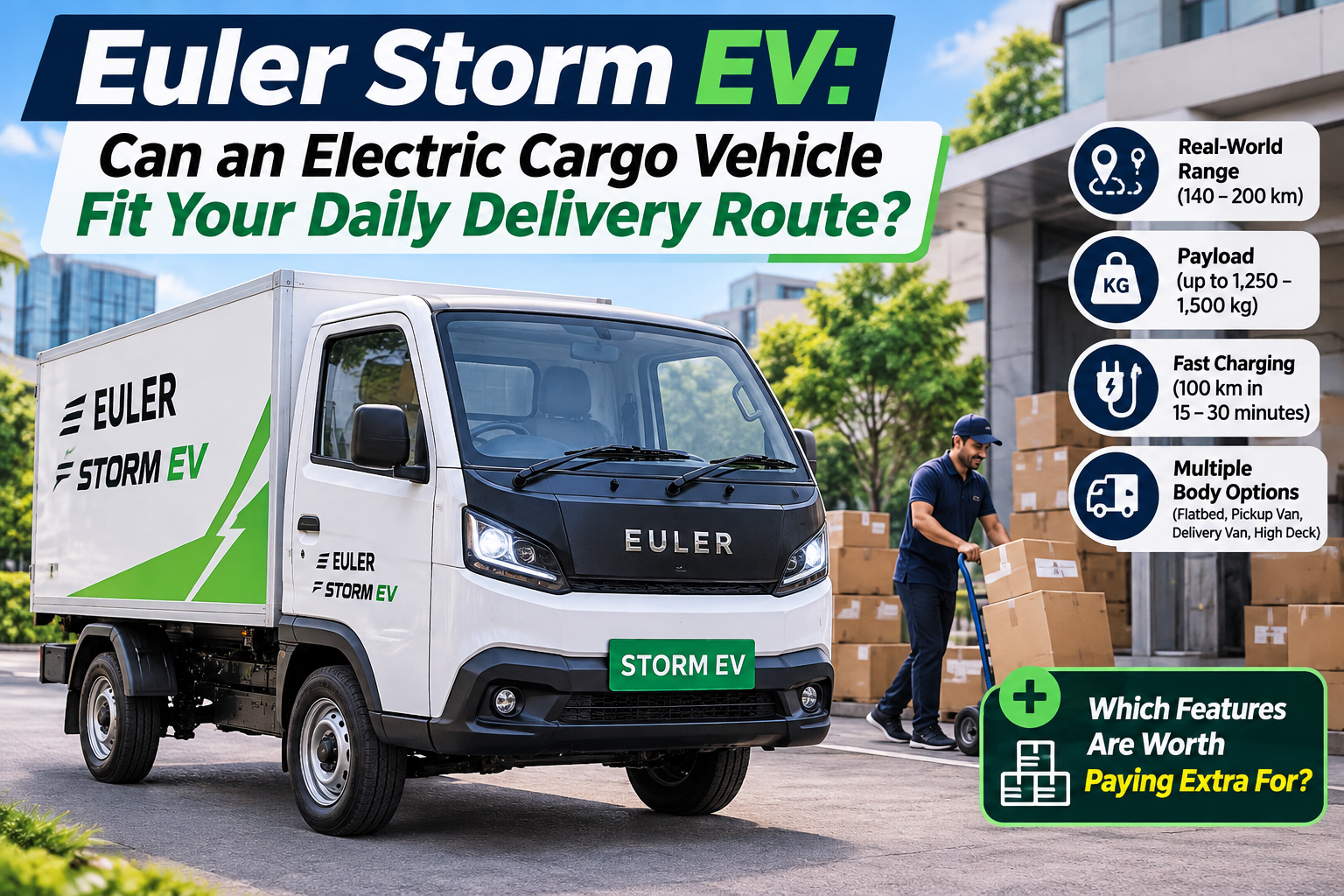
The Euler Storm EV is aimed at businesses looking to move cargo using an electric light commercial vehicle. Depending on the variant and specification, it offers a payload of up to 1,250 kg in the originally launched versions, while current listings also show newer T1500 specifications with a 1,500-kg payload. The Storm EV is offered with different range and body configurations for intra-city and longer delivery operations.
But does it actually fit a typical daily delivery route? And which features are worth paying extra for?
Is the Euler Storm EV Suitable for Daily Deliveries?
The first thing to consider is your route.
If your business involves predictable urban or regional deliveries, an electric cargo vehicle can make sense because daily driving distances are easier to plan around charging requirements.
The Storm EV T1250 was designed primarily for intra-city operations, with Euler quoting a real-world range of around 140 km, while the LongRange 200 is aimed at longer routes and is quoted at around 200 km of real-world range.
This makes the vehicle potentially suitable for applications such as:
- E-commerce deliveries
- FMCG distribution
- Retail deliveries
- Warehouse-to-store transportation
- Last-mile logistics
- Mid-mile cargo movement
- Local business deliveries
The important question isn't simply how far the vehicle can travel on paper. Businesses should calculate their actual daily route distance, number of stops, payload and charging opportunities.
How Much Cargo Can It Carry?
Payload is one of the most important considerations for a commercial vehicle.
The original Storm EV T1250 and LongRange 200 were launched with a 1,250-kg payload rating, while current specifications/listings also show the T1500 configuration with up to 1,500 kg. Buyers should therefore confirm the exact payload rating of the variant they are purchasing.
For businesses carrying relatively dense goods, payload capacity can have a direct effect on the number of trips required each day.
However, payload isn't the only consideration. Cargo volume can be equally important for businesses transporting lightweight but bulky products.
Cargo Body Options Add Flexibility
The Storm EV is available with different cargo-body configurations depending on the variant.
The T1250 has been offered with options including a flatbed, pickup van, high deck and delivery van, while the LongRange 200 has included pickup van, high deck and delivery van configurations.
This is useful because a vehicle used for packaged consumer goods doesn't necessarily need the same body configuration as one carrying construction materials or other dense cargo.
Choosing the right body can therefore be more important than simply selecting the most expensive variant.
Is the Range Enough for a Full Working Day?
This is probably the most important question for an electric cargo vehicle.
For the Storm EV T1250, current sources quote approximately 140 km of real-world range, while the LongRange 200 is positioned around a 200-km real-world range.
Suppose a delivery vehicle normally travels 80–100 km during a working day. The T1250 could potentially be a better fit than paying extra for the LongRange variant.
But if the vehicle regularly covers 150 km or more, makes long intercity runs or cannot return to its charging location during the day, the additional range of the LongRange version becomes considerably more valuable.
Businesses should also keep a safety margin rather than planning every route around the maximum claimed range.
Charging Time Can Affect Productivity
Charging downtime matters because a commercial vehicle earns money when it is working.
The Storm EV offers different charging options. The 3.3-kW onboard charger is listed at around six hours for charging, while the 6.6-kW option can reduce that to around four hours under suitable conditions.
Fast charging can be even more important for businesses that need to operate the vehicle for extended periods.
The T1250's DC fast-charging setup is claimed to add around 100 km of range in 30 minutes, while the LongRange 200's CCS fast-charging capability is claimed to add around 100 km in 15 minutes.
For a delivery business, that difference could matter when the vehicle needs a quick top-up between routes.
Which Features Are Worth Paying Extra For?
Not every feature will provide the same value to every operator. The right upgrades depend on how the vehicle is used.
1. LongRange Version — Worth It for Longer Routes
The LongRange 200 makes the most sense when the vehicle regularly travels longer distances.
If your daily delivery route comfortably falls within the T1250's practical range, paying more for additional range may not deliver enough benefit.
But for intercity deliveries or routes where charging access is limited, the extra range can provide greater operational flexibility.
Worth paying extra: Yes, for long-distance operators.
Skip it: If most routes are short and predictable.
2. Faster Charging — Worth It for High Utilisation
Fast charging can be particularly valuable for businesses running multiple shifts or requiring the vehicle to return to the road quickly.
A delivery vehicle that spends several hours charging during working time can lose productive hours. Faster charging can help reduce that downtime.
Worth paying extra: Yes, if the vehicle operates for long hours.
Skip it: If overnight charging is sufficient.
3. ADAS — Worth Considering for Safety
One of the Storm EV's standout features is its ADAS package.
The system has been associated with functions such as collision warnings, lane-related alerts and automatic emergency braking, while the vehicle also offers features such as night-vision assistance and cameras depending on configuration.
For a commercial fleet, safety technology can be particularly useful because vehicles may spend many hours on the road and may be driven by multiple employees.
Worth paying extra: Particularly for fleet operators and high-mileage users.
4. Connected Tracking — Useful for Fleet Owners
Fleet operators may benefit more from connected technology than individual business owners.
Euler's connected ecosystem includes functions related to vehicle tracking, charging information, maintenance and driver/vehicle data. The company's Shepherd platform has also been highlighted for vehicle tracking and security.
For a fleet manager, knowing where vehicles are and how they are being used can improve route planning and monitoring.
Worth paying extra: Yes, for multi-vehicle fleets.
Less important: For a single vehicle used by the owner.
5. Armoured Configuration — Only for Specific Loads
The Storm EV has also been offered with an armoured configuration designed for dense or demanding loads. It uses a reinforced chassis and heavier-duty suspension setup.
However, this isn't something every delivery business needs.
If you're transporting parcels, packaged food, clothing or other relatively light cargo, a standard configuration may be sufficient.
Worth paying extra: For dense/heavy-duty applications.
Skip it: For conventional parcel and retail deliveries.
What About the Three Driving Modes?
The Storm EV offers three driving modes: Range, Thunder and Rhino. These are intended to balance efficiency, performance and higher-torque operation depending on the driving environment.
For everyday deliveries, the Range mode can be useful when maximising available driving distance is the priority.
Thunder mode can be useful when stronger acceleration is needed, while Rhino mode is intended for situations where additional torque is beneficial, such as demanding roads or gradients.
For businesses, the ability to select different driving characteristics could help drivers adapt to changing route conditions.
Does It Work on Hilly Routes?
Road conditions should also be considered.
The Storm EV is listed with 140 Nm of peak torque and a claimed gradeability of up to 22 percent in current specifications.
The Rhino driving mode is intended to provide stronger torque characteristics for challenging conditions.
For businesses operating in hilly areas, however, route length, payload and gradient should all be considered together. A heavily loaded electric cargo vehicle travelling uphill can use significantly more energy than one operating on relatively flat urban roads.
 Khyati Sharma 2026-10-03